Pulse24 Original
Washington's New 50% Tariffs Sank the Canadian Dollar to a Two-Month Low. Toronto's Stock Market Gained 94 Points the Same Day.
August 25, 2026
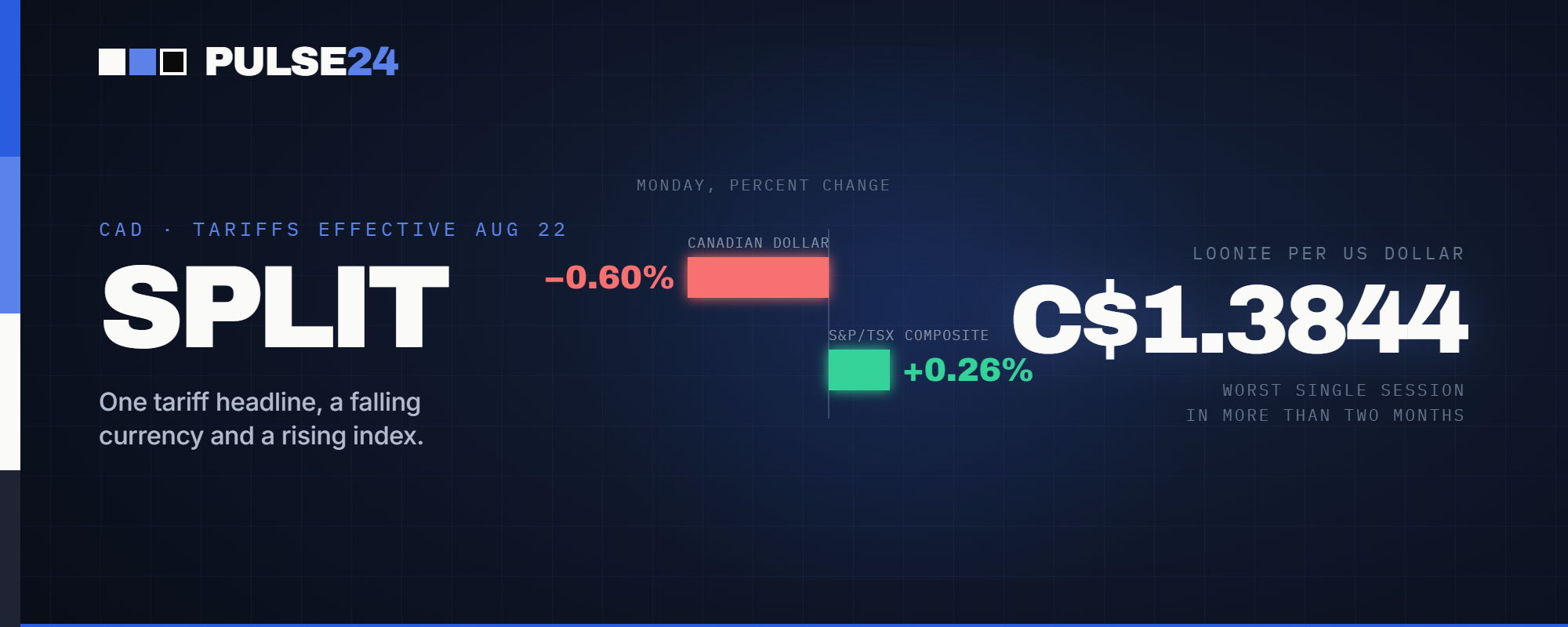
The Canadian dollar posted its worst single day in over two months after Washington's 50% tariffs on roughly $20 billion of Canadian goods took effect this weekend. The Toronto Stock Exchange gained ground the same day, and the split says something about how targeted trade shocks actually move markets.
The Canadian dollar fell 0.6% to C$1.3844 per US dollar on Monday, its worst single session in more than two months. Washington's new 50% tariff on roughly $20 billion of Canadian exports, covering dairy, alcohol, textiles, and a long list of consumer goods, is the reason why. It took effect over the weekend after last-minute trade talks between the two countries collapsed Friday night. Currency traders read that as bad news for Canadian growth and sold the loonie accordingly. Equity traders in Toronto read the same headline differently, and pushed the S&P/TSX Composite up 93.89 points to close at 36,714.12.
What Changed
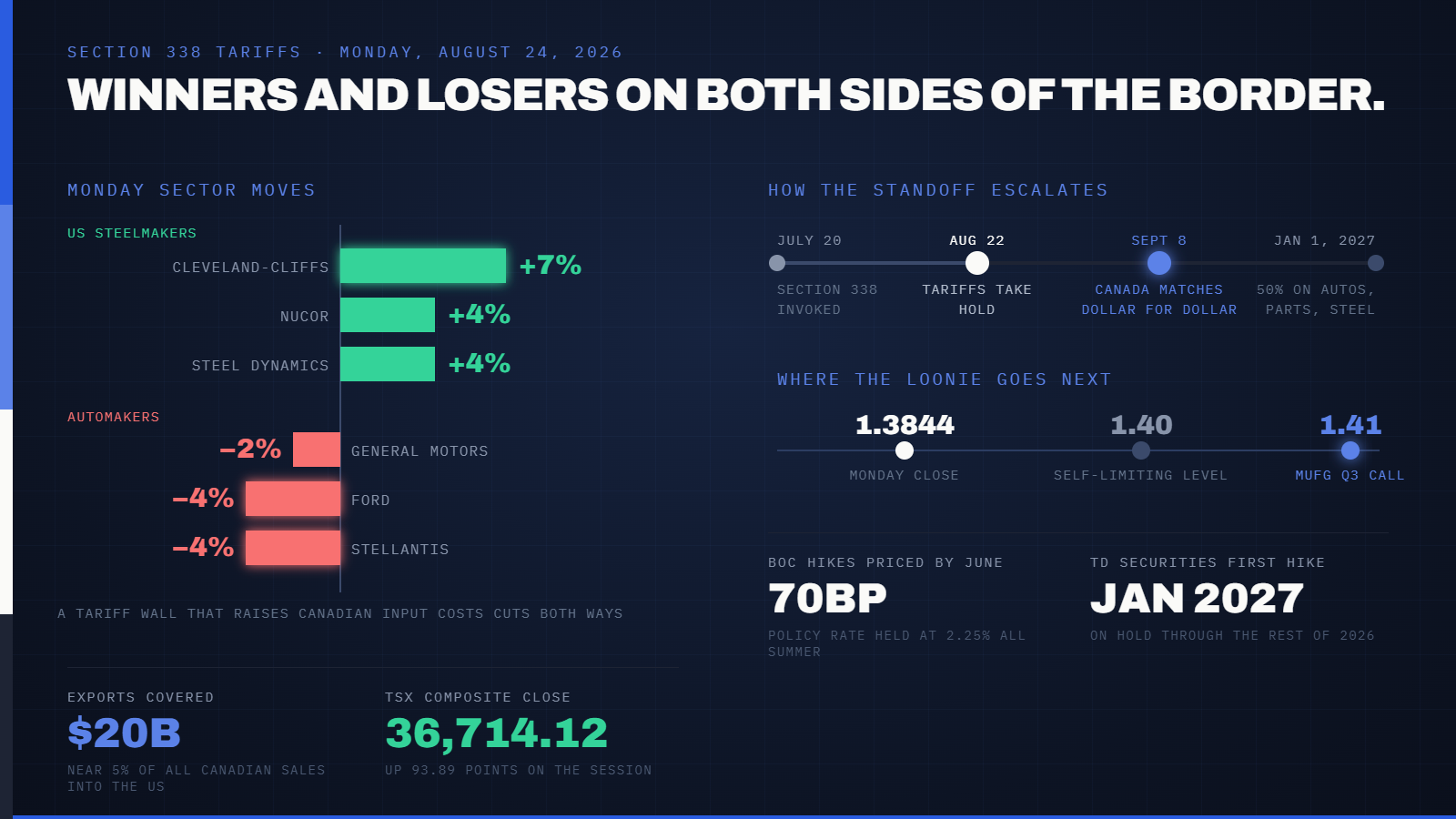
The tariffs stem from Section 338 of the Tariff Act of 1930, a rarely invoked statute that lets a president act unilaterally when he determines a foreign country discriminates against US commerce. Trump first invoked it against Canada on July 20, targeting three categories labeled dairy, alcoholic beverages, and motor vehicles, though the actual product lists run far wider than those names suggest: honey, semiconductors, toys, wooden furniture, and video game consoles are all swept in. Washington originally set an August 19 effective date, then delayed it three days while talks with Ottawa continued. Those talks fell apart just before midnight Friday, and the tariffs took hold Saturday morning, hitting close to five percent of everything Canada sells into the United States.
Monday's trading session split cleanly by sector once markets got their first chance to react. General Motors slipped roughly 2%, while Ford and Stellantis each fell about 4% on fears that costlier Canadian-sourced parts and materials will squeeze margins. US steelmakers moved in the opposite direction. Cleveland-Cliffs climbed roughly 7%, while Nucor and Steel Dynamics each gained about 4%, all benefiting from a tariff wall that makes Canadian steel pricier relative to their own. Trump has also floated a second, larger round: a 50% tariff specifically on Canadian vehicles, auto parts, and steel starting January 1, 2027, layered on top of what already took effect this weekend.
Why It Matters
That split between the currency and the stock market says something about how each one prices trade risk. NEI Investments' Adam Ludwick pointed out that most TSX constituents simply aren't touched by these specific tariffs, so the index isn't seeing the same drawdown facing companies directly in the tariffs' path. Currency markets work differently, since the loonie trades on the aggregate outlook for the Canadian economy, and a trade fight with the country's largest partner drags on that outlook regardless of which individual stocks are exposed. MUFG's Derek Halpenny put the risk plainly: the longer the standoff runs without resolution, the more downside the currency has left to give, with the bank penciling in a slide to C$1.41 per US dollar by the third quarter.
Prime Minister Mark Carney isn't treating this as a one-off. He has promised to match US tariffs "dollar for dollar," with Canada's own countermeasures on steel, dairy, appliances, farm equipment, pulp and paper, and electronics set to begin September 8. That gives both sides a two-week window in which the standoff could still be walked back, something Carney has said he would do if Washington meaningfully lowered its own tariffs first. Absent that, both economies start absorbing a genuine trade shock rather than a threatened one.
What To Watch Next
September 8 is the date to watch first. If Carney's retaliatory tariffs land as planned, the trade war stops being one-sided, and both economies start paying a two-way tax on cross-border commerce. Swaps markets are already pricing in roughly 70 basis points of Bank of Canada rate hikes by next June, a bet that tariff-driven inflation eventually forces Ottawa's hand even though the BoC has held its policy rate at 2.25% through the summer. TD Securities, for its part, expects the bank to stay on hold through the rest of 2026 and only start raising in January 2027, a timeline that would put the central bank roughly in step with Trump's threatened January 1 auto tariff deadline.
Watch the loonie's C$1.40 level too. MUFG's own analysts noted that a slide much beyond that mark becomes self-limiting if US rate cut expectations soften alongside it, since a narrower gap between American and Canadian rates takes some of the pressure off the currency pair. For now, the split reaction, a weaker loonie next to a stronger TSX, is the clearest sign yet that traders don't see this trade war as a uniform hit to Canada. It looks targeted instead, with clear winners and losers sitting on both sides of the border.
The Pulse24 Take
The instinct with any new tariff headline is to treat it as one number: bad for the country on the receiving end, good for the one imposing it. Monday's trading session argued against that framing. A single piece of trade policy produced a falling currency, a rising equity index, tumbling automaker stocks, and rallying steelmakers, all in the same country, on the same day. That is what a targeted tariff regime actually looks like in practice. It reallocates costs and benefits across an economy rather than spreading them evenly, and assets that track the aggregate, like a currency, can move in a different direction than assets tied to specific industries, like individual stocks.
The next two weeks matter more than this week did. September 8 brings Canada's retaliation, and if it lands as planned, the story shifts from a one-sided tariff hike to a genuine trade war with costs stacking on both sides of the border. Whether the loonie stabilizes near C$1.38 or keeps drifting toward MUFG's C$1.41 call probably depends less on Monday's numbers than on whether Ottawa and Washington get back to a negotiating table before that retaliation deadline arrives.
How we read the data
Curious how we get from raw data to a take like this? Our Trader's Toolkit walks through the tools we lean on.
Explore the Toolkit