Pulse24 Original
MongoDB Lost $6.1 Billion in a Single Session. The CEO Who Ran It Left for Meta Instead.
September 28, 2026
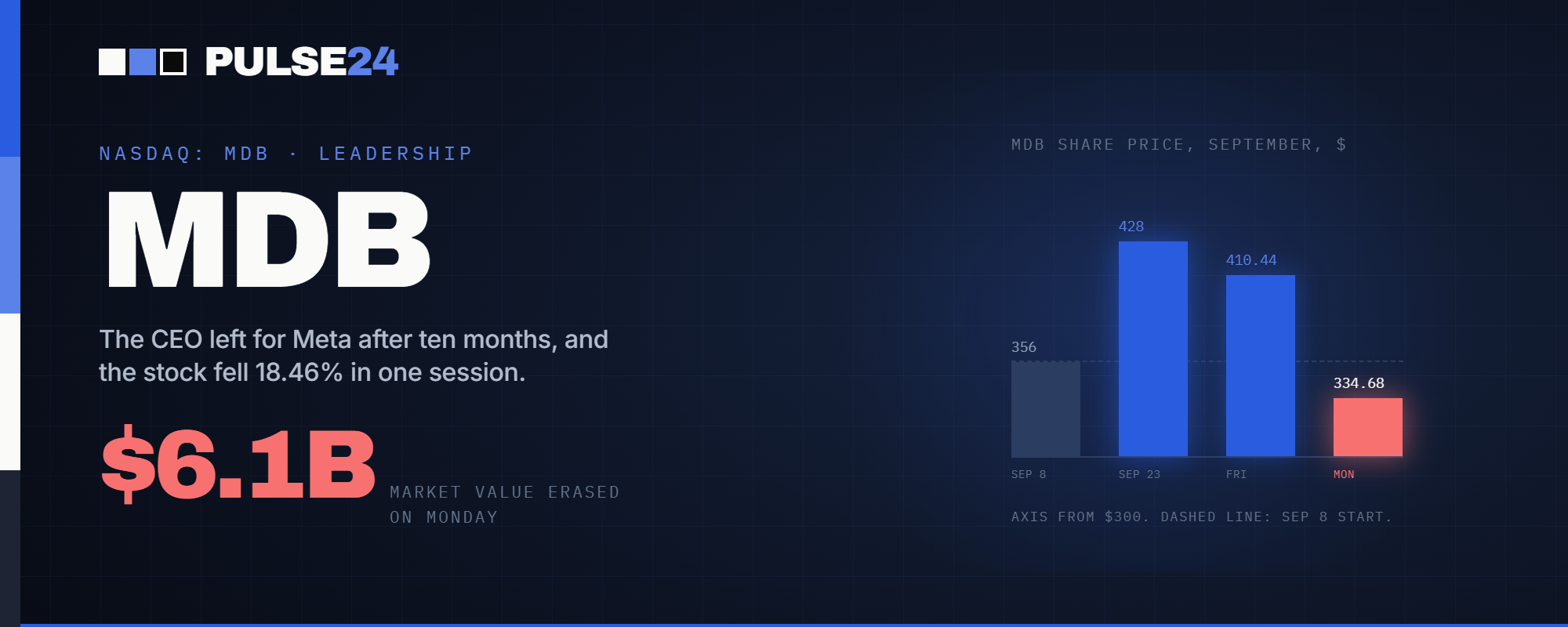
MongoDB lost about a fifth of its value on Monday after CEO CJ Desai left the job after just over ten months to run Meta's new enterprise AI platform, the same push that's now targeting Salesforce, ServiceNow and Microsoft. Dev Ittycheria, who ran MongoDB for more than a decade before Desai took over, is back as interim CEO one day before the company's investor day.
MongoDB closed Monday at $334.68, down 18.46% from Friday's $410.44. The reason wasn't a product recall or a lawsuit. It was a résumé change. Chirantan "CJ" Desai, the company's president and chief executive for just over ten months, resigned effective immediately to take a senior role at Meta, and the market treated the news like an earnings miss.
What Changed
Dev Ittycheria is stepping back in as interim president and CEO, effective immediately. He ran MongoDB from August 2014, through the company's 2017 initial public offering, until Desai took over in November 2025. The timing of his return is awkward: MongoDB's investor day, a scheduled pitch to Wall Street about the company's roadmap, falls on Tuesday, one day after Desai's exit became public.
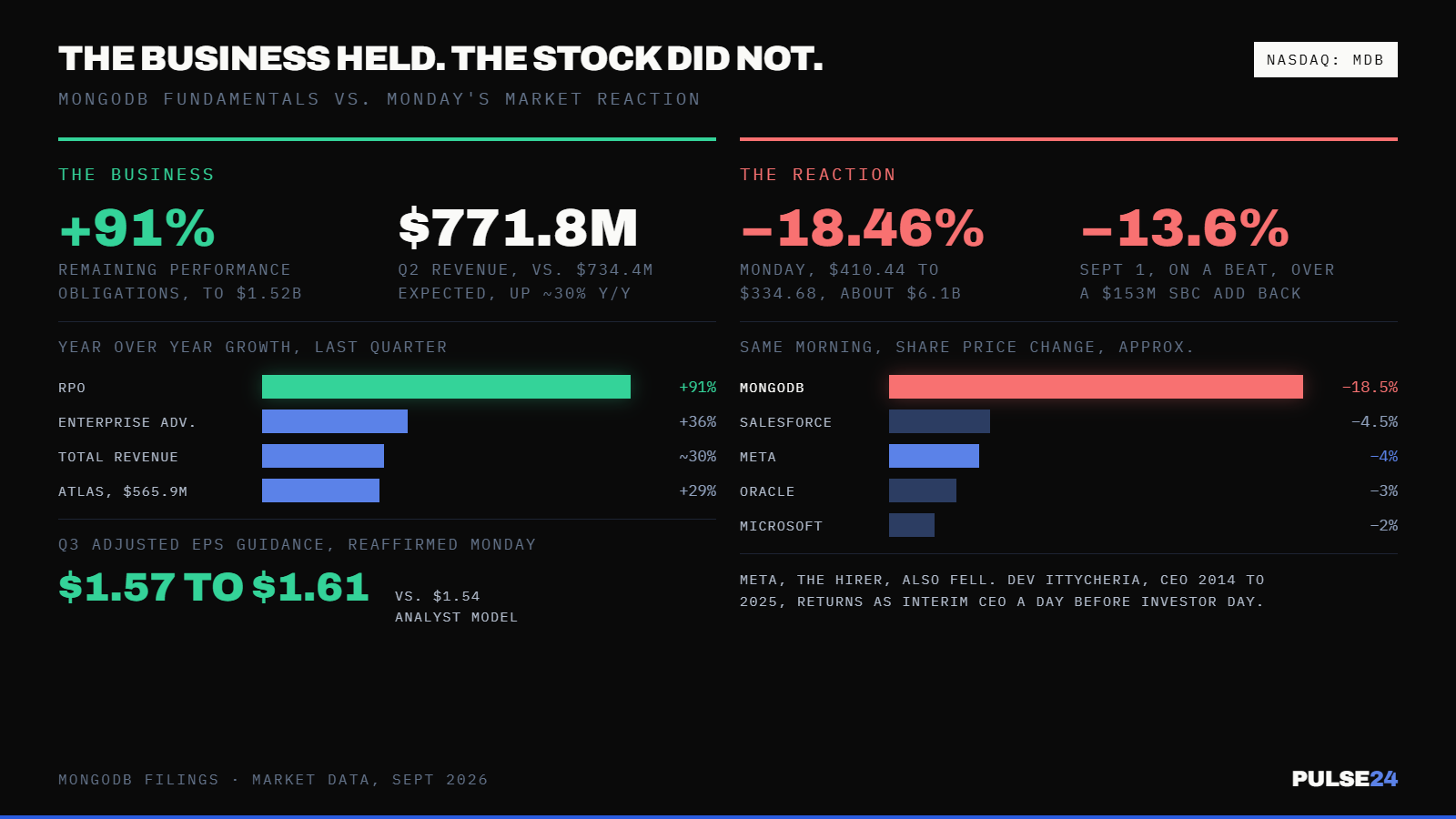
The dollar figures involved are large for what is, on paper, a personnel announcement. Based on MongoDB's roughly 80.56 million shares outstanding, Monday's decline erased somewhere around $6.1 billion in market value. That's a steep price given the underlying business didn't change overnight. Atlas, MongoDB's cloud database product, grew revenue 29% last quarter to $565.9 million. Enterprise Advanced revenue grew 36%. Remaining performance obligations, a measure of contracted future revenue, jumped 91% to $1.52 billion. The company reaffirmed the guidance it gave investors on September 1, including adjusted third-quarter earnings of $1.57 to $1.61 a share, above the $1.54 analysts had modeled.
Desai isn't joining a rival database vendor. He's joining Meta, which used the same morning to unveil what it calls Meta Enterprise Platform, built around tools named Muse Agent, Meta Business Agent, Muse API and Muse Code. Zuckerberg called it the company's "next major pillar," a push to get businesses running their operations on Meta's AI stack the way they already run advertising campaigns on it. Desai will lead the effort as chief enterprise platform officer, reporting directly to Zuckerberg. His résumé fits the assignment: nearly eight years at ServiceNow, including a stint as president and chief operating officer, then product and engineering leadership at Cloudflare, before MongoDB hired him in 2025.
Board chairman Tom Killalea framed Ittycheria's return as the safest possible transition. "MongoDB's business is strong, and there is no better person to take on the role of President and CEO in the interim than Dev Ittycheria," he said. Ittycheria, in the same release, called it a homecoming: "I'm honored to step back into the President and CEO role at MongoDB. I was privileged to lead the company for more than a decade and help build MongoDB into the global business it is today."
This is the second time in four weeks that MongoDB stock has fallen by a double-digit percentage on what looked, at first glance, like good news. When the company reported second-quarter results on September 1, revenue came in at $771.8 million against $734.4 million expected, roughly 30% higher than a year earlier, and adjusted earnings beat estimates too. The stock fell 13.6% anyway, because investors zeroed in on a $153 million stock-based compensation add-back that was larger, per share, than the entire adjusted profit figure it was added back to. Add Monday's leadership shock, and MongoDB is now trading below where its early-September rally even started. The stock had climbed from around $356 on September 8 to $428 by September 23. Monday's close sits nearly $21 below that starting point, meaning two weeks of gains, and then some, were wiped out in a single session.
Why It Matters
Two separate stories are colliding here. The first is company-specific: a fast-growing software business just lost its chief executive with no permanent successor named, on the eve of the one event designed to reassure investors about its long-term plan. Leadership uncertainty carries its own discount, separate from whatever the underlying numbers say.
The second story is bigger than MongoDB. Meta's stock has rallied more than 40% from its August lows on the strength of its AI infrastructure spending, even as earnings estimates for the company haven't kept pace with the share price move. Monday's launch adds a new variable to that trade: Meta isn't only building AI infrastructure anymore, it's trying to sell AI-powered business software directly to the customers of Salesforce, ServiceNow, Oracle and Microsoft. Investors' first reaction wasn't enthusiasm. Meta's own shares fell about 4% to roughly $720 on the news, and Salesforce, Oracle and Microsoft all dropped alongside it, down roughly 4.5%, 3% and 2% respectively.
That's an unusual pattern. Normally when a company announces it's entering a large new market, its own stock at least holds steady, on the theory that a bigger addressable market is good news. Here, both the incumbent losing its CEO and the challenger doing the poaching sold off on the same morning, which suggests the market isn't yet convinced this expansion pays for itself. Read as a talent story rather than a product story, it also fits a pattern that's shown up across the AI buildout all year: infrastructure spending is only half the fight for enterprise budgets. Hiring the executives who know how to sell that infrastructure into large companies is the other half, and it's now expensive enough that firms are paying for it with senior leadership, not just capital.
What to Watch Next
MongoDB's investor day happens Tuesday at Nasdaq's MarketSite, one day after this announcement, and it's now a very different presentation than the one originally planned. Ittycheria and the board will need to address, in person, why a ten-month CEO tenure ended this abruptly and how the search for a permanent replacement will be run. Whether the company commits to a timeline is worth watching closely.
Watch too for how Meta's enterprise push performs once it's tested against real corporate buyers rather than announced in a press release. Software incumbents have survived cloud giants entering their markets before. Whether this attempt is different depends on whether Muse Agent and its sibling products can do more than automate what ServiceNow and Salesforce already sell. MongoDB insider activity is a smaller but related signal: insiders have sold roughly $115 million in shares over the past twelve months with no purchases recorded, a pattern that predates Monday's news but reads differently now.
The Pulse24 Take
The easy read on Monday is that the market overreacted to a personnel change at a company whose actual business, by every operating metric MongoDB has published, kept growing. Atlas revenue up 29%, contracted future revenue up 91%, guidance reaffirmed rather than cut. None of that happened by accident, and none of it evaporated because one executive took a new job.
The harder read is that the market isn't only pricing MongoDB's fundamentals right now. It's pricing the possibility that the company briefly had access to unusually sought-after enterprise software talent, and that talent just walked across the street to help a much larger competitor build the thing MongoDB itself is trying to become essential to. A ten-month tenure ending for a bigger seat at Meta says something about where ambitious enterprise-software executives currently see the biggest opportunity, and it isn't necessarily at the companies running them today. That's a harder problem for a board to solve with a press release than a guidance beat is to deliver, and it's why a stock with genuinely strong quarterly numbers can still lose a fifth of its value in a single session.
How we read the data
Curious how we get from raw data to a take like this? Our Trader's Toolkit walks through the tools we lean on.
Explore the Toolkit