Pulse24 Original
Meta Is Up More Than 40% From Its August Lows. Its Earnings Estimates Haven't Followed.
September 24, 2026
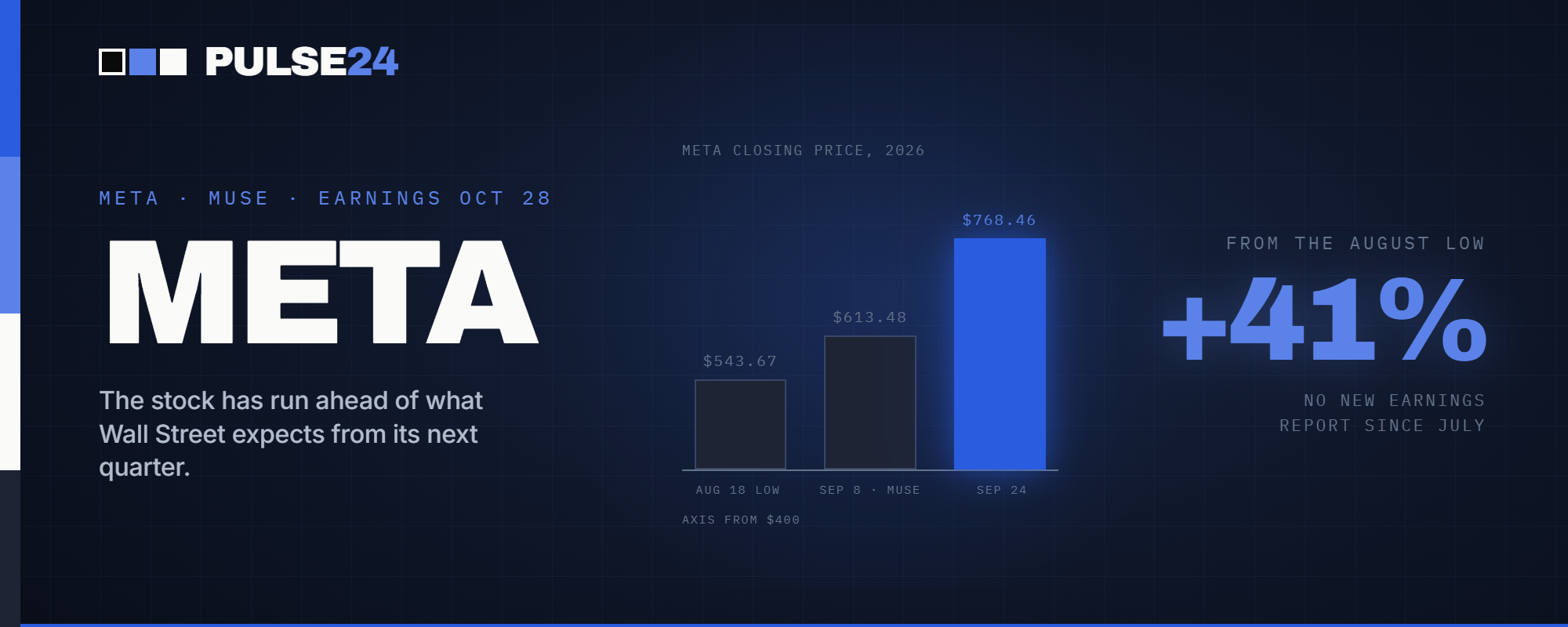
Muse has driven a real leg of Meta's rally, but the stock's 40% run from its August lows has outpaced its own Wall Street estimates. Meta's October 28 earnings will be the first real test of whether the numbers start catching up to the price.
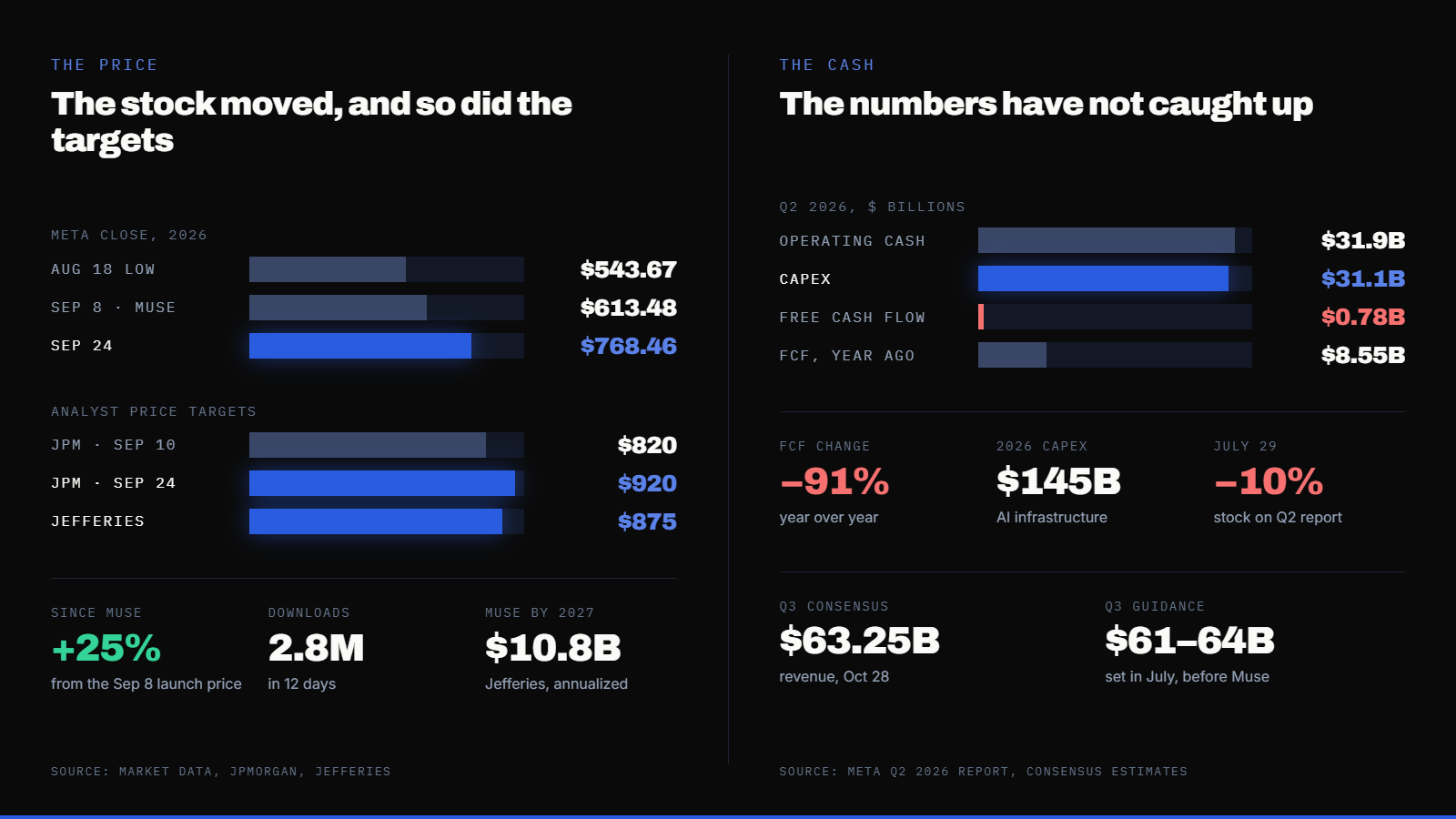
Meta closed at $768.46 on Thursday, up more than 40% from the $543.67 it traded at on August 18, its lowest close of the month. Meta hasn't reported another earnings quarter since the stock fell almost 10% on July 29. What's changed since then is a new product, a run of analyst upgrades, and how much investors are willing to believe about the $145 billion Meta is spending on AI infrastructure this year.
What Changed
The setup for this rally was laid on the night of July 29. Microsoft reported Azure revenue crossing $100 billion for the first time, with growth accelerating to 43% and commercial RPO, its contracted but not-yet-recognized cloud revenue, reaching $678 billion, and its shares eventually added nearly $450 billion in market value the next session, the largest single-day gain in the company's history. Roughly ninety minutes later, Meta reported its own quarter: revenue up 28% to $60.8 billion, ahead of estimates, but operating cash flow of $31.9 billion was almost entirely absorbed by $31.1 billion in capital spending, leaving free cash flow of just $784 million, down 91% from a year earlier. The stock fell almost 10%. Investors had just watched two companies spend heavily on the same kind of AI infrastructure and come away with very different numbers to show for it.
Meta's stock didn't wait for a new product to start recovering. It climbed from $545.83 on August 20 to $613.48 by September 8, a gain of roughly 12%, as the broader market rallied and some of the July selloff unwound. Then Muse launched: a personal AI agent built to handle tasks like scheduling and shopping rather than just answer questions. It reached 2.8 million downloads within 12 days. Nine sessions after launch, Meta closed at $768.46, a gain of about 25% from its Muse-launch price alone.
Two weeks after launch, Meta gave investors something more specific than a download count. At its Connect conference on September 23, Zuckerberg said Muse would stay free for most usage but that Meta would take a small fee on transactions completed through the agent, alongside new shopping partnerships with Walmart, Best Buy, Sephora, Wayfair, and Instacart. It was the first time Meta had described, even loosely, how Muse might turn into revenue rather than engagement.
Analysts responded in stages. JPMorgan upgraded Meta to Overweight on September 10, two days after launch, raising its target from $640 to $820 as Muse hit third place in the US app store. After the Connect announcement, JPMorgan raised the target again, to $920, calling Muse potentially the most widely used consumer AI application since ChatGPT. Jefferies raised its own target from $710 to $875 on September 22, modeling $10.8 billion in annualized Muse revenue by 2027 if the product reaches 1 billion users and 3% convert to a paid tier.
Why It Matters
Meta's stock is up more than 40% since its August lows. Wall Street's consensus revenue estimate for the October 28 quarter, meanwhile, sits at $63.25 billion, near the midpoint of the $61 billion to $64 billion range Meta itself guided to back in July, before Muse existed. Individual analysts have started modeling Muse specifically, Jefferies among them, at $10.8 billion by 2027. What hasn't happened yet is for that kind of modeling to show up in the consensus number covering Meta's very next quarter.
That's a different situation than Microsoft's July surge, and not fully comparable. Microsoft sells infrastructure and services directly to enterprise customers, so a $678 billion RPO figure is a reasonably direct measure of contracted future revenue. Meta sells advertising to a consumer audience, and Muse's transaction-fee model is brand new and unproven at any scale. Within ninety minutes on July 29, investors saw two different stages of the same AI-spending story: Microsoft could point to revenue already under contract, while Meta was still asking investors to fund the infrastructure before a comparable product existed.
Meta's own July numbers are why the stakes are high. The company generated $31.9 billion of operating cash flow in the second quarter and spent $31.1 billion of it on capital expenditures, leaving $784 million in free cash flow, down from $8.55 billion a year earlier. Muse hasn't changed that math yet. It has changed what investors think that spending will eventually buy.
What to Watch Next
October 28 is the checkpoint. That's when Meta reports third-quarter results, and management will have to say something concrete about Muse's usage, retention, and early transaction volume, rather than download counts and analyst models. Evidence that the transaction fee is actually generating revenue would give the consensus numbers a reason to move toward the stock price. A vague update would leave the current gap between the rally and the forecast unresolved.
Also worth watching is Meta's 2026 capex outlook. The company raised its ceiling to $145 billion back in April, then narrowed the range higher, to $130 billion to $145 billion, in July. Whether that range moves again on October 28, and whether it comes paired with anything concrete about Muse's early economics, will say a lot about how this rally is meant to resolve.
The Pulse24 Take
Muse hasn't answered whether Meta's $145 billion infrastructure build earns an adequate return. What it has done is give investors a specific product to attach that hope to, and a fast-growing one: 2.8 million downloads in under two weeks, a transaction-fee model with real retail partners, two JPMorgan price target increases, and a Jefferies model putting actual numbers on Muse's 2027 revenue. None of that has moved Meta's October 28 consensus, which still sits close to the midpoint of guidance Meta issued before Muse existed.
That gap is the story, and it isn't necessarily a contradiction. Markets are allowed to price years of future cash flow into a stock before that cash flow shows up in next quarter's income statement, and that is arguably what's happening here. Whether it turns out to be the right call depends on what Zuckerberg's team can actually show on October 28, the first earnings call where Muse will be a known product with a real monetization plan instead of a two-week-old download count.
How we read the data
Curious how we get from raw data to a take like this? Our Trader's Toolkit walks through the tools we lean on.
Explore the Toolkit