Pulse24 Original
60 Billion Yuan: China's Banks Extended the Least Credit on Record in August, Even as Factory Output Beat Every Forecast
September 16, 2026
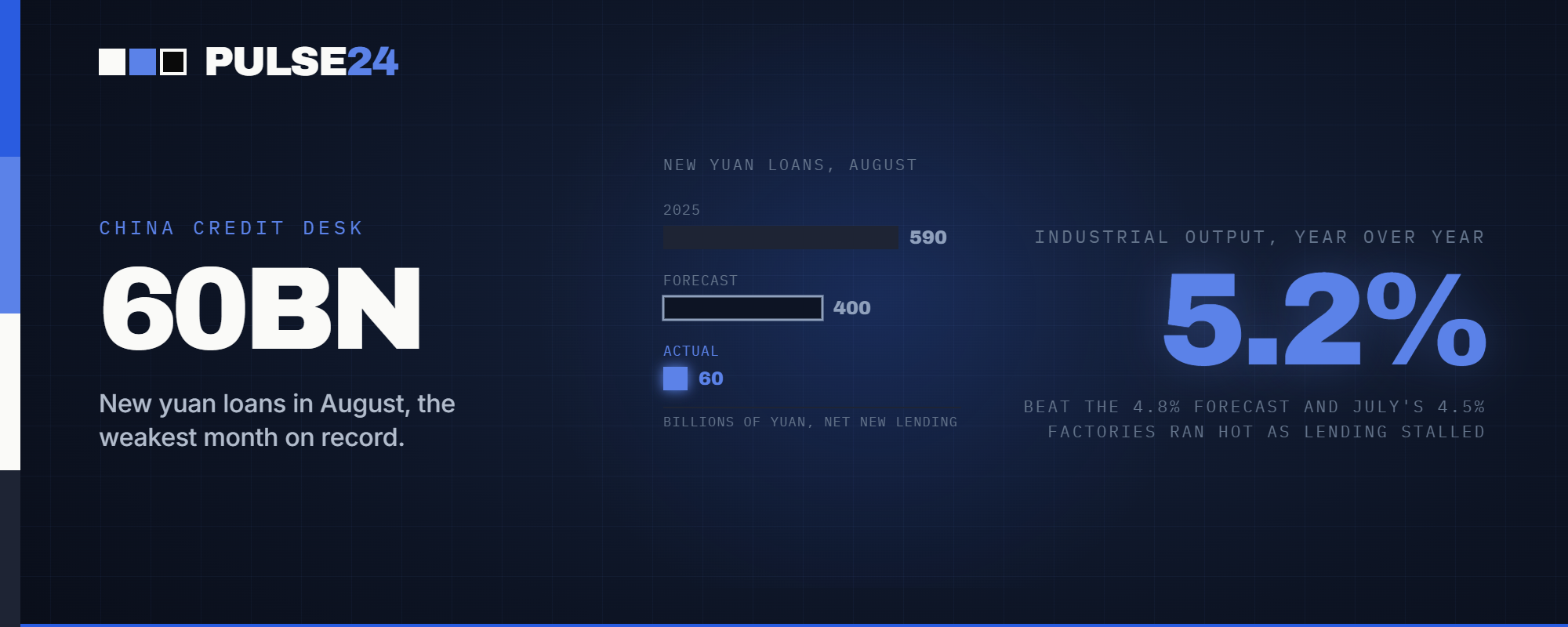
China's banks extended just 60 billion yuan in new loans in August, the weakest month on record and far short of the 400 billion yuan economists expected. Factories kept humming, exports jumped 25%, and producer prices held near their strongest levels since deflation broke in March, but the credit gap is pushing Beijing toward the fiscal stimulus decision it has been putting off.
Sixty billion yuan. That's the entire net increase in new bank lending across China in August, in an economy that produces roughly nineteen trillion dollars a year. Economists had forecast something closer to 400 billion yuan. A year earlier, in August 2025, banks extended 590 billion. Outstanding loan growth slowed to 4.9%, the weakest pace the People's Bank of China has on record.
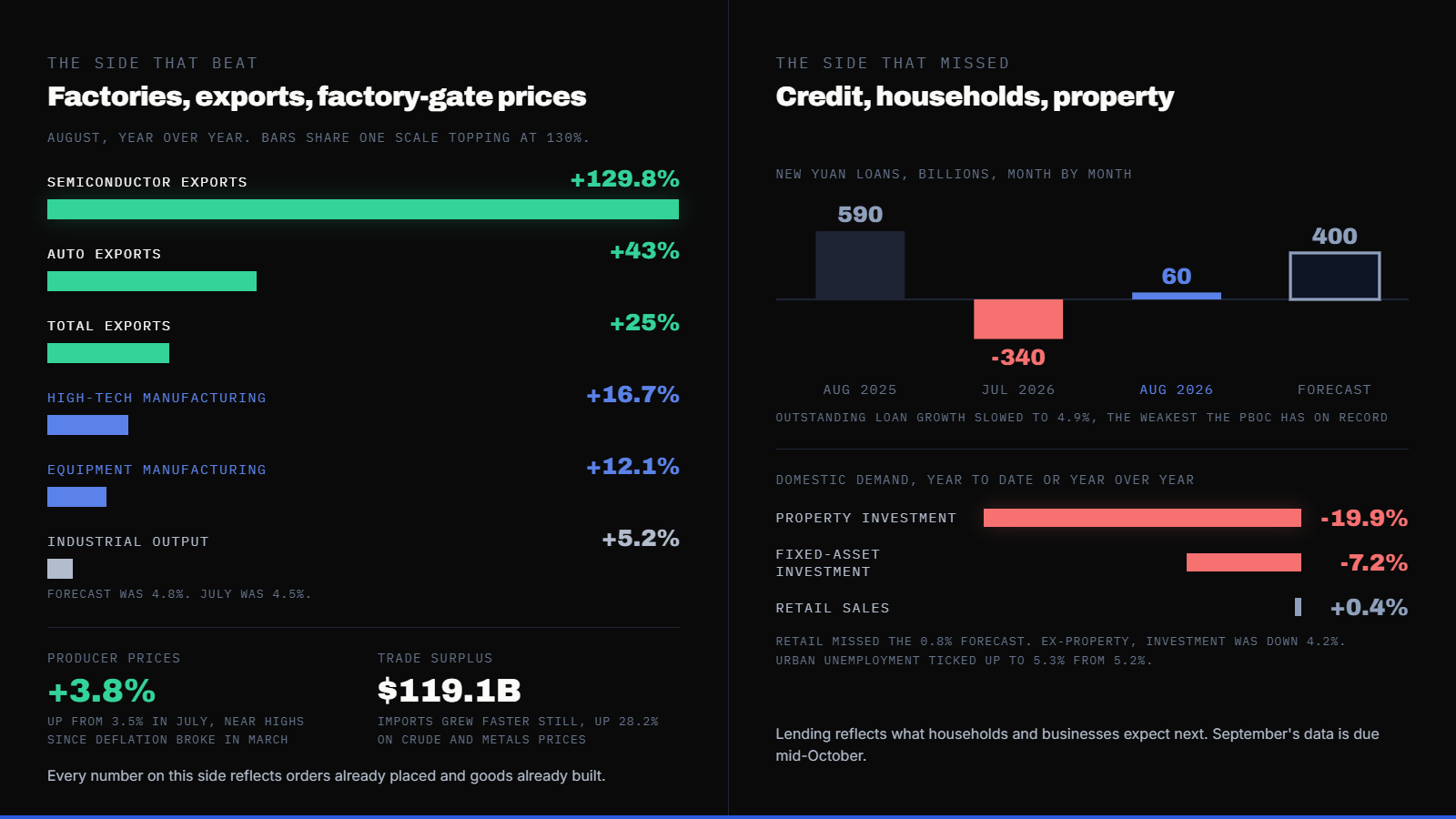
The same week brought a nearly opposite set of numbers. Industrial output climbed 5.2% year over year in August, ahead of the 4.8% economists expected and faster than July's 4.5% pace. High-tech manufacturing expanded 16.7%. Equipment manufacturing grew 12.1%. Producer prices, which broke a 41-month streak of declines back in March, held near their recovery highs at 3.8% year over year, up from July's 3.5%. Exports jumped 25% year over year, with semiconductor shipments more than doubling and the trade surplus widening to 119.1 billion dollars.
Put those two data sets side by side and China looks like two different economies sharing one currency. Factories are running hot, shipping more, and finally charging more for what they make. Households and small businesses have all but stopped asking their banks for money.
What Changed
August's credit figures weren't a one-month wobble. New yuan loans went from a 340 billion yuan contraction in July to a modest 60 billion yuan gain in August, a swing that still landed far short of what analysts expected heading into the print. Outstanding loan growth slowed to 4.9%, confirming that each successive month, the same stock of debt is growing more slowly than the one before.
Retail sales told a similar story from a different angle. The 0.4% year-over-year gain in August missed the 0.8% forecast and slowed from July's already soft 0.6%. Fixed-asset investment fell 7.2% over the first eight months of 2026, with property investment down 19.9%, though stripping out real estate, investment was down a more moderate 4.2%. The bright spot inside that number is high-tech industry investment, up 5.2% and accelerating for a third straight month, led by a 22.7% jump in information services and 14.9% in aerospace manufacturing. China's urban unemployment rate ticked up to 5.3% in August from 5.2% in July.
None of this reads as a crisis on its own. China's exports rose 25% year over year in August, the fastest pace in months, with semiconductor exports up 129.8% and autos up 43%. Imports grew even faster, up 28.2%, though economists cautioned that owes more to higher prices for imported crude oil and metals than to a genuine rebound in domestic demand. Producer prices held near their strongest levels since the deflation streak broke in March. China is manufacturing and trading its way to healthier headline growth even as the credit that normally accompanies that growth simply isn't showing up.
Why It Matters
The gap between what China's factories are doing and what its banks are doing matters because credit growth is usually the leading indicator, not the lagging one. Industrial output and exports reflect orders already placed and goods already built. Bank lending reflects what households and businesses expect to happen next, and right now they aren't borrowing to expand, renovate, or restock in any meaningful way. A 4.9% pace of loan growth, the weakest the PBOC has recorded, is a vote of limited confidence sitting underneath a strong industrial headline.
Zhiwei Zhang of Pinpoint Asset Management summed up where that leaves policymakers, saying the market is waiting for fiscal policy to become more supportive in the third quarter. ANZ Research went further, calling September a genuine policy window, the stretch before October's Golden Week holiday when Beijing has historically preferred to have measures already in place rather than announce them into a market on vacation. A policy rate cut, per ANZ, remains unlikely, which shifts the pressure toward fiscal tools: subsidies, targeted lending support, or direct spending rather than a change in the price of money.
There's a currency wrinkle too. The yuan has climbed to its strongest level since February 2023, with the PBOC setting its daily fixing near 6.77 to the dollar this week as it manages the pace of the rally. A stronger yuan should make imported goods and commodities cheaper, which sits awkwardly next to the imported crude oil and metals prices that officials have cited as a driver of the factory-gate price recovery since the spring. It also makes Chinese exports marginally less competitive at the exact moment autos and semiconductors are doing the heavy lifting.
What to Watch Next
The clearest signal will be whether Beijing actually moves before the October holiday, or lets the policy window ANZ described close without using it. Property investment down nearly 20% for the year is the number most likely to force the issue, since a construction sector that keeps shrinking eventually drags down steel, cement, and the local government revenue that funds everything else.
September's credit data, due out in mid-October, is the next real test of whether August was a trough or a new baseline. A repeat of a sub-100 billion yuan month would be hard to write off as noise. Watch too for any follow-through on the property support measures Beijing has already announced, since the gap between an announced policy and a financed one has been the recurring theme of China's response to this slowdown.
The Pulse24 Take
It's tempting to read August's data as good news wrapped around a footnote: industrial output beat, exports beat, deflation ended, with weak lending filed away as a technicality. The more useful reading treats that technicality as the headline. Factories can run on export orders and existing capacity for a while without fresh credit behind them. What credit growth measures is whether households and businesses are willing to bet on what comes after the current order book runs out, and right now that bet isn't being placed.
This is also a reminder that headline growth and financed growth aren't the same thing, in any economy. A country can beat on industrial output while its financing engine idles, just as a country can miss on GDP while credit expands underneath it. Pulse24 will be watching whether Beijing's fiscal response, if it arrives before October, targets the property and household side of this divide or simply adds more support to the manufacturing side that's already outperforming. The first would address the actual gap in August's data. The second would just make the gap wider.
How we read the data
Curious how we get from raw data to a take like this? Our Trader's Toolkit walks through the tools we lean on.
Explore the Toolkit