Pulse24 Original
Bank of America Just Moved Its Yen Forecast to 149 From 152. It's Betting Japan Hikes Rates in September, Not October.
August 6, 2026
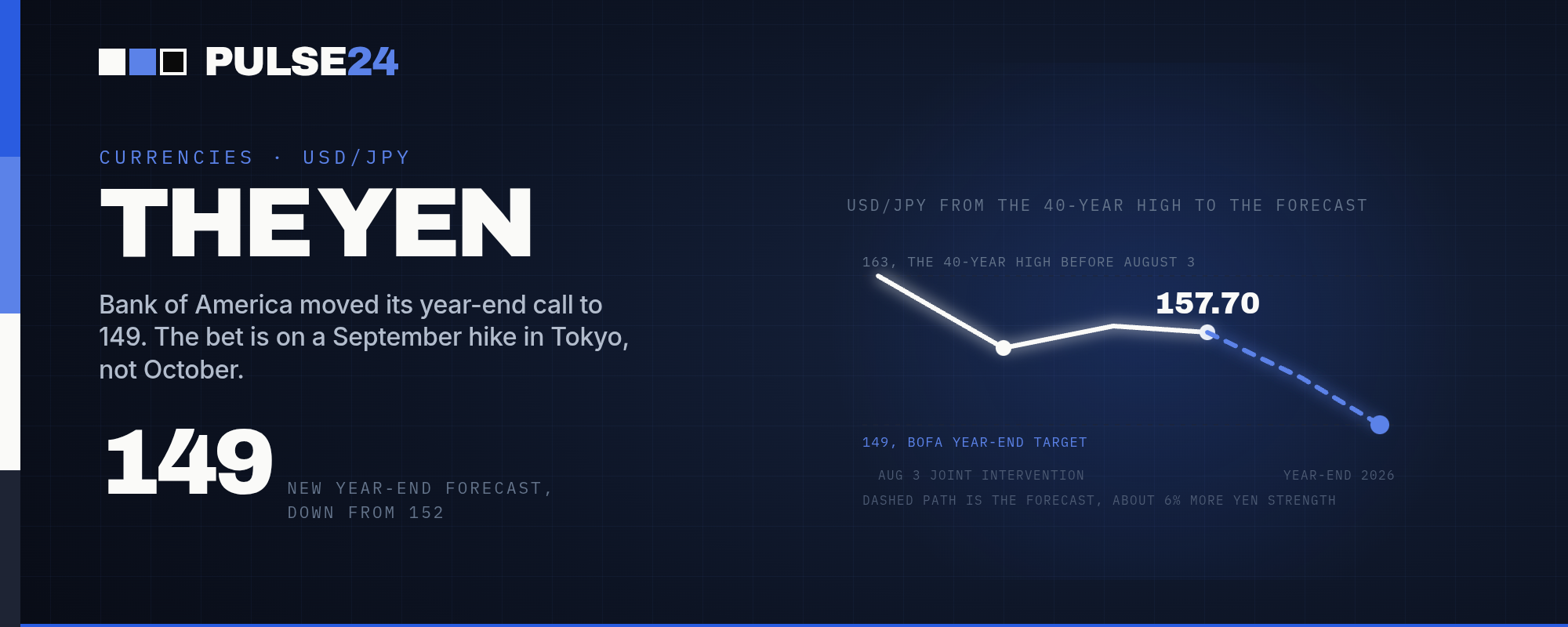
Bank of America cut its year-end USD/JPY forecast to about 149 from 152, betting the Bank of Japan hikes rates in September rather than October. Here's why the timing of that call matters more than this week's currency intervention.
Bank of America shaved its year-end 2026 forecast for USD/JPY to about 149 this week, down from 152 just a few weeks earlier. That's a bank telling clients to expect roughly 6% more yen strength than it thought likely a month ago, and it lands only two days after Washington and Tokyo jointly bought yen for the first time since 1998.
The pair closed near 157.70 on Wednesday, still well off the 40-year high above 163 it touched before that intervention hit the tape on August 3, but higher than the roughly 156 level it fell to in the immediate aftermath. Traders have spent the days since testing whether the move holds. BofA's answer, delivered through strategist Shusuke Yamada, is that it probably does, and the reason has less to do with last week's currency purchases than with what happens next at the Bank of Japan.
What Changed
Japan has tried to prop up the yen more than once in 2026 already, and an earlier solo intervention by the Ministry of Finance knocked the pair down about 3% in a single session before it clawed back nearly all of that within 24 hours. Yamada's note argues the joint operation raises the bar for what counts as a successful defense of the yen going forward, since markets now expect the US and Japan to show up together again rather than treating any single dip as one-off relief. That's the same dynamic Pulse24 covered when the coordinated buying first hit the tape: the purchases matter less on their own than the credibility they buy policymakers to follow through with something more durable, which in BofA's view is a faster Bank of Japan.
Why September Matters More Than the Yen Level
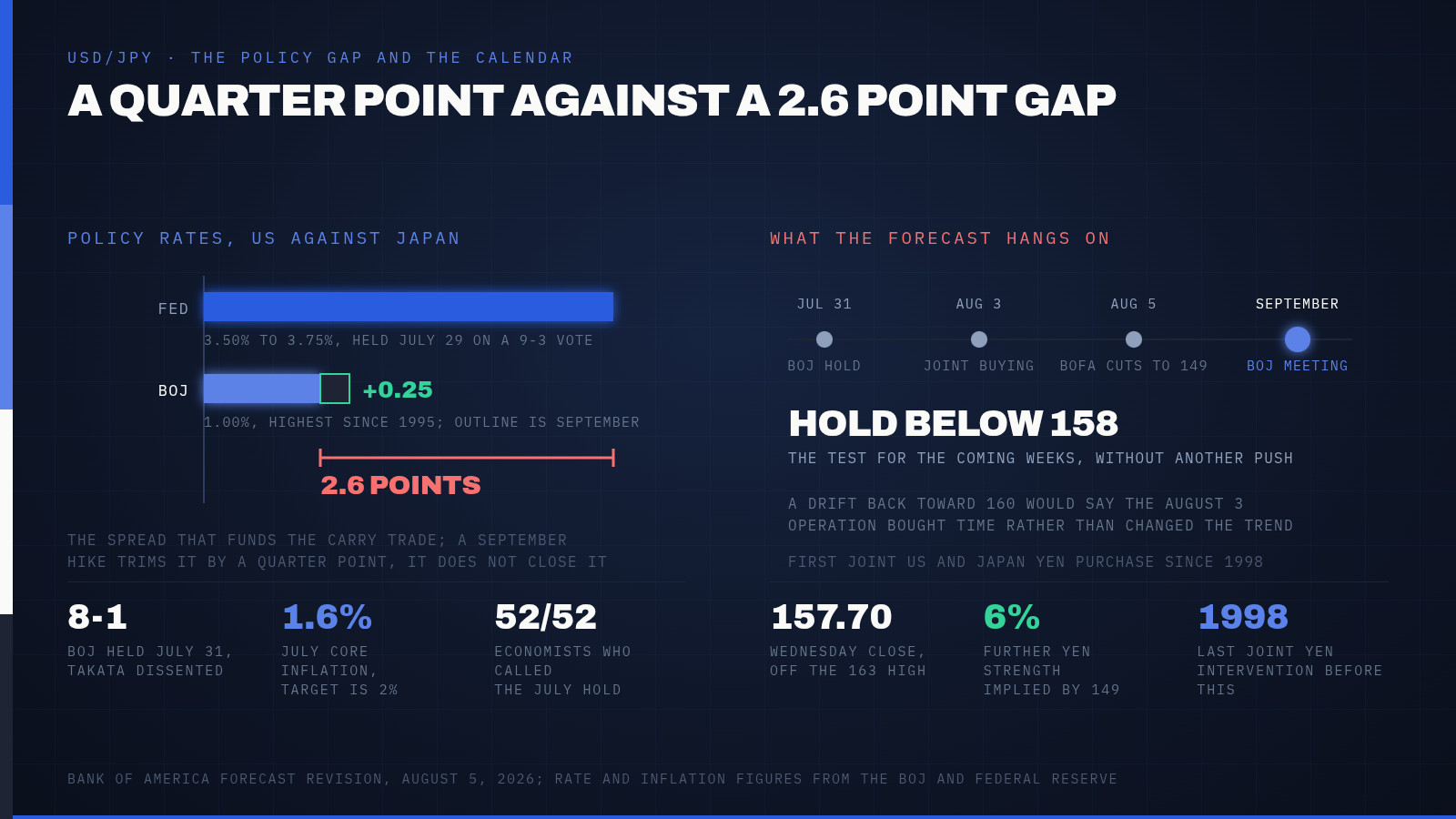
The Bank of Japan held its policy rate at 1.00% on July 31, matching every one of 52 economists surveyed ahead of the decision and extending a rate that's already the highest since 1995. The vote wasn't unanimous. Hajime Takata dissented, pushing for an immediate quarter-point increase to 1.25%, and Governor Ueda Kazuo used the post-meeting briefing to warn that waiting too long to act could eventually force a rapid, more disruptive round of hikes instead of a gradual one.
Core inflation ran at 1.6% in July, still short of the BOJ's 2% target on paper. The bank's own outlook report tells a different story about where that number is headed, projecting inflation moves well above 2% starting in the second half of the fiscal year as wage increases feed into prices, oil costs stay elevated, and a weaker yen keeps raising the cost of imported goods. Most analysts had penciled in October for the next hike. BofA now says September, timed to land before that inflation overshoot shows up in the data rather than after.
The Rate Gap Still Does the Heavy Lifting
None of this closes the gap on its own. The Federal Reserve held its target range at 3.50% to 3.75% on July 29 in a 9-3 vote that saw three of its own officials push for a hike rather than a hold, leaving roughly 2.6 percentage points between US and Japanese policy rates even after the BOJ's June increase. That spread is what has funded the yen carry trade for years: borrow cheaply in yen, invest in higher-yielding dollar assets, pocket the difference. A September hike would trim that gap by a quarter point, not close it, but currency markets tend to react to the direction of travel more than the destination. Every basis point the BOJ adds while the Fed sits still narrows the incentive to stay short the yen.
What to Watch Next
The next real test isn't a headline number, it's whether USD/JPY can hold below 158 through the coming weeks without another push from Tokyo. A drift back toward 160 would suggest the July intervention bought time rather than changed the trend, the same pattern that played out after Japan's solo attempt earlier this year. The September BOJ meeting is the one to watch now instead of October, and so is whether Takata's dissent becomes the majority view rather than staying a lone vote. Global risk appetite has its own stake in this: a yen that keeps strengthening on a faster BOJ makes the carry trade less attractive, and unwinding that trade has moved markets before, most visibly during the volatility spike in August 2024.
The Pulse24 Take
Forecast revisions from a single bank aren't proof of anything by themselves, and Yamada's note stopped short of recommending an outright long yen position, which says something about how much conviction sits behind the new number. What makes this one worth tracking is the shift in timing more than the shift in level. Moving a rate hike call from October to September is a bet that Japan's central bank has decided credibility is worth moving faster for, not just once with a currency intervention but with actual policy. If September comes and goes without a hike, the 149 forecast probably goes with it, and USD/JPY drifting back toward 160 becomes the more likely story. If the BOJ delivers, this cycle starts looking less like a one-off rescue and more like the first move in a longer repricing of the yen.
How we read the data
Curious how we get from raw data to a take like this? Our Trader's Toolkit walks through the tools we lean on.
Explore the Toolkit