Pulse24 Original
HubSpot and Datadog Both Beat Estimates and Fell 20% and 17% in a Day. Paycom and Unity Beat Too, and Jumped 25% and 15%.
August 7, 2026
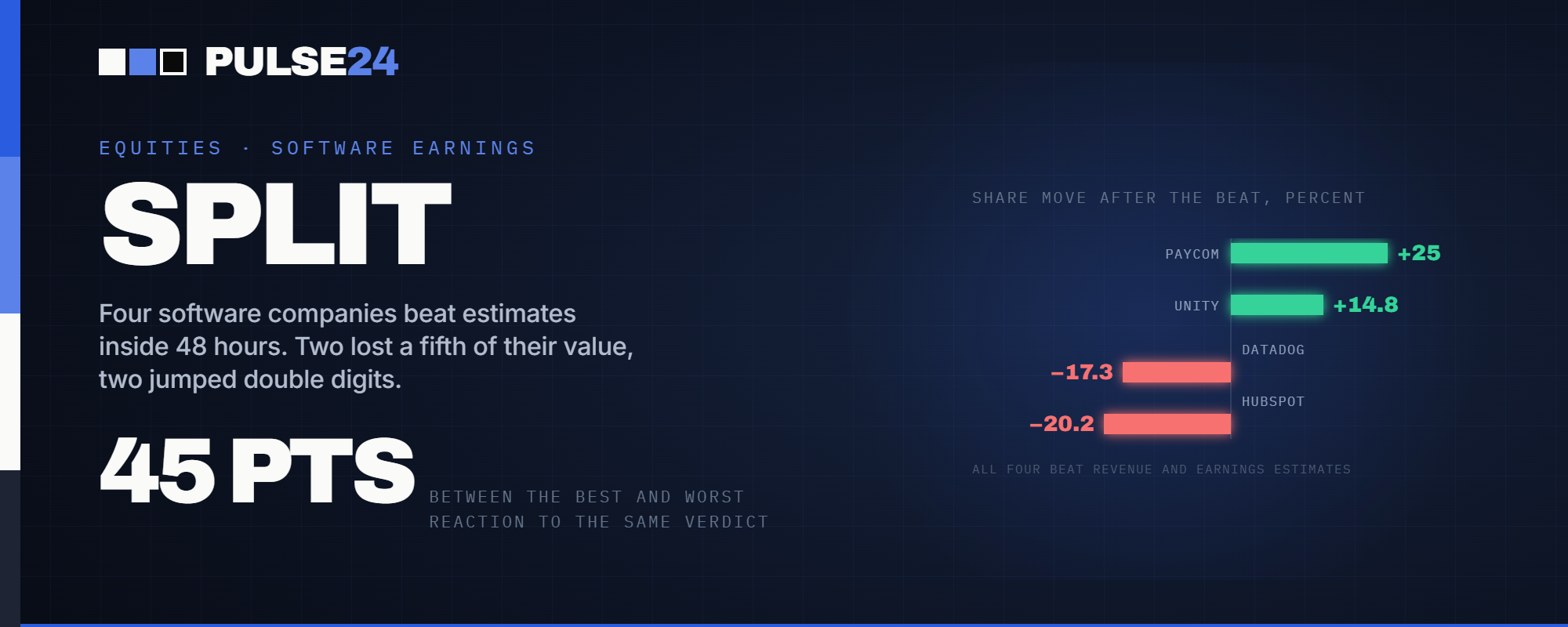
Four software companies reported earnings within 48 hours of each other this week, and Wall Street split them into two groups. HubSpot and Datadog beat estimates and lost a fifth of their value anyway, while Paycom and Unity beat too and jumped double digits.
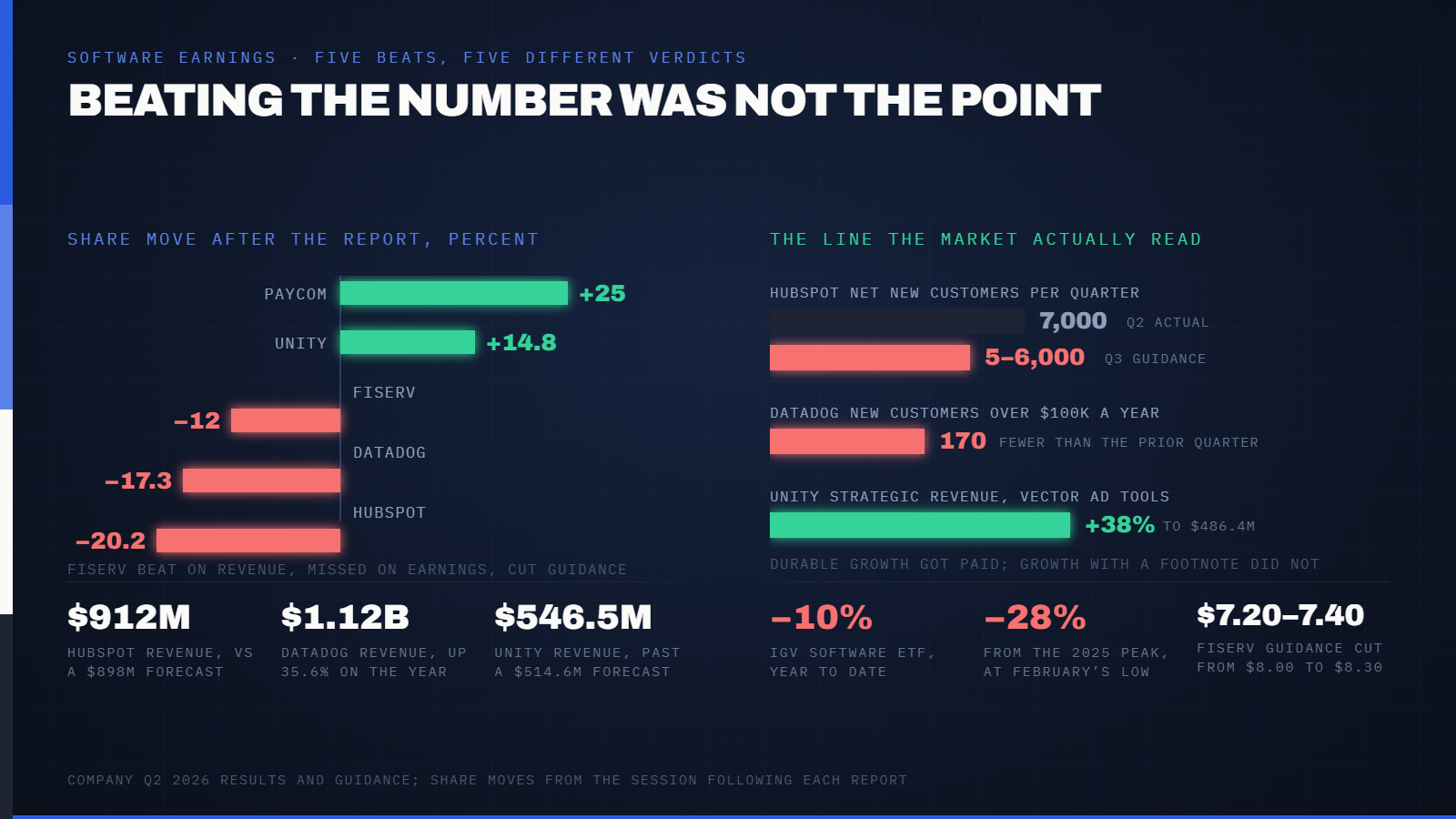
HubSpot beat Wall Street's earnings estimate by 24 cents a share this week. Revenue came in at $912 million against a $898 million estimate, and free cash flow grew 44% year over year. None of that mattered much by the next morning. The stock fell 20.2%, a drop several analysts described as the steepest single session in the company's history as a public company.
The reason wasn't in the headline numbers. It was buried in the customer count. HubSpot added just 7,000 net new customers in the quarter and guided to only 5,000 to 6,000 in the third quarter, a deceleration that Piper Sandler and Bernstein both flagged in same-day notes. Bernstein pointed to HubSpot's April overhaul of its go-to-market and pricing strategy as the source of the slowdown. A company can beat the number Wall Street models and still miss the number Wall Street actually cares about.
Datadog told a similar story with better math attached. Revenue grew 35.6% year over year to $1.12 billion, beating estimates by close to 4%, and adjusted earnings beat by more than 11%. Management didn't just meet expectations, they raised full-year revenue guidance to a $4.46 billion midpoint and lifted adjusted earnings guidance by 5%. Even so, the stock dropped 17.3% to $234.23. The soft spot: only 170 new customers paying more than $100,000 a year, fewer large new contracts than the prior quarter. Growing 35% wasn't the question investors were asking. Whether that growth rate holds was.
Two Beats That Went the Other Way
Paycom and Unity Software reported in the same window and drew the opposite verdict from the same market. Both beat on the headline lines: Paycom posted $531.2 million in revenue against a roughly $513 million estimate and adjusted earnings of $2.78 a share versus $2.38 expected, then raised full-year revenue guidance above what analysts had already modeled. The stock jumped as much as 8% in after-hours trading the night of the report and kept climbing, closing roughly 25% higher within two sessions.
Unity's turnaround was sharper still. Revenue reached $546.5 million, up 24% year over year and well past the $514.6 million estimate, while adjusted earnings of 28 cents a share beat a consensus that had called for a loss. Strategic revenue, the segment that includes Unity's Vector advertising and monetization tools, climbed 38% to $486.4 million. CEO Matt Bromberg tied the strength directly to Unity's AI-driven ad products. The stock closed up 14.8% at $40.72.
Why It Matters
None of these four companies had a bad quarter by the numbers. What separated the winners from the losers was whether the growth in front of investors looked durable, and increasingly, whether it carried a credible AI angle attached to it. Unity's pitch is that AI-powered tools are pulling in more advertiser spending. Paycom's is operating leverage and a guidance raise investors could take at face value. HubSpot and Datadog offered strong quarters with a footnote that made the next one look less certain.
That footnote is landing in a market already primed to read it harshly. The software-focused IGV ETF is down more than 10% in 2026, and was off as much as 28% from its September 2025 peak at its worst point in February, part of what traders have started calling the "SaaSpocalypse," the fear that AI agents will erode the seat-based licensing model much of the software industry was built on. Not every analyst buys the framing. Some argue the selloff has been indiscriminate, punishing durable, cash-generative franchises alongside the names genuinely exposed to AI disruption. But indiscriminate or not, it's the backdrop every software earnings report is being read against right now, which is why a 44% jump in free cash flow bought HubSpot nothing and a 93%-growth quarter got Palantir a 25% rally days earlier in a similar test. A version of that same pattern played out across AI-linked infrastructure names the week before, where the deciding factor was capital spending rather than customer counts. The common thread: the size of a beat matters less this earnings season than the specific number investors have decided to worry about next.
What to Watch Next
The July jobs report lands Friday morning, and a soft print would reinforce the case for a September rate cut that's already building after a weak private payrolls read earlier this month. A cooler labor market doesn't resolve the software sector's problem on its own, since this divergence has been driven by company-specific growth signals rather than the rate outlook, but easier policy would lower the bar these stocks need to clear to re-rate higher. More software names are still due to report in the coming weeks, and the same test will apply to each one: is the growth rate holding, and is there an AI story investors can underwrite, or is the quarter simply a beat with a soft spot the market has learned to go looking for.
The Pulse24 Take
It's tempting to treat "beat estimates" as the whole story and stop reading there. This week is a reminder that the market has moved past that shorthand for software stocks specifically. HubSpot and Datadog did what they were supposed to do on the income statement and got sold anyway, while Paycom and Unity did the same thing and got bought. The difference sat in customer counts, guidance credibility, and whether an AI narrative was attached to the growth. None of this means HubSpot or Datadog are broken businesses. Both are still growing faster than most of the market. It means the bar for software earnings has quietly moved from "did you beat" to "will this still be true next quarter," and that's a harder number to guess in advance.
How we read the data
Curious how we get from raw data to a take like this? Our Trader's Toolkit walks through the tools we lean on.
Explore the Toolkit