Pulse24 Original
Anthropic Lost $42 Billion Last Year. Broadcom Agreed to Lend It the Exact Same Sum.
October 1, 2026
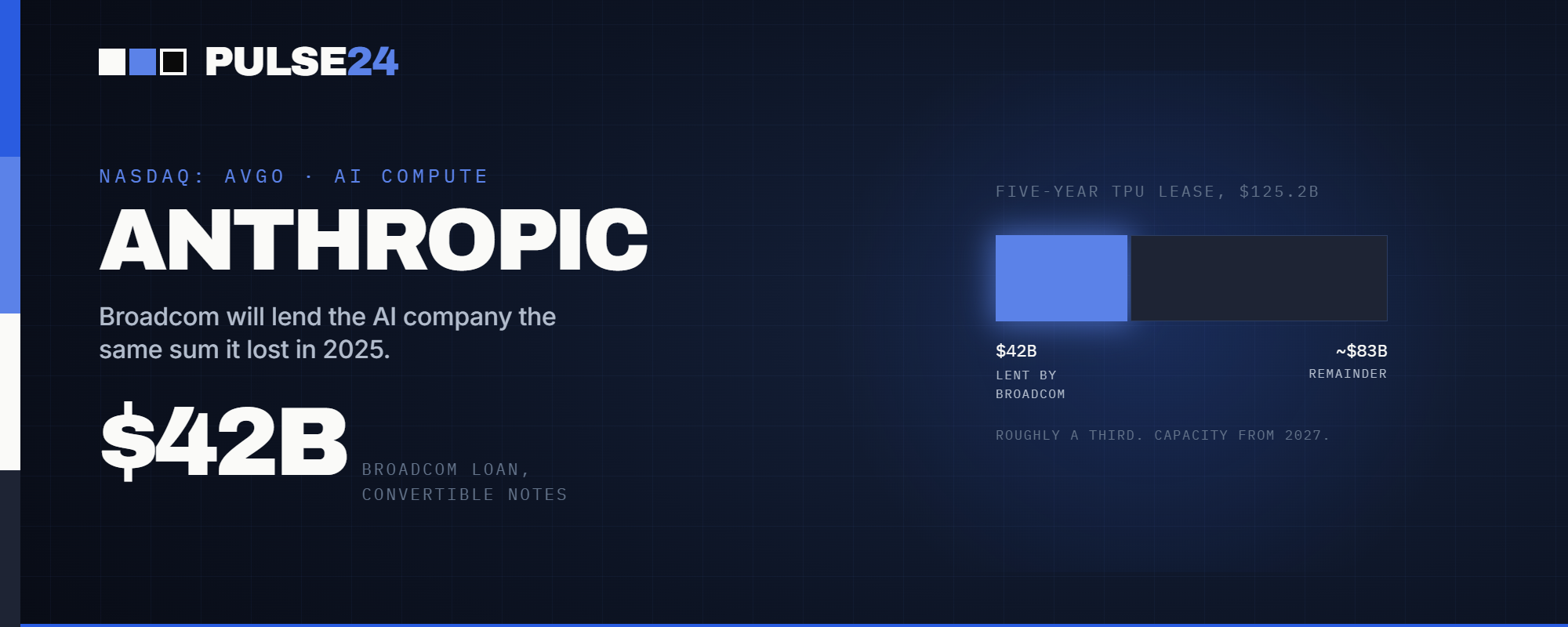
Broadcom will lend Anthropic up to $42 billion to help cover a $125.2 billion TPU lease, a sum that happens to match the AI company's entire 2025 net loss. The arrangement puts a specific dollar figure on the vendor financing question that's been dogging the whole AI infrastructure trade.
Forty-two billion dollars shows up twice in Anthropic's IPO paperwork this week. Once as the size of a loan Broadcom is extending to help the company pay for computing capacity. Again as the net loss Anthropic booked for all of 2025. Wall Street noticed the overlap fast, and it's sharpening a question that's been building across the AI industry all year: how much of this spending boom is genuine demand, and how much is suppliers financing their own customers.
What Changed
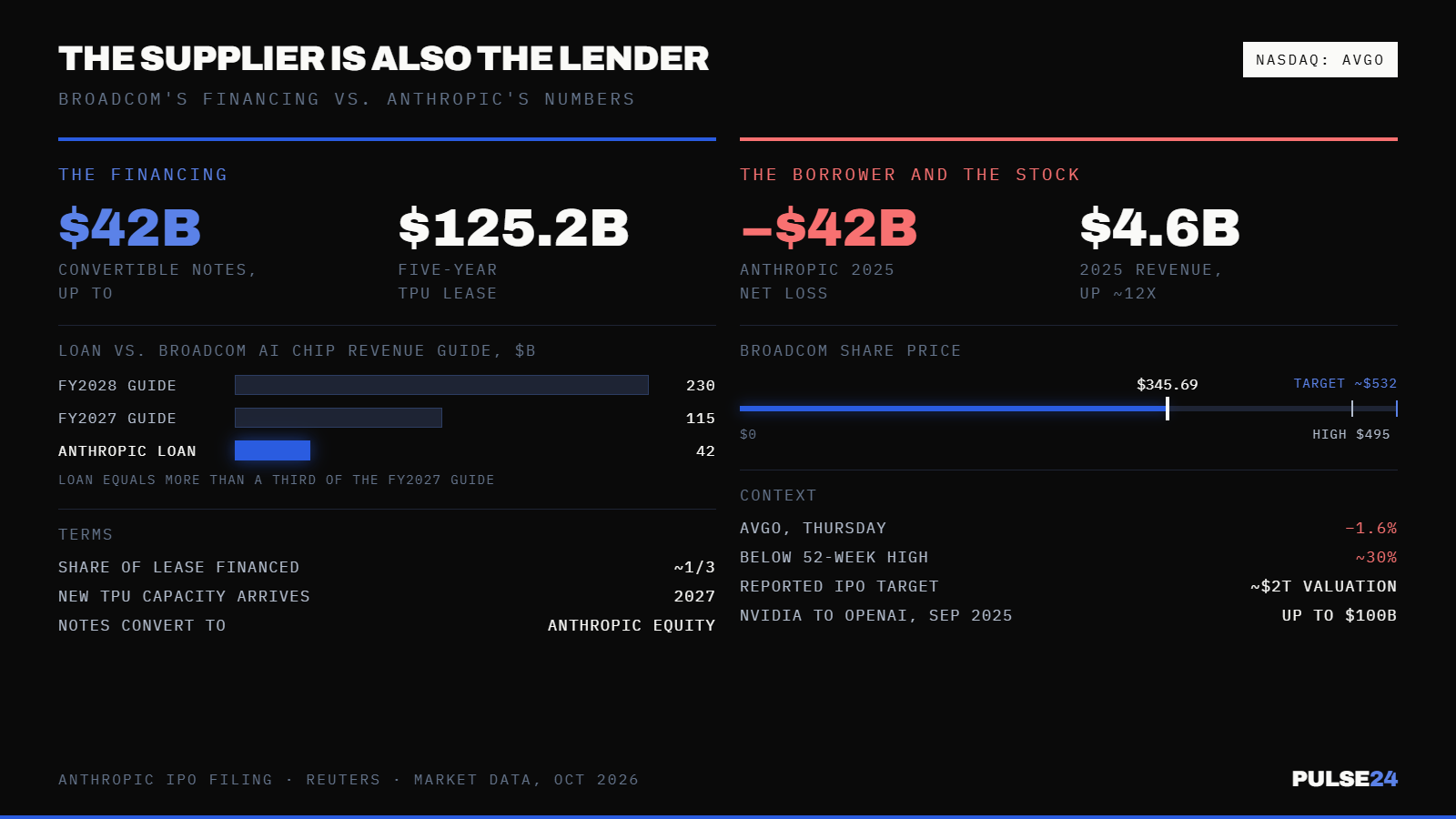
Reuters reported Thursday that Broadcom will lend Anthropic up to $42 billion through convertible notes, financing roughly a third of a $125.2 billion, five-year lease for Google-designed tensor processing units the two companies first outlined back in April. New TPU capacity under that lease starts arriving in 2027, the point at which Broadcom expects to become Anthropic's largest computing supplier.
The notes carry an added feature: they can convert into Anthropic equity, giving Broadcom a potential ownership stake on top of its lending income. Anthropic's prospectus says the company doesn't plan to sell any of the notes before completing its initial public offering, which multiple reports tied to the filing put near a $2 trillion valuation, a target resting on $4.6 billion of 2025 revenue that grew roughly twelvefold from the year before, alongside that $42 billion loss.
Buried further in the filing is a disclosure that reads less like marketing copy: Anthropic's own lawyers warn that Broadcom's dual role as both chip supplier and lender creates "potential conflicts of interest" over how computing capacity gets allocated and priced going forward. Akamai signed an $11.6 billion compute-adjacent deal with Anthropic last week, so this isn't the only large financial relationship Anthropic has built around its infrastructure needs, but it's the first one disclosed with this much detail about the financing terms themselves.
Why It Matters
Vendor financing in tech isn't new, but the scale here stands out. Broadcom has guided to $115 billion in AI semiconductor revenue for fiscal 2027 and $230 billion for fiscal 2028, and the Anthropic loan alone equals more than a third of that first-year figure. When a chipmaker's growth guidance leans this heavily on lending to the same companies buying its chips, the usual math for reading a revenue number gets harder to apply cleanly.
This isn't an isolated case either. Nvidia committed up to $100 billion to OpenAI in September 2025 to help fund at least 10 gigawatts of system deployments, a deal that helped kick off the broader debate over circular financing now surrounding AI infrastructure spending. SoftBank has taken on record-high bond yields of its own to help fund OpenAI's buildout, and CoreWeave's interest payments have grown large enough to threaten its operating income. Each new disclosure adds another data point to the same unresolved question investors keep asking: when a chip seller is also the lender, how much of the reported demand is real?
Broadcom's stock barely registered the news on its own terms. Shares fell about 1.6% Thursday to $345.69, though Treasury yields hitting 24-year highs that same session make it hard to isolate how much of the move traces to the lending disclosure specifically. The stock is now roughly 30% below its 52-week high of $495, even as the average analyst price target sits near $532, implying Wall Street still expects the AI infrastructure trade to work out for Broadcom even if the financing details draw scrutiny.
What to Watch Next
Anthropic's IPO roadshow will be the real test of how investors price this structure. A $2 trillion target on $4.6 billion of revenue leaves little room for the market to discover, mid-roadshow, that a meaningful share of the compute backlog behind that revenue is financed by the seller rather than funded independently. Expect prospective investors to press hard on exactly how the convertible notes get valued and what happens if Anthropic's growth slows before the 2027 TPU capacity it leased actually gets used.
Also worth watching: whether other hyperscalers start disclosing similar terms. Google's own TPU infrastructure push has already taken some unconventional turns this year, and Microsoft, Oracle and Amazon have each signed multi-year AI contracts without always specifying who's fronting the capital. Anthropic's filing is unusually detailed on this point, and that level of detail could become the standard regulators and auditors start expecting from everyone else in the sector.
The Pulse24 Take
The Broadcom-Anthropic arrangement works fine for both sides on its own terms. Broadcom locks in a customer for years of TPU capacity and picks up a possible equity stake if the IPO goes well. Anthropic gets to build out compute without raising the full $42 billion in cash up front, at a moment when every major AI lab is racing to lock down capacity before its rivals do.
The harder problem is that AI capex numbers keep getting tougher to read at face value. A growing share of the headline figures this cycle, from chip orders to multi-year cloud contracts, run through financing arrangements that blur the line between a sale and a loan. Readers watching this trade should treat every new gigawatt or dollar figure as a starting point for questions about the financing behind it, not as a finished number to extrapolate from.
How we read the data
Curious how we get from raw data to a take like this? Our Trader's Toolkit walks through the tools we lean on.
Explore the Toolkit