Pulse24 Original
Google's Next AI Data Center Launches Into Orbit on October 1. It Runs on Sunlight, Not the Grid.
September 27, 2026
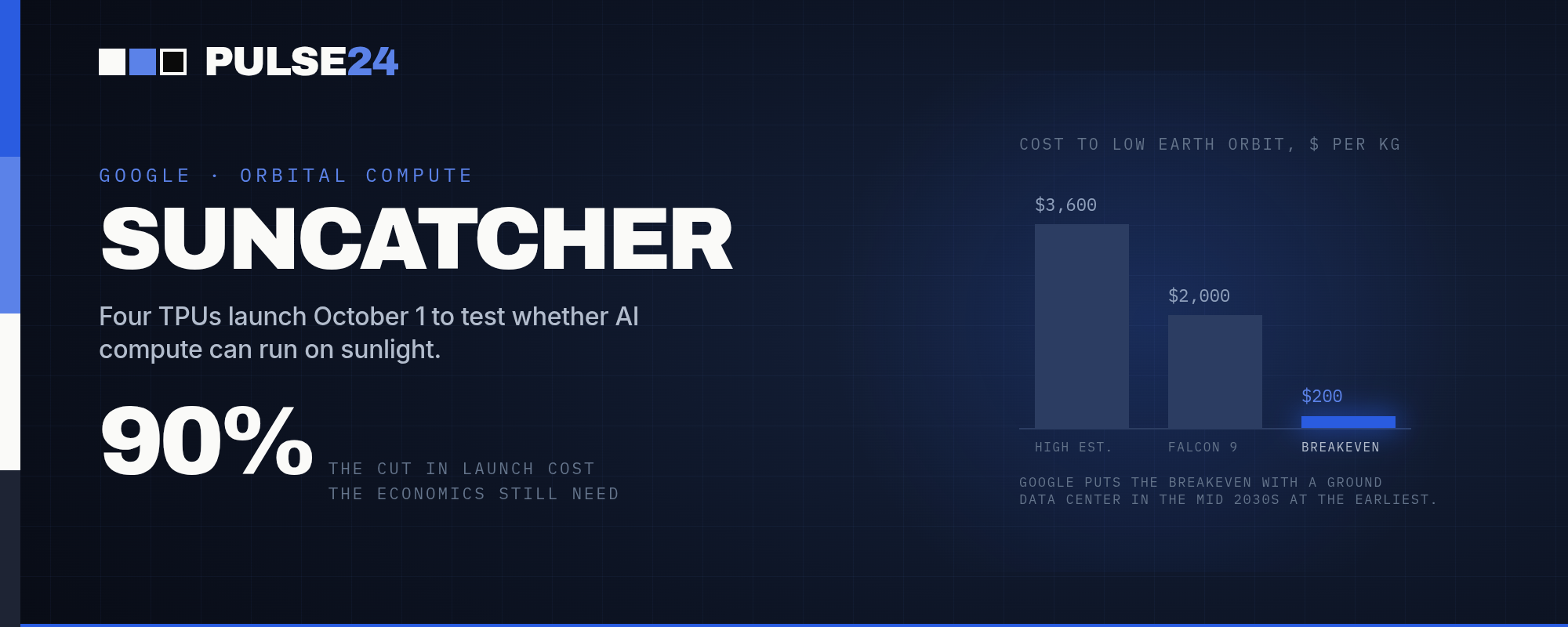
Google is sending four AI chips into orbit this week to test whether compute can move off an overloaded power grid and into space. The economics only work if launch costs fall by nearly 90 percent from where they sit today.
Four Trillium TPUs are scheduled to leave Earth on October 1, riding a SpaceX Falcon 9 as part of a Transporter-18 rideshare mission out of Vandenberg Space Force Base. They belong to Google, and their destination is low-Earth orbit.
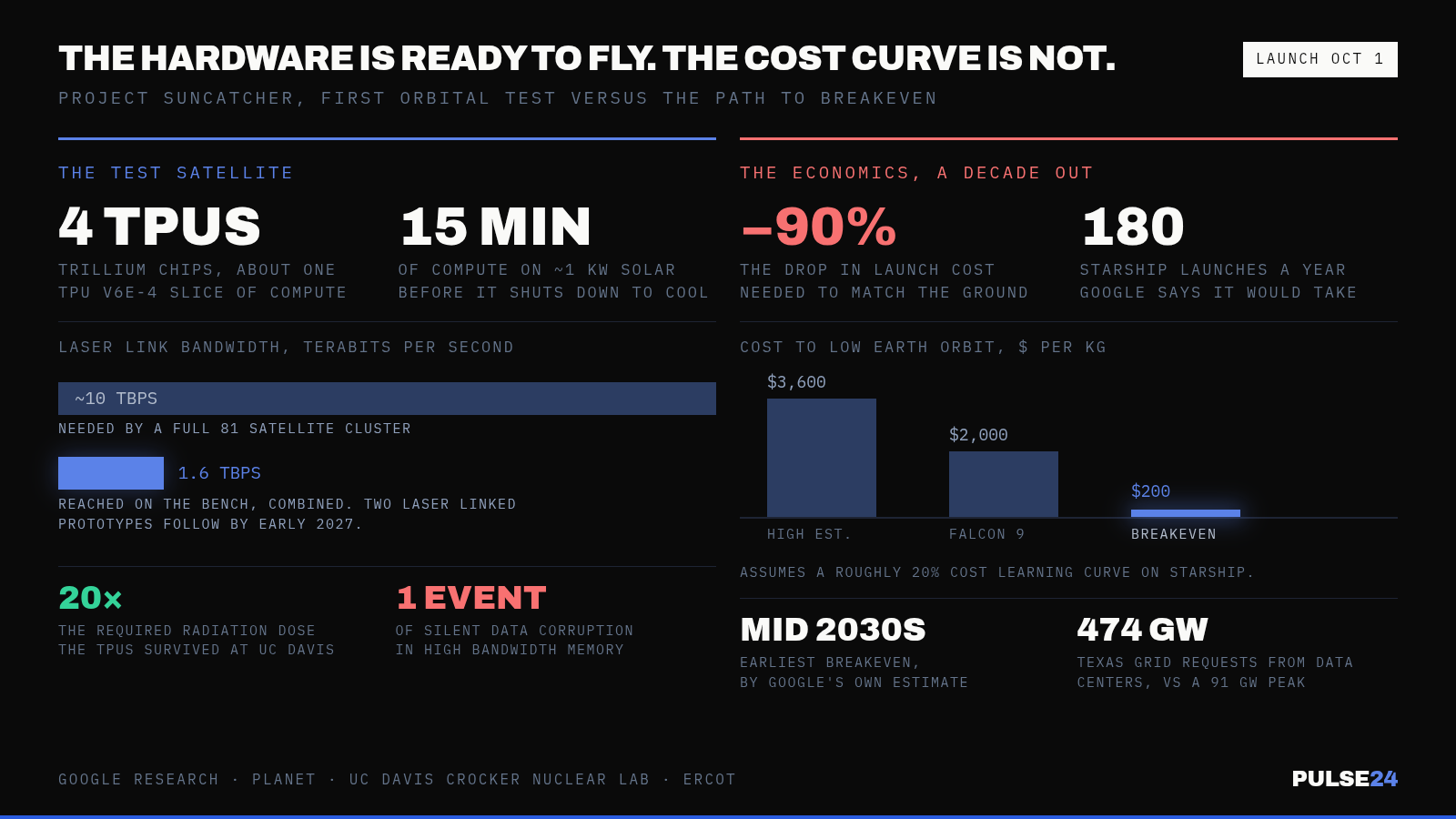
The satellite carrying them is a minimum viable product built with Planet, the satellite imaging company, and it packs roughly the compute of a single Google Cloud TPU v6e-4 slice. About a kilowatt of solar power will run it, heat pipes and radiators will cool it, and it gets roughly 15 minutes of usable compute time before it has to shut down and let the heat dissipate. The whole system is designed to operate for about a year before it deorbits within roughly six years.
This is the first orbital test of Project Suncatcher, the research effort Google has been running under Travis Beals, the senior director leading the project. The idea of putting compute in orbit isn't new. What changed this month is that Google is now willing to put real hardware on a real rocket and find out whether the theory survives contact with actual radiation, actual thermal cycling, and actual orbital mechanics.
Why Space At All
The answer sits partly in Texas. Data center developers there have filed for a combined 474 gigawatts of grid connections, against a grid whose all-time peak demand record is only 91 gigawatts. PJM, the grid operator covering a large swath of the mid-Atlantic and Midwest, has hit its capacity auction price cap for three straight years as AI-driven demand collides with a slow-moving buildout of new power plants. Orbit has no permitting queue and no interconnection agreement to negotiate. A satellite in the right orbit sees the sun for nearly all of its trip around the planet, without clouds, weather, or a utility standing in the way.
That's the pitch, and Google isn't the only one making it. Starcloud, a startup that put an Nvidia H100 chip into orbit in November 2025, raised a $250 million Series A extension in August at a $2.3 billion valuation and has floated plans for a 5-gigawatt orbital data center. Nvidia has its own orbital compute module in development. SpaceX, which is Google's launch provider for this mission, is no longer a neutral party either. After absorbing xAI in a roughly $1.25 trillion merger that closed in February, the company that just weeks earlier had pegged its own addressable market at $28.5 trillion is now both the infrastructure Google depends on to reach orbit and a direct competitor building AI compute of its own.
The Cost Math Is Still a Decade Away
The arithmetic is less generous than the pitch. Today's launch costs run somewhere north of $2,000 per kilogram to low-Earth orbit on a reusable Falcon 9, and some estimates put the figure closer to $3,600. Google's own analysis ties the breakeven point for orbital compute against a terrestrial data center to roughly $200 per kilogram, close to a 90% reduction from where costs sit now. Reaching that level, by Google's own reckoning, would require something like 180 Starship launches a year and a roughly 20% cost-learning curve, a path that points toward the mid-2030s at the earliest, not next year.
Radiation is the other open question, and the early results are encouraging without being conclusive. Google tested its Trillium TPUs at UC Davis's Crocker Nuclear Laboratory using a 67 MeV proton beam calibrated to simulate years of orbital exposure. The chips absorbed roughly 20 times their required dose without failing. High Bandwidth Memory held up less well, showing irregularities at a much lower threshold, though most of the resulting errors were fixable with a simple restart. One event, though, produced silent data corruption, the kind of error that doesn't announce itself and can quietly poison a training run. It's a small footnote in a single test campaign, but it's the sort of failure mode that will need to be solved before anyone trusts a real workload to a satellite.
What to Watch Next
The October 1 launch itself is the first checkpoint. If the hardware performs in orbit the way it did on the ground, Google plans to follow with two more prototype satellites carrying laser links between them by early 2027, testing the inter-satellite networking that any real cluster would depend on. Bench demonstrations have already reached 800 gigabits per second in one direction and 1.6 terabits per second combined, well short of the roughly 10 terabits per second Google says a full 81-satellite cluster would eventually need.
The more useful signal for markets is probably launch pricing, not this single mission. If Starship's per-flight costs keep falling toward Google's $200-per-kilogram target over the next several years, orbital compute stops being a research curiosity and starts becoming a genuine hedge against the land and power constraints already showing up in Texas and across PJM's footprint. If those costs stall instead, this becomes one more example of a hyperscaler spending research dollars on a moonshot while the real capacity decisions keep happening on the ground, in front of a utility commission, the way they always have.
The Pulse24 Take
This isn't a story about Google solving the AI power crunch next quarter. The economics are roughly a decade from working by Google's own numbers, and the near-term power buildout will keep running through natural gas turbines, nuclear restarts, and long interconnection queues, not satellites. What this launch does confirm is that the largest AI infrastructure spenders now view the terrestrial power constraint as serious enough to fund an alternative that sounded closer to science fiction two years ago.
Watch how crowded the field gets from here. When Google, Nvidia, Starcloud, and a newly AI-focused SpaceX are all chasing the same orbital compute thesis within the same twelve months, that's usually a sign the underlying problem, the gap between what AI wants to consume and what the grid can deliver, is real enough that capital is willing to fund several competing approaches at once rather than wait for one to prove out first.
How we read the data
Curious how we get from raw data to a take like this? Our Trader's Toolkit walks through the tools we lean on.
Explore the Toolkit