Pulse24 Original
SpaceX Says Its Addressable Market Is $28.5 Trillion. About 80% Comes From Enterprise AI.
September 20, 2026
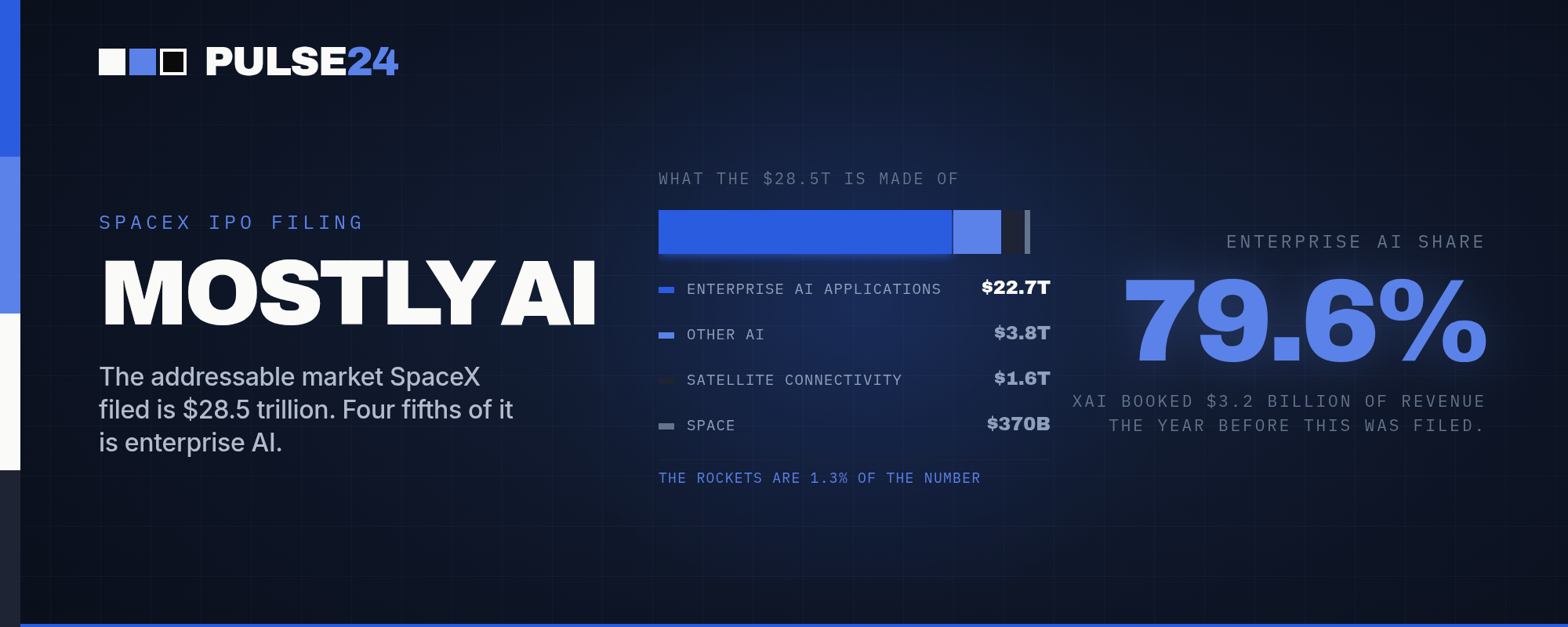
SpaceX's IPO materials put its total addressable market at $28.5 trillion, a figure the company itself calls "the largest actionable" TAM in history. About 80% of it comes from enterprise AI applications following its combination with xAI. A framework for reading any company's TAM claim before taking the headline number at face value.
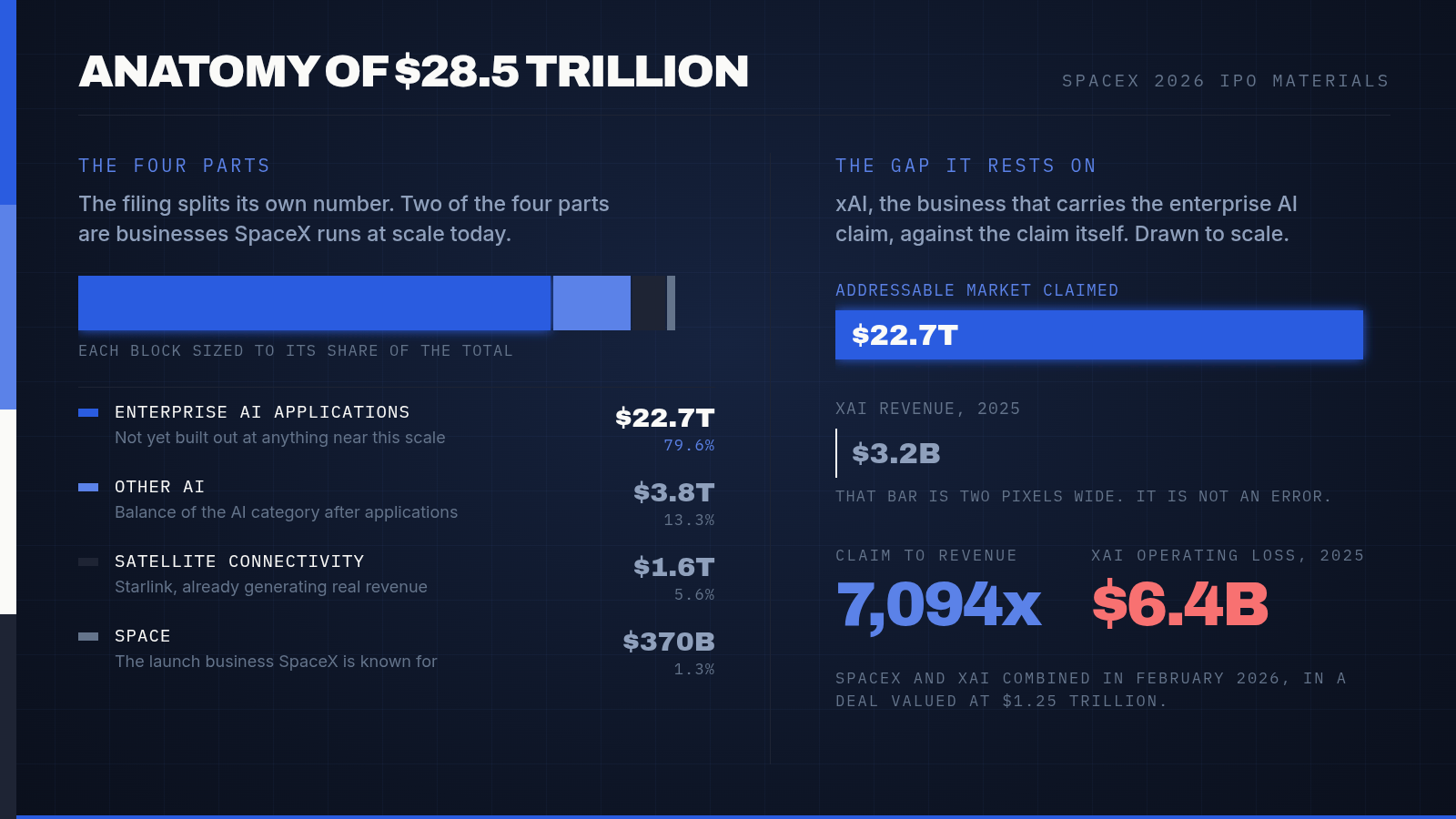
SpaceX's IPO materials describe what the company calls "the largest actionable total addressable market in human history": $28.5 trillion. Space, the business SpaceX is famous for, accounts for $370 billion of that figure. Satellite connectivity, the Starlink business already generating real revenue, accounts for $1.6 trillion. The rest, $26.5 trillion, is labeled AI, and $22.7 trillion of that alone, about 80% of the entire TAM, is enterprise AI applications.
That breakdown is worth sitting with. SpaceX merged with Elon Musk's AI company xAI in February 2026, in a deal valued at $1.25 trillion, so enterprise AI genuinely is part of the business being presented to IPO investors now. xAI already had revenue before the merger, $3.2 billion in 2025, alongside a $6.4 billion operating loss the same year. The business exists and generates real revenue. What's unproven is whether anything operating at a $3.2 billion scale can plausibly grow into a claim on $22.7 trillion of addressable market.
What a TAM Number Measures
A total addressable market isn't a standardized accounting measure like revenue or earnings. There is no single prescribed methodology requiring two companies to define their markets the same way, which means superficially similar TAM figures can be built from very different assumptions: current sales in a market that already exists, a company's own read on a market it hopes to enter, or, as later examples show, the broader economic activity a technology could someday touch. Reading a TAM claim starts with figuring out which of those three is being described.
How Much of the Number Comes From Businesses Operating at Scale Today?
SpaceX is the cleanest example of this question, because the filing itself does the work of breaking the number into parts: roughly $2 trillion in space and connectivity, businesses SpaceX operates at meaningful scale today, against $26.5 trillion in AI, most of it enterprise applications the combined company has not yet built out anywhere near that scale. A company is entitled to include markets it intends to enter or expand into. The analytical question is how much of the headline TAM, and by extension how much of the investment thesis, depends on a business whose current revenue is still small relative to the opportunity being claimed. For SpaceX, enterprise applications alone account for roughly four-fifths of the entire $28.5 trillion estimate, resting on a business that generated $3.2 billion in revenue the year before the IPO filing.
Whose Estimate Is It, and What Definition Is It Using?
Nvidia's Jensen Huang has projected that annual data center capital spending will reach $3 trillion to $4 trillion by the end of the decade, a figure Nvidia has also framed in terms of its own revenue opportunity per gigawatt of AI factory capacity across its chip generations. Needham's Laura Martin has contrasted that broader figure with consensus estimates of roughly $1.03 trillion in hyperscaler capital spending by 2028, calling Huang's number far more ambitious than what industry participants expect the largest cloud buyers to spend. The two figures likely aren't measuring quite the same thing: Huang's number describes a broader market at the end of the decade, while the consensus estimate covers a narrower group of buyers two years earlier. That mismatch doesn't resolve which estimate is closer to right. It does mean neither number should be treated as a clean benchmark for the other without first checking who's counted, what year, and what kind of spending, hyperscaler capex, sovereign AI, enterprise, neoclouds, sits inside each figure.
Revenue, or the Economic Activity Around It?
Anthropic, which is racing toward its own IPO, is reported to be telling investors it sees more than $30 trillion in potential revenue, a figure close to the size of the entire US economy. Anthropic's detailed methodology for that number isn't publicly available, and public reporting has linked it to the broad value of knowledge work AI could eventually touch without confirming the exact calculation. Technology analyst Fred Hickey called the figure "nonsense" and noted it approaches the $32.5 trillion size of the entire US economy, a blunt reaction, though one that doesn't require knowing Anthropic's exact math to land. Whatever the methodology, the headline figure is difficult to compare directly with estimates built from software revenue or infrastructure spending. The distinction that matters doesn't depend on getting Anthropic's exact math right: a technology can touch an enormous amount of economic activity without its vendors capturing anything close to that amount as revenue. If AI helps perform work currently valued at $100,000 a year, that doesn't automatically create $100,000 of new software revenue anywhere. The relevant number is what share of that activity could realistically become a vendor's own revenue, and that share is almost always far smaller than the economic activity it's measured against.
Why These Numbers Expand So Easily
AI makes a TAM slide unusually easy to expand because the technology crosses traditional industry boundaries in a way most products don't. A chipmaker can count the infrastructure spending its chips go into. A model company can count every software category its models could eventually touch. A company that combines rockets, satellites, and now a foundation model lab can add all three together and call the sum a single market. Once the definition shifts from revenue in the market a company sells into today toward the full economic activity a technology could someday touch, the number can grow by an order of magnitude without a corresponding change in the company's current revenue. The resulting figure still means something, just not the same thing as before: an estimate of economic activity isn't comparable to an estimate of hardware and systems spending, even when both show up on a slide labeled TAM.
Don't Add Them Together
One more thing worth knowing before comparing TAM claims across companies: they overlap enormously, and stacking them up doesn't tell you anything about the size of the industry. Nvidia's data center opportunity sits inside SpaceX's AI infrastructure estimate. AMD competes for pieces of the same compute spending Nvidia is counting. Anthropic's enterprise ambitions overlap with the enterprise applications category inside SpaceX's own $22.7 trillion figure. Adding these numbers together is a bit like adding Apple's, Samsung's, and Qualcomm's own estimates of the smartphone market and treating the sum as the actual size of the smartphone industry. It isn't, and the same problem applies here.
The Pulse24 Take
None of this means the opportunities SpaceX, Nvidia, or Anthropic describe are fake. TAM is simply a different kind of number from revenue or earnings: it describes the potential size of a market under a set of assumptions, not what a company is earning today. The label gets applied to at least three different kinds of figure, current revenue, projected revenue in a market that doesn't exist yet at scale, and the economic value of work a technology might someday touch, and treating all three as the same measurement is where most of the confusion starts.
So the next time a trillion-dollar TAM shows up in an investor presentation, five questions do most of the work: what exactly is being counted, how much of it comes from a business operating at scale today, who produced the estimate and what they gain if a bigger number gets believed, whether it's pricing revenue a company could realistically collect or the economic activity around it, and whether it overlaps with TAMs being claimed elsewhere in the same industry. SpaceX's own filing shows why that matters: enterprise applications alone account for about 80% of its $28.5 trillion estimate, resting on a business that generated $3.2 billion in revenue the year before the number was filed with the SEC.
How we read the data
Curious how we get from raw data to a take like this? Our Trader's Toolkit walks through the tools we lean on.
Explore the Toolkit