Pulse24 Original
Adobe's Backlog Grew 8% Last Quarter. Revenue Grew 13%, and That Gap Is Why the Stock Fell Anyway.
September 13, 2026
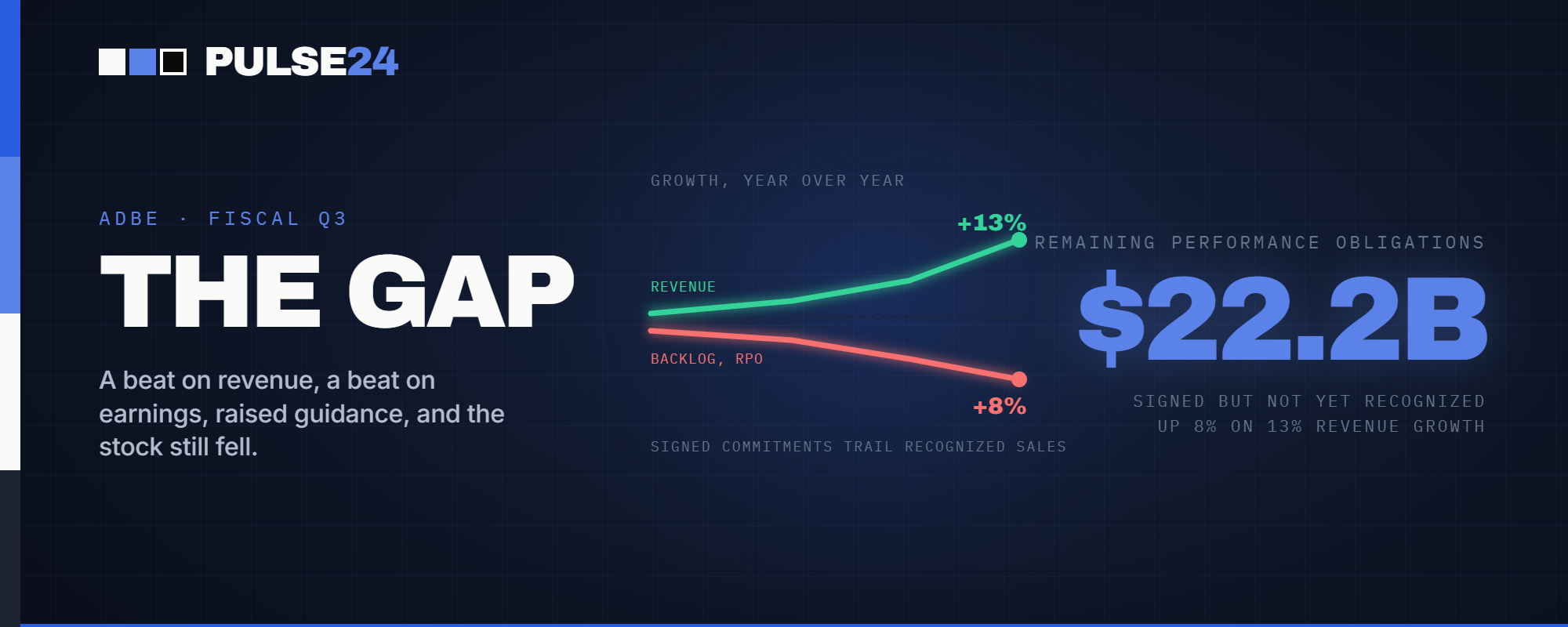
Adobe beat revenue and earnings estimates in its fiscal third quarter and even raised full-year guidance, but investors sent the stock down anyway. A backlog metric growing barely half as fast as revenue is telling a more cautious story than the AI numbers Adobe wants investors to focus on.
Adobe's revenue climbed 13% to $6.76 billion last quarter, comfortably ahead of what analysts had modeled. Non-GAAP earnings of $6.13 a share beat estimates too, by about a nickel. Full-year guidance went up, not down. None of that stopped the stock from falling.
Shares dropped as soon as the numbers landed Thursday evening and stayed lower through Friday's regular session, closing at $248.83, off roughly 2.5% from where they started the week. A quarter that beats on revenue, beats on earnings, and arrives with raised guidance is not supposed to trade like a disappointment. This one did, and the reason sits a few lines below the headline numbers.
What Changed
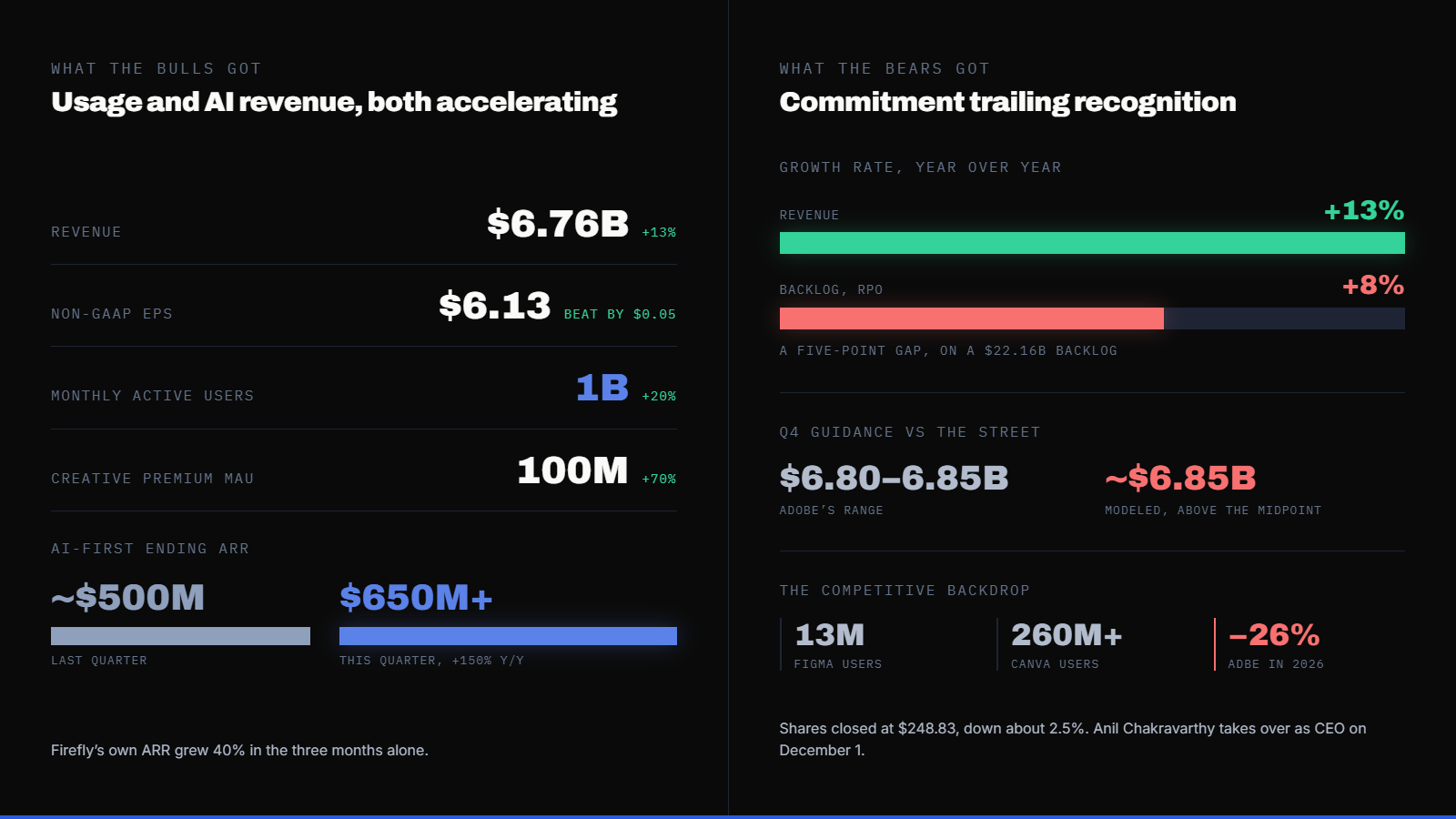
The parts of Thursday's report built for headlines looked strong. Business Professionals and Consumers revenue reached $1.91 billion, up 16% year over year, while Creative and Marketing Professionals revenue hit $4.65 billion, up 13%. AI-first ending ARR, Adobe's tally of recurring revenue tied directly to its generative AI products, topped $650 million, more than 150% higher than a year earlier and up from roughly $500 million just last quarter. Firefly's own ARR grew 40% in the three months alone. Total monthly active users crossed 1 billion for the first time, up more than 20% year over year, with Creative Premium MAU passing 100 million and Business Professionals and Consumers MAU topping 900 million.
Sitting next to those numbers was a quieter one that mattered more to traders. Remaining performance obligations, the value of contracts customers have already signed but Adobe hasn't yet recognized as revenue, grew 8% year over year to $22.16 billion. Total revenue grew 13% over the same stretch. A backlog expanding at roughly five points slower than the revenue it's supposed to be feeding is the kind of detail that gets buried in a press release but not in an earnings call.
Guidance added to the unease rather than settling it. Adobe's fourth-quarter outlook of $6.80 billion to $6.85 billion put its midpoint just under the roughly $6.85 billion analysts had penciled in. Interim CFO Steven Day pointed to a foreign-exchange headwind heading into the quarter as one factor weighing on the range, on top of the freemium and monetization-timing questions that have followed Adobe for most of the year.
Why It Matters
Remaining performance obligations get less attention than revenue or earnings per share, but many investors treat the number as a cleaner read on forward demand. Revenue reflects contracts signed months or years ago finally being recognized. A backlog is closer to a real-time vote on what customers are willing to commit to right now. When a backlog grows slower than the business built on top of it, the concern isn't this quarter, it's the next several.
Adobe isn't the first software company to get punished for exactly this pattern. MongoDB beat revenue, earnings, and guidance in its own recent quarter and still watched its stock fall 12%, because one specific growth number refused to accelerate the way the rest of the report suggested it should. Snowflake shows the opposite side of the same coin. Its product revenue grew 37% last quarter, and Wall Street sent the stock up 22% in a single session, because nothing in that report undercut the growth story investors were being asked to pay for. Adobe's problem this week wasn't a bad number. It was one good number sitting next to one that wasn't good enough.
None of this is happening in a vacuum. Adobe walked into Thursday's report already down roughly 26% for the year, a stock that has become something like the test case for whether generative AI helps or replaces incumbent creative software. Figma, with roughly 13 million users, and Canva, with more than 260 million, both let people skip Adobe's tools entirely for a growing share of everyday design work. General-purpose AI models add another layer of competition: OpenAI's Sora, Anthropic's Claude, and xAI's Grok can now generate images and video from a text prompt without touching a Creative Cloud subscription at all. Firefly, Adobe's answer to that threat, is the product behind the AI-first ARR figure, and on its own terms it grew fast enough to justify the bet Adobe has made on it. The market wanted that growth paired with a backlog that looked just as convincing, and this quarter it didn't get both at once.
The timing adds another layer. Thursday's numbers were the last full quarter reported under Shantanu Narayen, who has run Adobe for nearly two decades and moves to Executive Chair on December 1. Anil Chakravarthy, currently President of Customer Experience Orchestration, takes over as CEO and has already started talking publicly about "agentic software" as the next phase for Adobe's creative, productivity, and enterprise products. Adobe is also running its finance function on an interim basis, with Steven Day filling in as CFO since Dan Durn left for Marvell Technology earlier this year. A leadership handoff during a quarter with a genuinely mixed message is its own kind of test for how the new team frames the tradeoffs ahead.
What to Watch Next
The next earnings call is the obvious checkpoint. If remaining performance obligations reaccelerate back toward revenue growth, this week's selloff starts to look like an overreaction to one metric. If the gap widens instead, it stops being a one-quarter story and becomes the market's working thesis on Adobe. Firefly's own ARR trajectory is worth tracking separately from the broader AI-first number; a fourth straight quarter of strong sequential growth there would say more about genuine monetization than the headline percentage alone.
Chakravarthy's first moves as CEO, once he formally takes over in December, will also matter more than usual. Investors have specific, pointed questions about freemium pricing, how much of Adobe's free user base ever converts to paying tiers, and how the company plans to compete with tools that are often free or nearly free at the point of use. A new CEO's early public comments tend to move stocks more than they should on substance alone, and Adobe's is primed to react either way.
The Pulse24 Take
Both sides of the argument about Adobe pulled real ammunition from the same earnings report this week. The bulls got AI-first ARR growing more than 150% and a billion monthly active users, proof that Adobe's products are still where a huge number of people go to create things, whether or not they're paying yet. The bears got a backlog growing at roughly half the pace of revenue, a specific, quantifiable sign that future commitments aren't keeping up with the growth story being told about the present.
Neither read is wrong, and that's what makes this quarter harder to trade than a clean beat or a clean miss. Usage metrics and backlog metrics measure different things: one captures enthusiasm, the other captures commitment. Adobe has spent the past year proving it can win the first one. This week's reaction says Wall Street is still waiting to be convinced on the second, and until remaining performance obligations start growing in line with everything else in the report, that's likely to stay the more important number in the room.
How we read the data
Curious how we get from raw data to a take like this? Our Trader's Toolkit walks through the tools we lean on.
Explore the Toolkit