Pulse24 Original
Snowflake's Product Revenue Grew 37% Last Quarter. Wall Street Sent the Stock Up 22% in a Single Session.
September 4, 2026
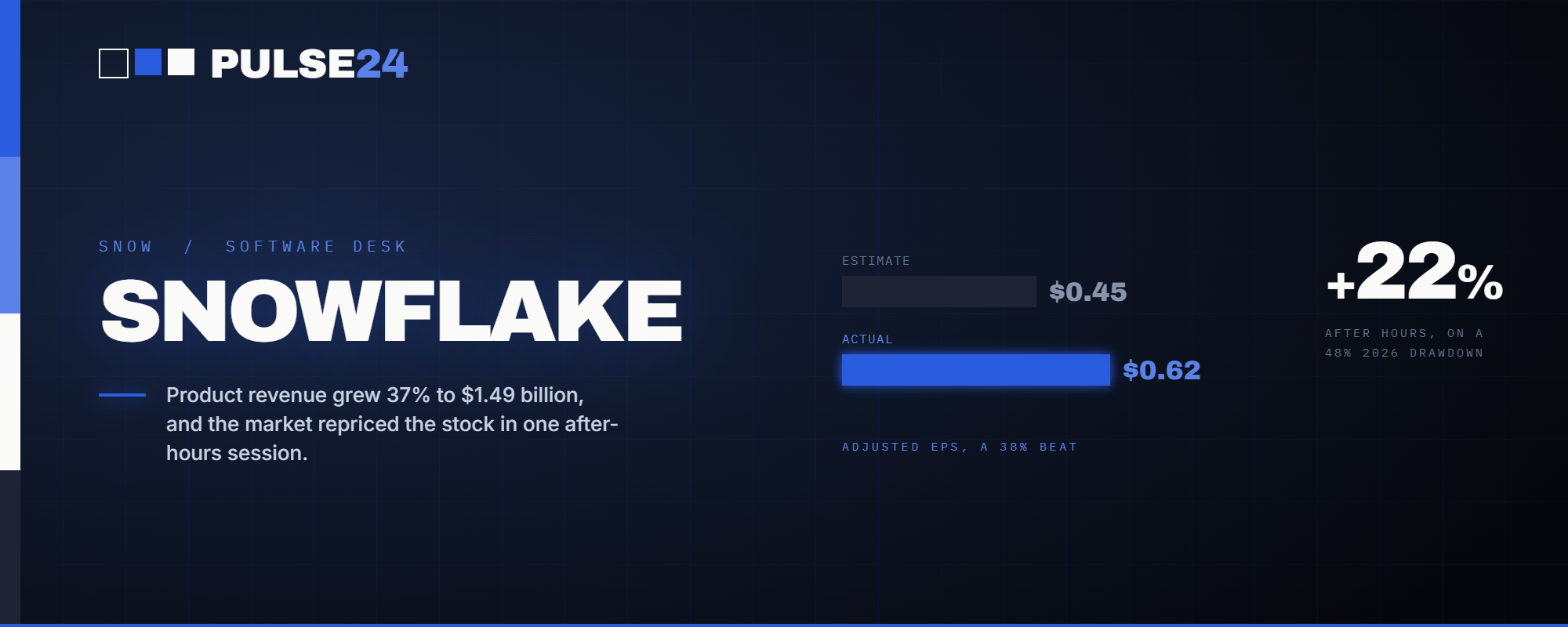
Snowflake's second-quarter results beat expectations across revenue, earnings, and guidance, and the stock's sharpest single-day gain in years suggests investors are starting to pay for AI-driven software growth, not just AI chips.
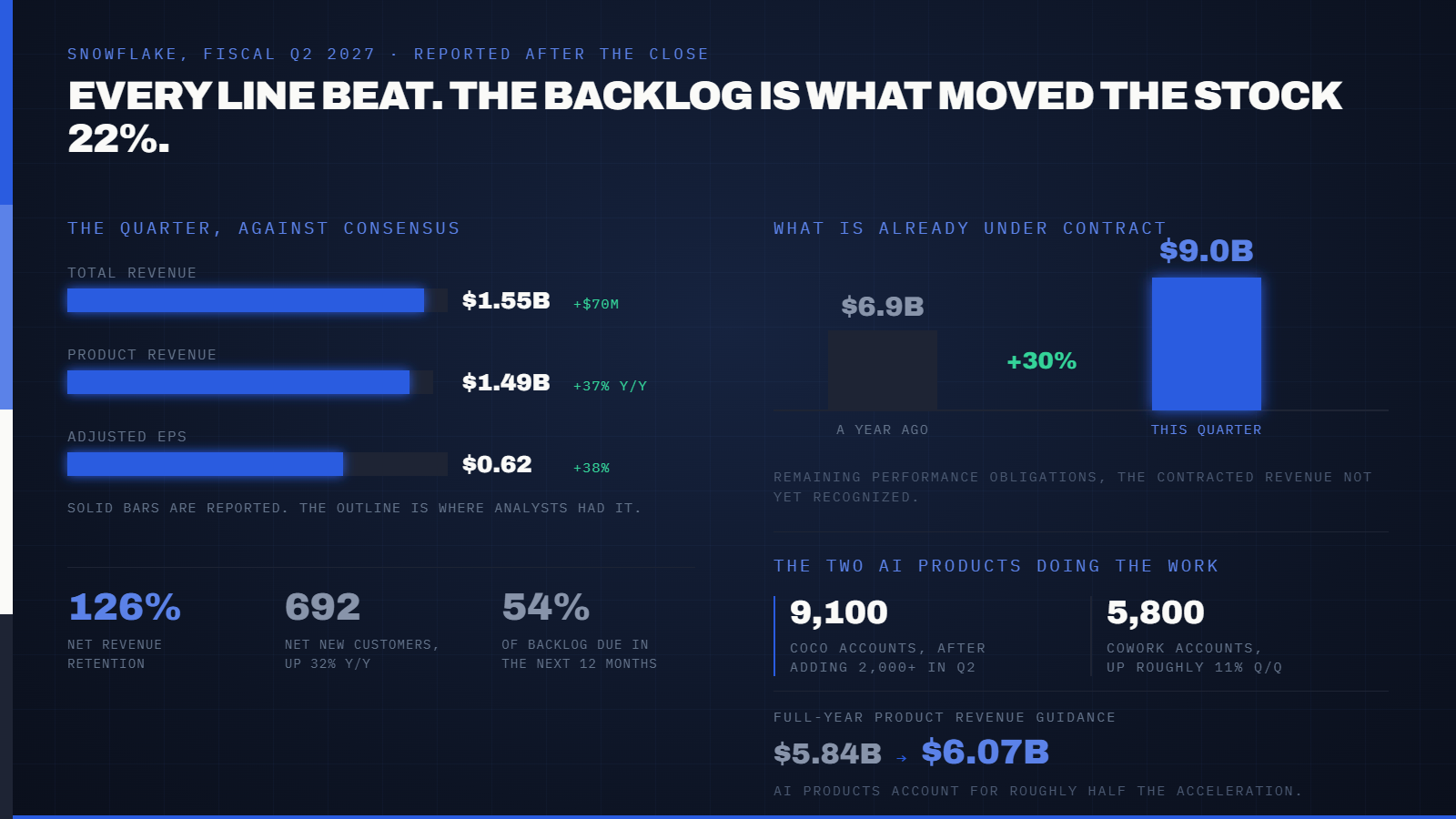
Snowflake reported $1.55 billion in quarterly revenue this week, roughly $70 million above what analysts had modeled. Product revenue, the company's core consumption-based line, grew 37% year over year to $1.49 billion. The stock did the rest of the talking: shares jumped 22% in after-hours trading, reversing a 4% decline from the regular session and marking one of the sharpest single-day moves the cloud data company has produced in years.
Context matters here. Snowflake had lost close to half its value earlier in 2026, dragged down by a market that grew impatient waiting for its AI investments to show up in actual dollars. This week's numbers were the clearest answer yet. Adjusted earnings per share landed at $0.62 against a $0.45 estimate, a beat of nearly 38%. Net new customers rose 32% year over year to 692, and net revenue retention held at 126%, meaning existing customers are still spending meaningfully more than they were a year ago.
What Changed
Two products are doing most of the work. CoCo, Snowflake's AI-assisted data engineering tool, crossed 9,100 accounts after adding more than 2,000 in the quarter. A newer product called CoWork reached 5,800 accounts, up roughly 11% from the prior quarter. Management said AI-related products now account for close to half of the quarter's revenue acceleration, a specific enough claim that analysts spent much of the earnings call pressing for detail on where exactly that revenue was landing.
Remaining performance obligations, the backlog of contracted revenue not yet recognized, rose 30% year over year to $9 billion. About 54% of that is expected to convert to revenue over the next twelve months. That is the kind of figure that matters more than a single quarter's beat: it tells you what customers have already committed to, not just what they bought last quarter.
The company also raised its full-year product revenue guidance to $6.07 billion, up from $5.84 billion, and lifted its non-GAAP operating margin target to 14.5% from 13.5%. Wall Street responded in kind. Needham, Canaccord Genuity, and DA Davidson all raised price targets to $450, while JPMorgan moved to $426 and Cantor Fitzgerald to $430.
Why It Matters
The AI infrastructure story has mostly been told through hardware this year. Broadcom's AI chip revenue jumped 221% last quarter, yet a guidance miss of just $230 million wiped out 5% of its market value within hours. Five hyperscalers are on pace to borrow $175 billion this year to keep building data centers, and that debt has been pushing long-dated Treasury yields toward multi-decade highs. The question hanging over all of that spending has been simple: is anyone actually paying for what gets built?
Snowflake's quarter is a data point on the demand side of that equation, not the supply side. That does not prove every AI-linked capital expenditure will pay off, but it does show that at least one category, enterprise data and AI tooling, is converting adoption into contracted revenue rather than promises. Canaccord's note on the earnings put it plainly: AI monetization is now showing up in the profit and loss statement, not just in management commentary. Salesforce told a similar story about a week earlier, when an AI-expanded product lineup helped drive a 13% stock jump on an earnings beat of its own.
That distinction, hardware capex funded by debt versus software revenue funded by paying customers, is likely to keep separating winners from losers as the AI trade matures. Investors spent early 2026 treating every AI-adjacent stock the same way. Snowflake's reversal from a 48% drawdown to a 22% single-day pop suggests that phase may be ending in favor of more selective, numbers-driven judgment.
What To Watch Next
Snowflake's next test comes with the September Fed decision on the 16th, which will shape the discount rate applied to growth stocks broadly. A software company trading on a premium multiple is more exposed to rate moves than a slower-growing peer, so a hawkish surprise could erase some of this week's gain even if the underlying business keeps performing. Watch also whether CoCo and CoWork adoption keeps compounding into next quarter's numbers, since a single strong print does not settle the argument about whether AI tooling revenue is durable or front-loaded by early adopters. Rival data platforms and cloud consumption names are likely to face the same scrutiny investors just applied to Snowflake: show the AI number in revenue, not just in the pitch deck.
The Pulse24 Take
Snowflake's quarter will get read as a single-company story, and in the narrow sense it is. But it lands in the middle of a much bigger argument about whether trillions of dollars in AI infrastructure spending are actually generating revenue anywhere in the chain. For most of this year, the evidence on that question has come from the hardware side, where debt-funded data center buildouts and volatile chip guidance have made for a shaky case. A consumption-based software company posting 37% product revenue growth, a 30% jump in contracted backlog, and raised full-year guidance offers a cleaner signal than that. The broader debate about whether AI infrastructure spending outpaces real demand is far from settled, but where AI tools are genuinely embedded in daily enterprise workflows, customers are still willing to pay for them. That is the distinction worth tracking as more software companies report this earnings season.
How we read the data
Curious how we get from raw data to a take like this? Our Trader's Toolkit walks through the tools we lean on.
Explore the Toolkit