Pulse24 Original
MongoDB Beat Revenue, Earnings, and Guidance. Its Stock Still Fell 12%, Because One Growth Number Refused to Accelerate.
September 7, 2026
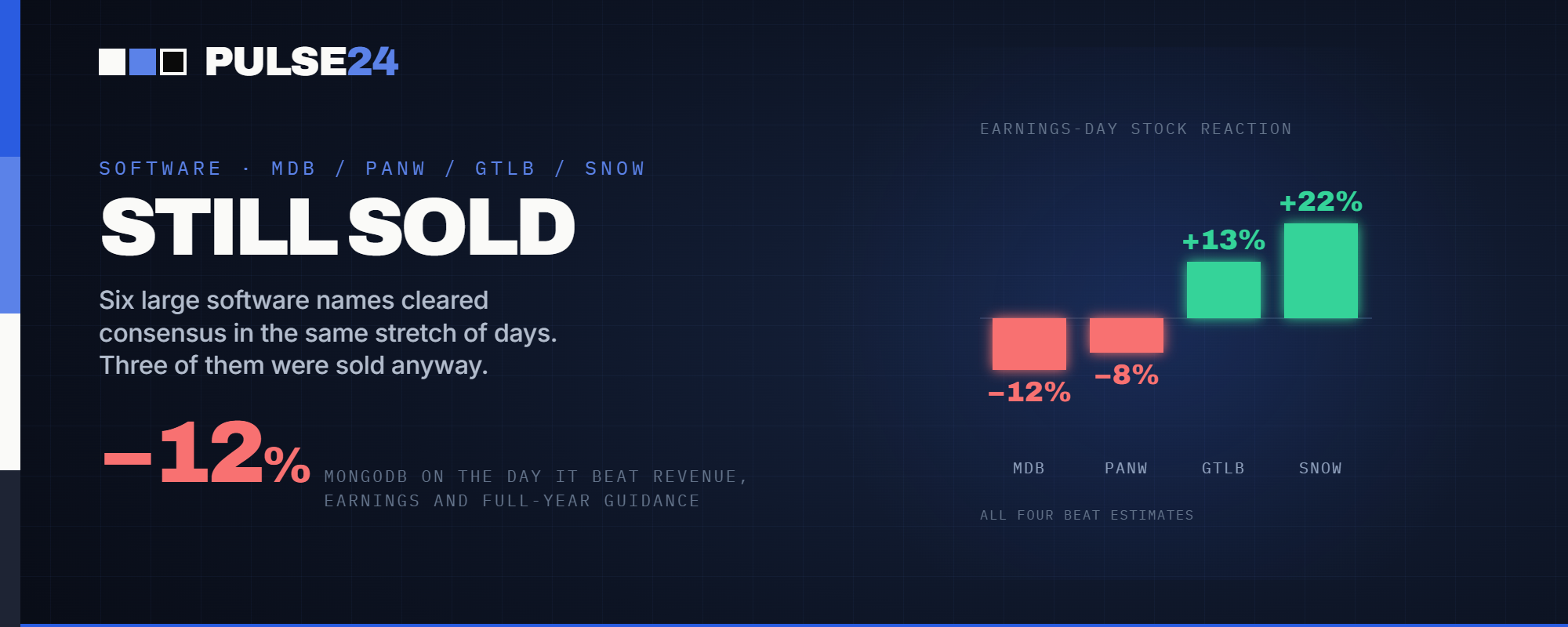
MongoDB topped every estimate on its earnings sheet and the stock dropped 12% anyway. GitLab beat by less and jumped 13%. The gap says more about what Wall Street is now pricing into software multiples than either earnings report does on its own.
MongoDB grew revenue 30% to $771.8 million last quarter, beat its own adjusted earnings estimate by nearly 18%, and raised full-year guidance to as much as $3.03 billion. Wall Street's response was to erase almost 12% of the stock's value in a single session. A few days earlier, GitLab, a much smaller company by revenue, had reported an accelerating growth number and gained nearly 13%. Two software companies, two beat-and-raise quarters, two opposite verdicts.
That split wasn't an isolated MongoDB story. Palo Alto Networks posted 34% revenue growth, its next-generation security annual recurring revenue grew 63%, and management lifted its outlook for the year ahead. The stock fell anyway, down about 8% the day after reporting and roughly 10% for the week, even as the broader market ticked up. Something other than the beat itself was setting the price.
What Changed
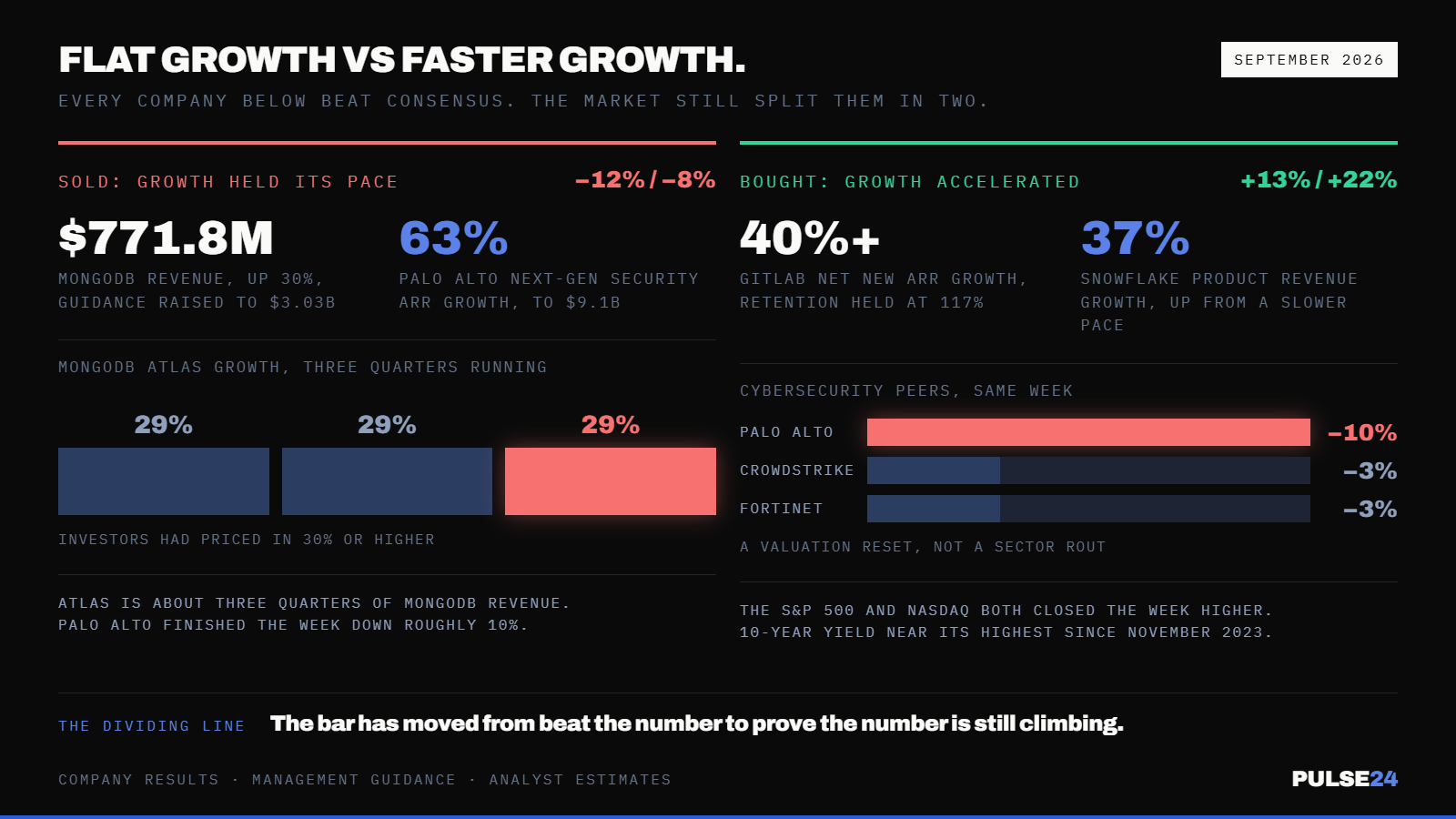
Look past the headline numbers and the pattern comes into focus. MongoDB's growth engine is Atlas, its cloud database product, which now makes up about three-quarters of total revenue. Atlas grew 29% year over year, the same rate as the prior two quarters. Investors had priced in acceleration toward 30% or higher, not a third straight quarter of flat growth, and a high-multiple stock with no cushion for disappointment got repriced the moment that number failed to move.
Palo Alto's story ran on a similar track. Next-generation security annual recurring revenue, the metric the company has trained analysts to watch most closely, grew 63% to $9.1 billion. That would ordinarily read as a blowout. But estimates going into the print already assumed something close to that pace, and one analyst note framed it plainly: the beat itself was fine, the acceleration investors wanted wasn't there, and at Palo Alto's multiple that gap was enough to trigger a sharp reset.
GitLab and Snowflake sat on the other side of the same coin. GitLab's net new annual recurring revenue grew more than 40% year over year, well above what its stock price had implied, and its dollar-based net retention rate held at 117%. Snowflake's product revenue accelerated to 37% growth from a slower pace earlier in the year. Both moves were framed by analysts as acceleration stories, not just beats, and both stocks were rewarded far more than a simple earnings-day bounce.
The Common Thread Wasn't the Beat
Every one of these companies topped Wall Street's estimates. Dell also beat, with AI server orders reaching $60.9 billion, and Broadcom beat too, growing AI chip revenue 221% before a guidance shortfall of roughly $230 million knocked 5% off its stock. Add MongoDB and Palo Alto Networks to that list and six large technology companies, all reporting within the same stretch of days, all cleared consensus. Three of the six still sold off.
What separated the winners from the losers wasn't whether the number beat the estimate. It was whether the growth rate was speeding up or merely holding steady. At today's valuations, steady isn't neutral. A software stock priced for acceleration that instead delivers a repeat of last quarter's growth rate is, in the market's arithmetic, delivering bad news, even when every other line item on the income statement looks healthy.
Why the Rate Story Doesn't Fully Explain It
It would be easy to file this under the broader Fed narrative. The 10-year Treasury yield pushed toward its highest level since November 2023 during the same week, and higher discount rates mechanically weigh harder on stocks priced for growth many years out. Gold fell sharply on a similar yield move just a few days earlier, and rate hike odds for the September Fed meeting have swung from a coin flip to well above fifty percent over the past two weeks, so a rates-driven explanation isn't unreasonable on its face.
But the broader market didn't sell off the same week. The S&P 500 and Nasdaq Composite both closed modestly higher over the same five sessions that took Palo Alto Networks down 10%. CrowdStrike and Fortinet, direct cybersecurity peers sitting on similarly rich multiples, fell only 3%, nowhere near Palo Alto's decline. If elevated yields alone were driving the selloff, the damage should have spread more evenly across richly valued names. Instead it concentrated in the handful of stocks whose growth numbers came in flat rather than faster.
That distinction matters for how investors should read the next round of earnings. Yields set the backdrop and raise the bar every high-multiple stock has to clear. But the specific winners and losers within that backdrop are still being decided quarter by quarter, based on whether each company's growth is actually accelerating, not just beating a number Wall Street set months ago.
What to Watch Next
The August Consumer Price Index lands September 11, followed by the Fed's rate decision on September 16, and both will move the discount rate that the entire software sector is priced against. Separately, watch whether MongoDB's Atlas growth shows any sign of reaccelerating next quarter, since a fourth straight period stuck near 29% would raise different questions than a one-quarter blip. The same goes for Palo Alto Networks and its next-generation security backlog. A market this willing to punish flat growth at a premium multiple is likely to reward the first sign of reacceleration just as sharply, in either direction.
The Pulse24 Take
The easy read on this earnings stretch is that rate fear hit software stocks. The more useful read is narrower and more interesting: investors have stopped rewarding a beat on its own and started pricing the second derivative, whether growth is speeding up or just holding its pace. MongoDB and Palo Alto Networks both delivered quarters that would have been celebrated in almost any other market environment, and both got sold because deceleration at a still-healthy growth rate is no longer acceptable at today's multiples. GitLab and Snowflake show the other side of that same discipline rewarded generously. None of this means the software trade is broken or that elevated yields don't matter at the margin. It means the bar for premium multiples has moved from beat the number to prove the number is still climbing, and that is a harder bar to clear every single quarter.
How we read the data
Curious how we get from raw data to a take like this? Our Trader's Toolkit walks through the tools we lean on.
Explore the Toolkit