Pulse24 Original
Nvidia Jumped 3.44% on SpaceX's Exclusive Chip Deal. SpaceX Fell 13.61% the Same Day, and the Reason Has Nothing to Do With Nvidia.
August 6, 2026
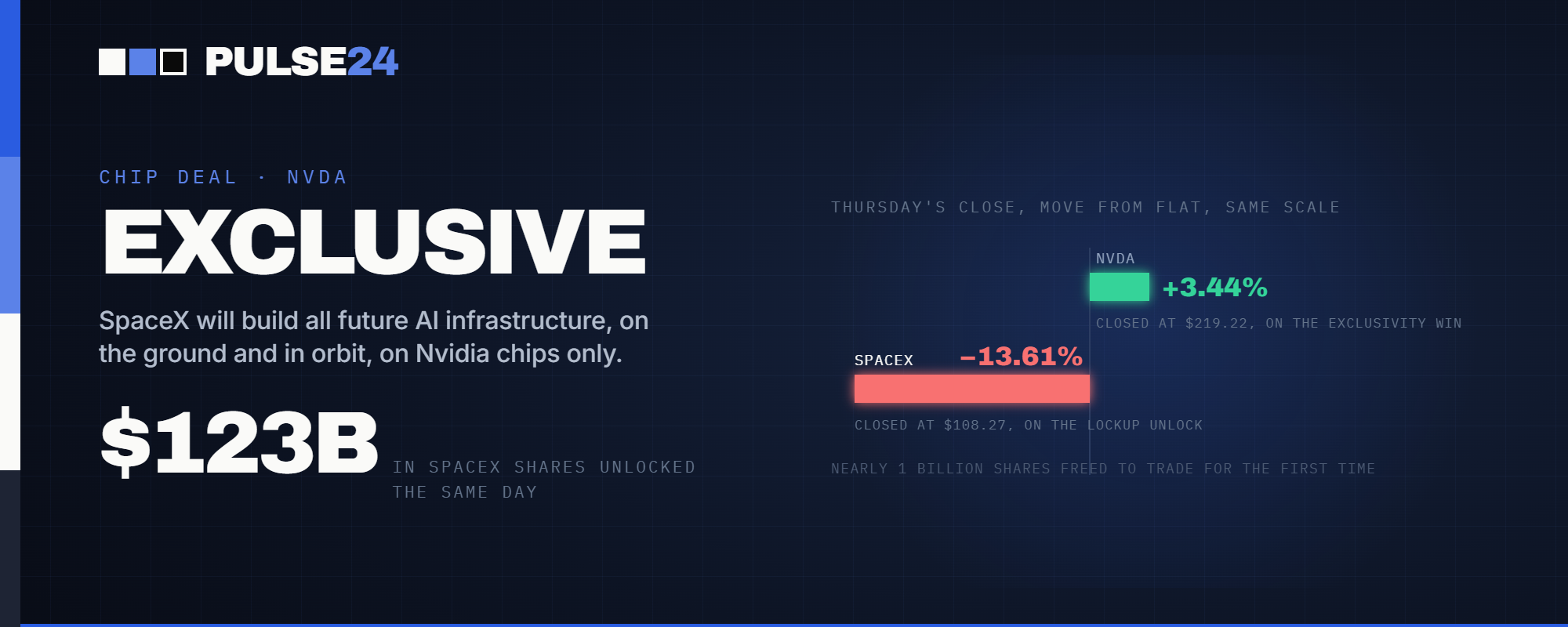
SpaceX said it will build all future AI infrastructure, on the ground and in orbit, exclusively on Nvidia chips. Nvidia rallied on the news, but SpaceX's own stock fell as nearly $123 billion in newly unlocked shares hit the market the same day.
Nvidia closed up 3.44% at $219.22 on Thursday. The catalyst was one sentence from Elon Musk: SpaceX will build all of its future AI infrastructure, on the ground and in orbit, exclusively on Nvidia hardware. SpaceX's own stock did not celebrate. Shares fell 13.61% to $108.27 on the same trading day.
The two moves happened within hours of each other, on headlines that ran side by side, which made it easy to read them as connected. They aren't, and untangling why matters for anyone trying to gauge whether the AI buildout is accelerating or wobbling this week.
What Changed
The deal centers on Starmind AI1, the first satellite in a proposed network of orbital AI data centers. It will carry Nvidia's Vera CPUs and Rubin GPUs, packaged in the Vera Rubin NVL72 rackscale system, the same architecture Nvidia is shipping to terrestrial data center customers. Musk was direct about the choice. "Going forward, we've decided to build exclusively on Nvidia, because we think the Vera Rubin architecture is the best architecture," he said. He added, "We're exclusive to Nvidia."
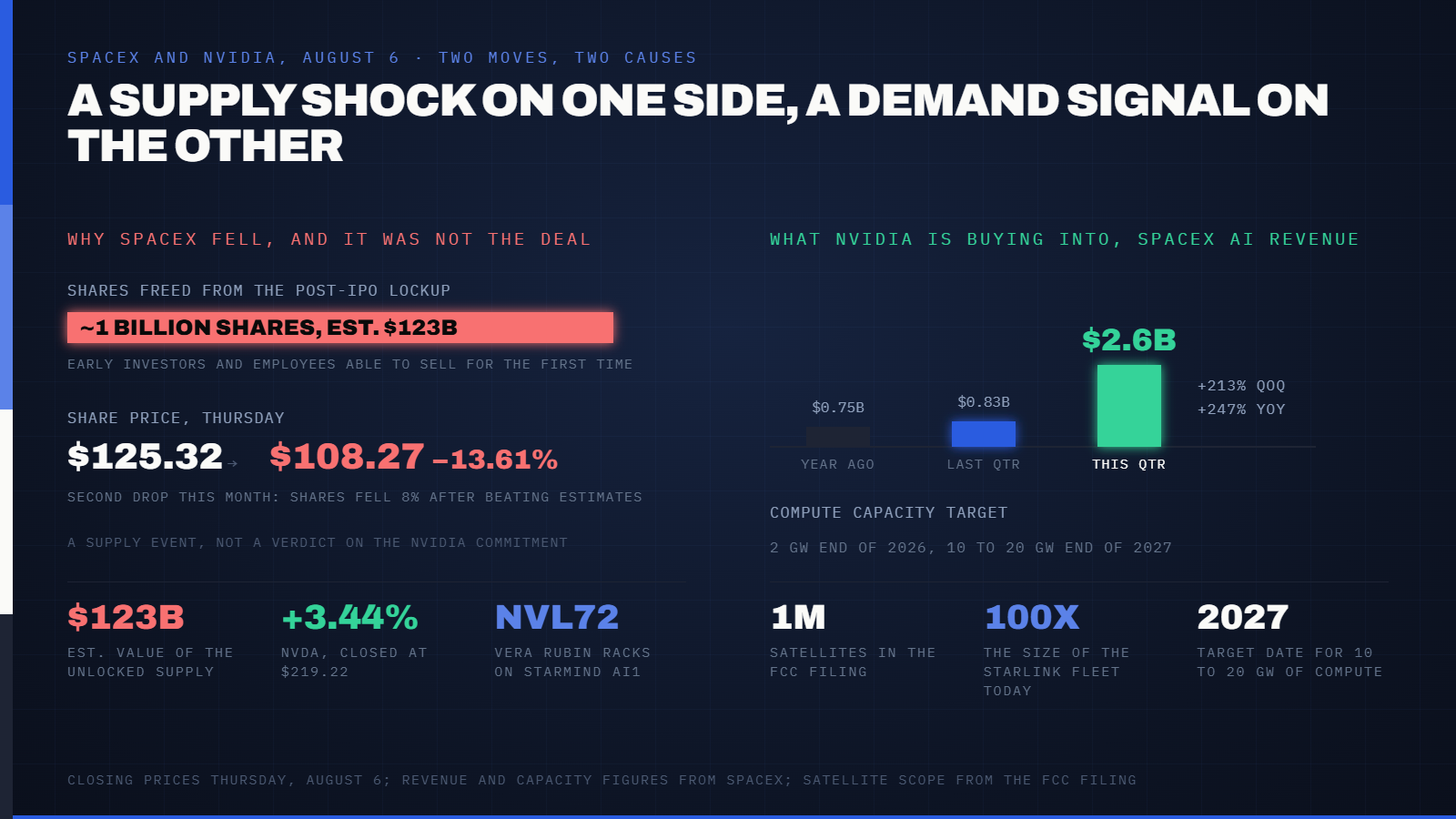
The ambition behind that single satellite is large. SpaceX has filed with the FCC for a megaconstellation of up to 1 million Starmind satellites, roughly 100 times the size of its current Starlink fleet. Musk said launches are targeted to begin next year, with the pitch resting on physics rather than marketing: orbit offers near-constant solar power and radiative cooling that doesn't require water or land, two of the biggest cost and permitting headaches for terrestrial AI data centers.
SpaceX's stock decline traces to a separate event entirely. Nearly 1 billion shares, worth an estimated $123 billion, unlocked from the company's post-IPO lockup on Thursday, freeing early investors and employees to sell for the first time. That kind of supply shock has hit newly public companies before, and it landed on the same day as the Nvidia headline, which made the two easy to conflate. SpaceX beat estimates earlier this month and still watched its shares fall 8%; this week's drop is a different mechanism producing a similar-looking chart.
Why It Matters
Markets have been treating Nvidia's order book as one of the cleanest reads on whether AI capital spending is real or overextended. AMD and SanDisk both beat estimates this month and still fell 7% and 6%, while Nvidia rose on both of those days; this SpaceX commitment fits the same pattern. When a major buyer locks in exclusivity with Nvidia rather than splitting orders across AMD, in-house silicon, or custom chips, investors tend to read it as a vote that the current architecture, and the capital tied to it, still has room to run.
The revenue behind that vote is growing quickly. SpaceX's AI-related revenue reached $2.6 billion last quarter, up 213% from the prior quarter and 247% from a year earlier, driven by cloud service agreements plus Grok and X subscription growth. The company has also signed multibillion-dollar compute leasing agreements with Google and Anthropic, positioning Starlink's satellite backbone as a landlord for AI workloads, not just a broadband provider.
What to Watch Next
Two timelines matter here, and they aren't the same length. Nvidia's exclusivity commitment shows up in quarterly revenue almost immediately. The orbital data center concept won't prove itself until satellites actually launch, which Musk has pointed to next year, and even that is an early estimate for a program still working through FCC approval for its full million-satellite scope.
Compute capacity is the number worth tracking from here. SpaceX is targeting more than 2 gigawatts by the end of this year, and management has pointed to a range of 10 to 20 gigawatts by the end of 2027, a wide enough band to show how uncertain that buildout still is. Pulse24 covered last week how markets started pricing in what AI infrastructure actually costs; the launch, insurance, and depreciation costs of a satellite data center are a new variable in that same math, and the market hasn't fully priced them yet.
The Pulse24 Take
The stock market delivered a clean verdict on the supplier and a messy one on the buyer, and both reactions were rational on their own terms. Nvidia's 3.44% gain reflects a real commercial win: one more large customer with no plans to hedge across chipmakers. SpaceX's 13.61% drop is mostly plumbing, a scheduled unlock of nearly a billion shares that had nothing to do with satellites or GPUs. The harder question is the one neither stock price answers yet. Building a data center in orbit solves for power and cooling, two genuine constraints on Earth, but it adds launch risk, radiation exposure, and a repair problem no terrestrial facility has to think about. That tradeoff won't clear up on the next earnings call. It clears up once the first Starmind satellite is actually in orbit and running, which by Musk's own timeline is still more than a year away.
How we read the data
Curious how we get from raw data to a take like this? Our Trader's Toolkit walks through the tools we lean on.
Explore the Toolkit