Pulse24 Original
AMD and SanDisk Both Beat Every Estimate This Week and Watched Their Stocks Fall 7% and 6%. Nvidia Rose Both Days.
August 6, 2026
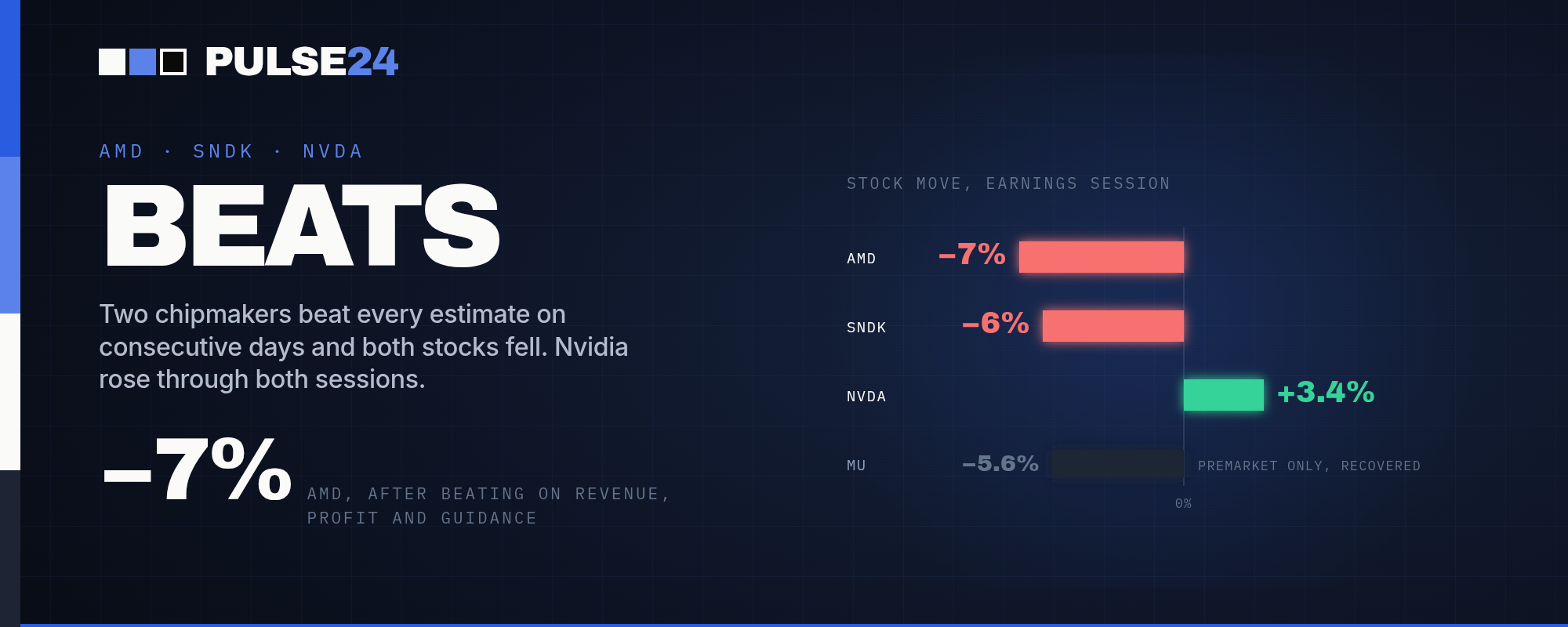
AMD beat on revenue, profit and guidance and fell 7% on a slower-than-hoped AI ramp. SanDisk beat by even wider margins and sank as much as 11% in premarket trading before settling closer to 6%. Nvidia climbed through both selloffs, and the gap between them says more about this market than either single earnings report does.
AMD's data center segment brought in $6.7 billion last quarter, more than double what it did a year earlier. Revenue, profit and guidance all beat Wall Street's numbers. The stock fell 7% anyway, closing Wednesday at $482.05.
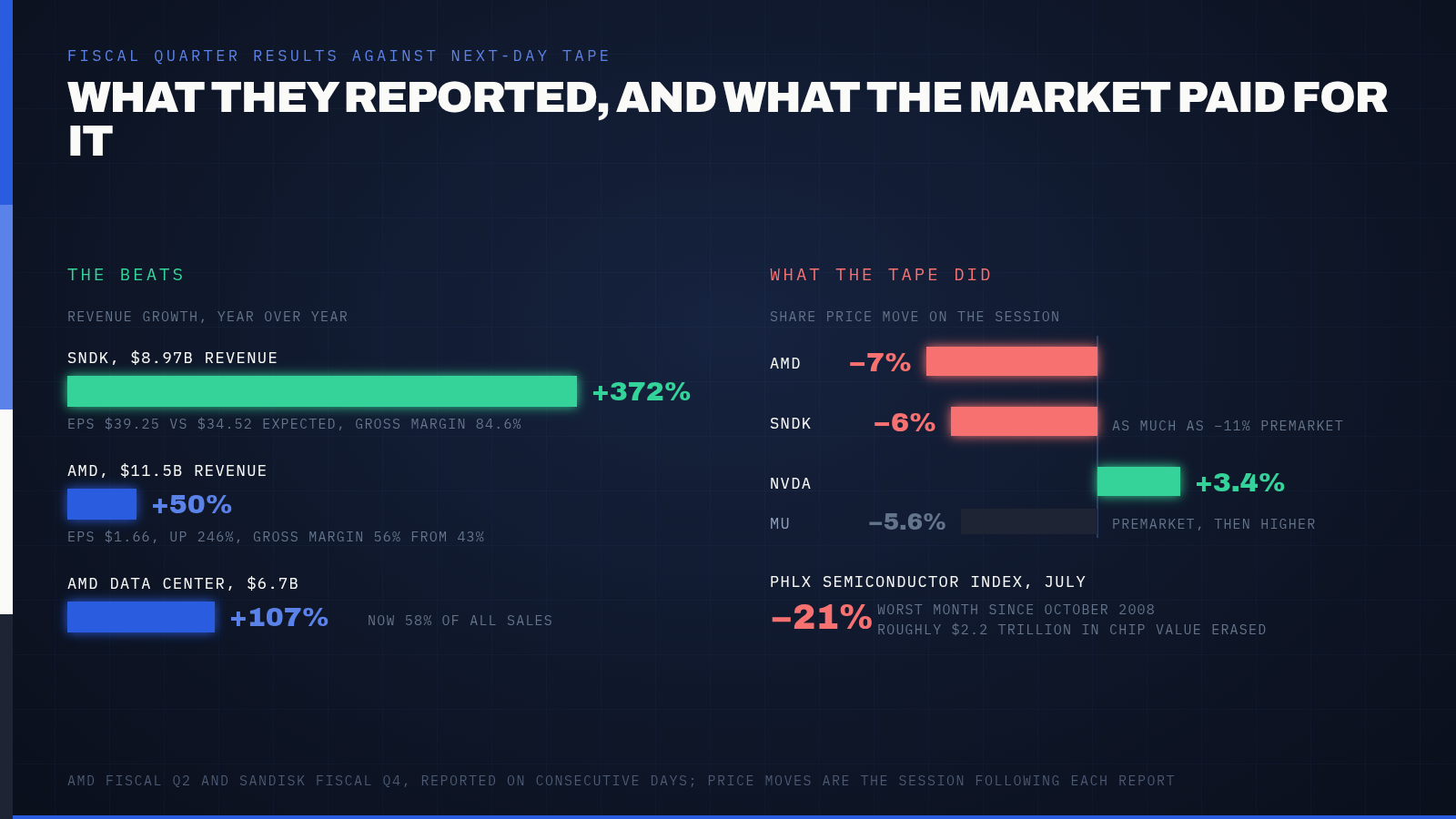
A day later, SanDisk did something similar on a bigger scale. Fiscal fourth-quarter revenue jumped 372% year over year to $8.97 billion, non-GAAP earnings per share came in at $39.25 against a $34.52 consensus, and gross margin hit 84.6%. Shares sank as much as 11% in premarket trading, and were still down nearly 6% once trading opened Thursday.
Two companies, two clean beats, two selloffs. Neither move looks like the AI trade breaking. Both look like the cost of a rally that had already priced in perfection, with investors deciding this quarter wasn't quite perfect enough to justify what the stock had already done.
What Changed
AMD's problem wasn't really the top line. Revenue came in at $11.5 billion, up 50% year over year and 13% sequentially, ahead of what analysts expected. Data center revenue, the segment tied most directly to EPYC server chips and Instinct AI accelerators, grew 107% and now makes up 58% of the company's sales. Non-GAAP earnings per share rose to $1.66, up 246% from a year earlier.
The margin story is more nuanced than the first headlines suggested. AMD's non-GAAP gross margin actually came in at 56%, up sharply from 43% a year earlier, and Q3 guidance calls for roughly the same 56% again. That's not a miss. What unsettled investors was the shipment timeline for Helios, AMD's new rack-scale AI system: CEO Lisa Su said the first units ship near the end of the third quarter, with a larger ramp in the fourth quarter and another step up in the first quarter of 2027. For a stock already priced for a faster AI buildout, a schedule that stretches meaningful volume into next year read as a delay rather than a confirmation.
Capital spending added to the unease. AMD's own capex came in at $808 million, up from $282 million a year earlier, the same tension an earlier look at SpaceX, Alphabet and Palantir's earnings found running through this entire earnings season: whether a company's spending is growing faster or slower than the revenue it's meant to produce.
Shay Boloor, chief market strategist at Futurum, put it plainly afterward: the rally into the print had already priced in something close to a blowout quarter, and a solid beat across the board wasn't enough to reset those expectations for a stock trading near 60 times earnings.
SanDisk's selloff followed a similar script one trading day later, on a far more extreme scale. The stock had climbed more than 500% year to date heading into Wednesday night's report, one of the largest single-name rallies anywhere in markets this year, built on a memory chip shortage that has pushed NAND and DRAM prices sharply higher through 2026.
The fiscal fourth-quarter numbers themselves were not the problem. Revenue beat the $8.39 billion consensus by more than half a billion dollars, and non-GAAP earnings per share beat estimates by roughly 14%. What disappointed was the outlook: guidance for the September quarter came in at $10.3 billion to $10.8 billion, a midpoint of $10.55 billion against a Street high end near $10.8 billion. After a rally that size, guidance that merely matched the top of expectations read to traders as guidance that fell short of them.
That pressure spilled into Micron too, briefly. Micron, which doesn't report its own results for several more weeks, fell as much as 5.6% in Thursday's premarket trading purely on the SanDisk read-through, before recovering to trade modestly higher once the session opened, a sign of how tightly, and how nervously, the market is now linking every memory name to every other one. SK Hynix's own results in late July set off a version of the same dynamic: a record operating margin of 76% and operating profit up 557% year over year, overshadowed by a plan to lift 2026 capital spending to a record $31 billion, which traders read as a sign of an overheating buildout rather than confirmation of durable demand.
Why It Matters
What's notable is who didn't fall, and who didn't stay down. Nvidia, still the most direct way to own the AI compute buildout, rose 3.4% on Wednesday, the same session AMD dropped 7%, and opened modestly higher again Thursday. Micron briefly dropped alongside SanDisk before the open, then recovered. SanDisk was the one name still meaningfully lower once trading actually got underway. If the market had simply turned against AI infrastructure spending as a category, all three would be falling together. They aren't.
That split matters more than either single-day move. It suggests investors are drawing a line between companies whose growth currently requires heavy, escalating spending to sustain (AMD's Helios ramp, SanDisk and Micron's capacity buildout) and a company whose scale and margin structure already clear a higher bar. It's a more selective market than the blanket "AI trade" framing usually allows for, and it's worth remembering the next time any chip stock reports.
There's also a real supply story underneath the sentiment-driven selling. Samsung warned in late July that the memory shortage could persist through 2028, and nothing in SanDisk's report contradicts that. The stock didn't fall because demand for memory is weakening. It fell because the share price had run further ahead of even a strong quarter than the quarter could support.
Zoom out and the pattern fits a rougher month than either of these two prints alone. The Philadelphia Semiconductor Index fell 21% in July, its worst month since October 2008, erasing roughly $2.2 trillion in market value across the sector. Nearly half of July's trading sessions closed with a move of 4% or more in the index, and every session carried an intraday swing of at least 2%, a level of volatility the sector hadn't seen since 2020.
What to Watch Next
Micron reports its own results in late September, and by then the market will have a clearer read on whether SanDisk's guidance was company-specific caution or an early signal for the broader memory complex. AMD's next test comes sooner. Its Q3 guidance of roughly $13 billion, itself a touch below the most bullish analyst estimates near $14 billion, becomes the number to beat when it reports again in early November. Nvidia's next earnings call, still weeks away, will show whether this week's relative resilience was a genuine vote of confidence or simply a matter of not having reported yet.
Watch the pace of forward guidance, not just the size of the beat, on any of these names. This week showed twice that a strong quarter buys very little patience if the guidance behind it doesn't clearly accelerate from here.
The Pulse24 Take
Two companies beat estimates this week by wide margins. Both watched their stocks fall by more than a normal earnings-day move. That's not evidence the AI infrastructure trade is over, and it's not proof that AMD or SanDisk did anything wrong. It's a market that has gotten pickier about what a beat needs to include.
A year ago, a 50% revenue jump, let alone a 372% one, would have been the headline on its own. Now investors read past it to gross margin trajectory, to capital spending relative to revenue, to whether guidance implies the good news is still building or just holding steady. Nvidia's calm reaction alongside AMD's and SanDisk's selloffs is the clearest evidence yet that this isn't a broad rejection of AI spending. It's a market drawing finer lines than it did a year ago, rewarding the names it trusts to convert spending into margin and pressing the ones still proving it. That's arguably a healthier market than one that buys every AI-adjacent beat without asking questions, even if it doesn't feel that way to anyone holding AMD or SanDisk this week.
How we read the data
Curious how we get from raw data to a take like this? Our Trader's Toolkit walks through the tools we lean on.
Explore the Toolkit