Pulse24 Original
China's Yuan Touched a Three-and-a-Half-Year High on Friday. Tuesday's Central Bank Fixing Delivered the Sharpest Pushback Since February.
August 25, 2026
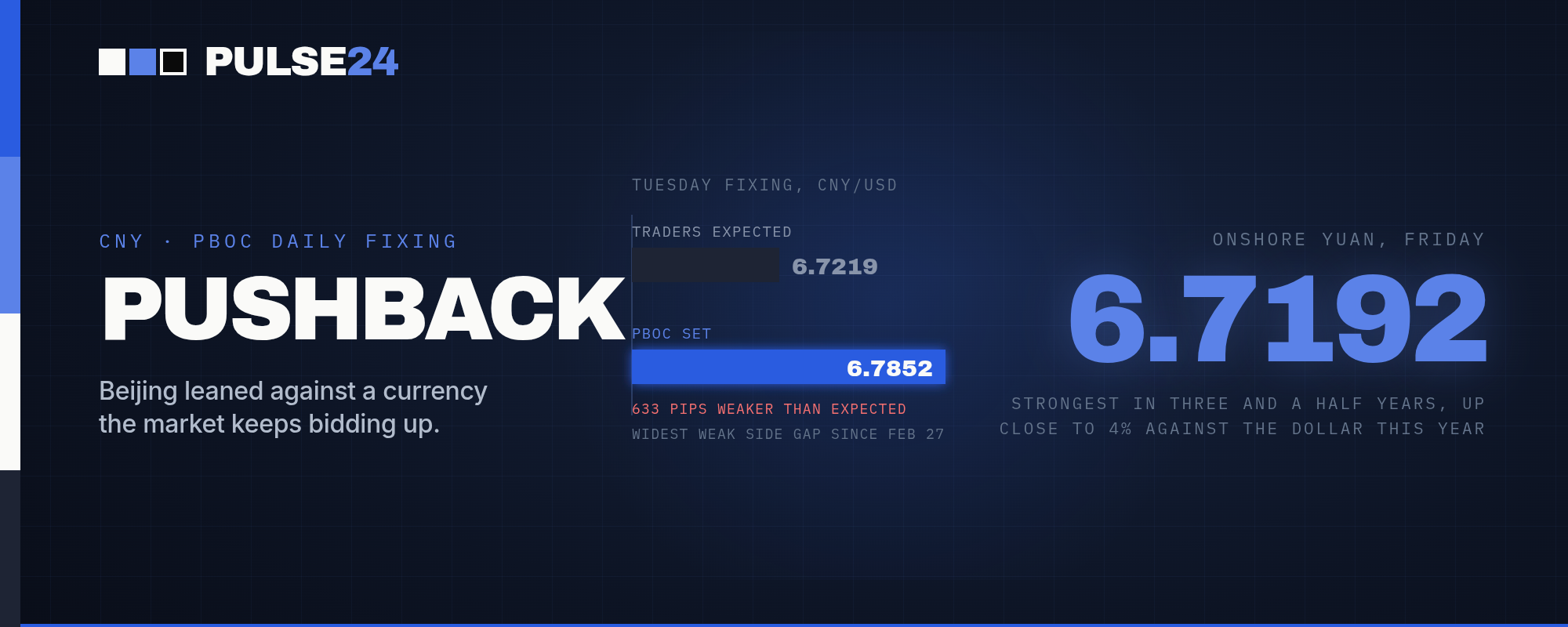
The onshore yuan hit its strongest level in three and a half years last week, and the PBOC answered with its biggest weak-side fixing gap since February. The pushback says as much about a divided Fed as it does about China.
The onshore yuan touched 6.7192 per dollar on Friday, a level China's currency hasn't reached in three and a half years. That put it among the best-performing currencies in Asia this year, up close to 4% against the dollar even as the greenback struggles broadly. Beijing did not look pleased about it.
What Changed
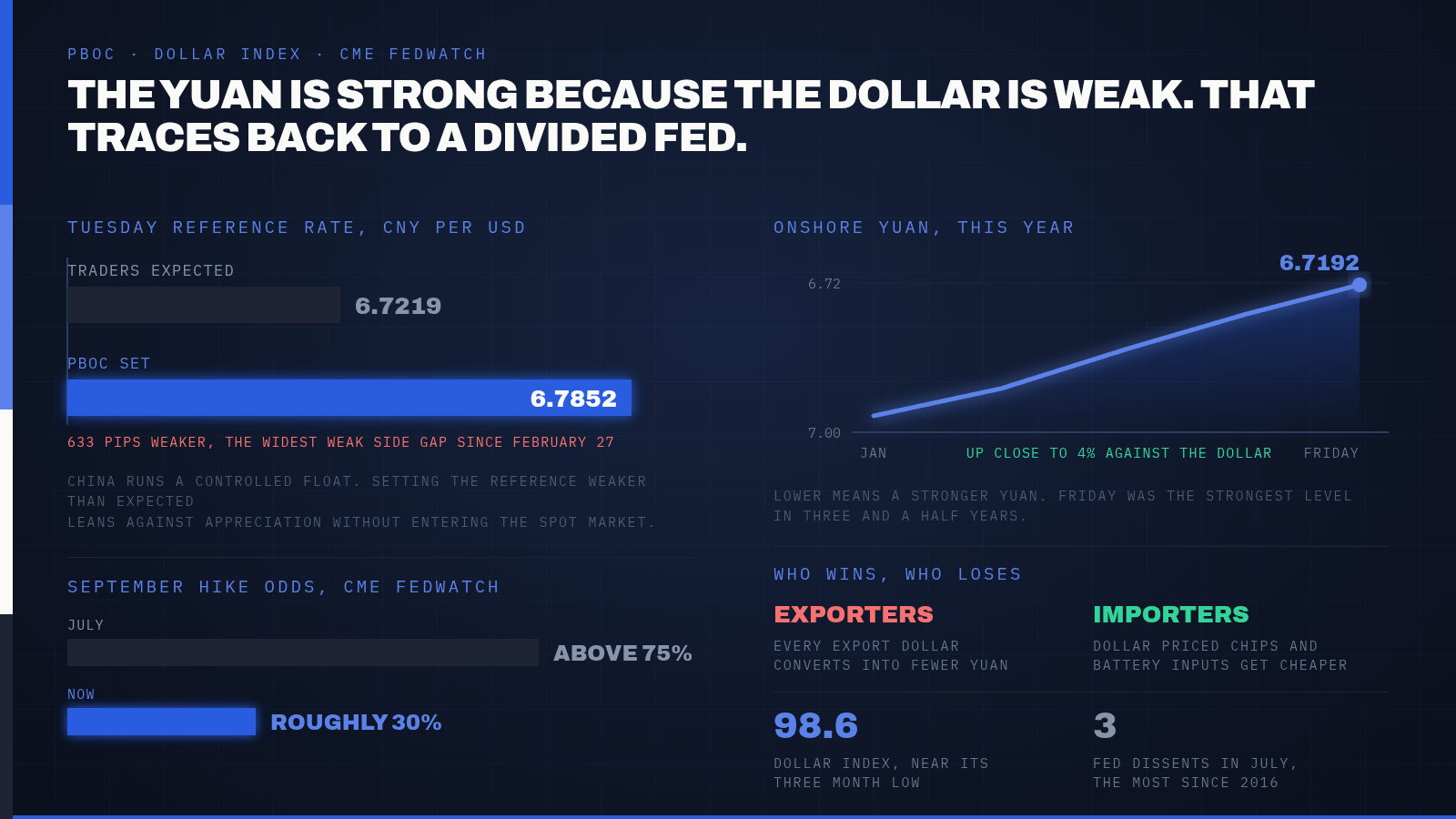
On Tuesday, the People's Bank of China set its daily reference rate at 6.7852 per dollar. Traders had expected something closer to 6.7219. The 633-pip gap between the two was the largest weak-side deviation the central bank has engineered since February 27.
China manages the yuan through a controlled float rather than a free-floating exchange rate. Each morning, the PBOC sets a reference point and lets the currency trade within a band around it. Setting that reference weaker than the market expects is a way of leaning against further appreciation without wading into the spot market directly. Chinese banks had already nudged dollar deposit rates higher earlier this year for a similar reason: making it marginally less attractive to hold yuan over dollars.
None of this is happening in isolation. The Dollar Index has been sliding for weeks and last traded near 98.6, not far from the three-month low it touched days earlier. That weakness traces back to a Federal Reserve that looks more divided than it has in years. Three regional presidents dissented in favor of a rate hike at July's meeting, the first time that many policymakers broke from the majority since 2016.
Traders are now pricing roughly a 30% chance of a September rate hike, down from above 75% just weeks earlier. Kevin Warsh's Friday appearance at Jackson Hole, his first as Fed chair, is likely to move those odds again.
Why It Matters
A stronger yuan is a mixed blessing for China, and the mix isn't even across the economy. Exporters running assembly operations on thin margins feel the appreciation almost immediately. Every dollar of export revenue converts into fewer yuan, and for a factory clearing single-digit margins, a move of this size can be the difference between a profitable order and a break-even one.
Importers see it from the other side. Companies buying dollar-priced chips, battery materials, or industrial inputs get those goods cheaper in yuan terms when the currency strengthens. Given how much of China's manufacturing base now runs through semiconductor and battery supply chains still priced globally in dollars, that offset is not small.
There is a broader signal buried in the currency move too. A currency does not drift to a multi-year high by accident. Capital has been finding its way into yuan-denominated assets, helped along by relative returns in China's own bond and equity markets and by a softening dollar that makes almost every other major currency look stronger by comparison. The PBOC's pushback suggests policymakers are more worried about losing export competitiveness than they are pleased about a stronger currency signaling investor confidence.
What to Watch Next
Kevin Warsh's Friday appearance at Jackson Hole is the next scheduled catalyst on the dollar side of this trade. A hawkish tone from Warsh would likely support the dollar and take some pressure off the yuan, while a more dovish one could send the PBOC back to the fixing lever again next week.
Also worth tracking is whether Tuesday's fixing actually holds the yuan below 6.72, or whether the currency grinds back toward Friday's high regardless. Beijing has shown before that one strong fixing does not always stop a trend once capital flows are moving in a single direction. If the yuan keeps climbing despite the pushback, that would suggest the pressure is coming from broad dollar weakness more than anything specific to China, and the PBOC may need more than a fixing surprise to slow it down.
The Pulse24 Take
Currency moves rarely draw the attention a big stock swing does, but this one is worth watching because it sits at the intersection of two stories investors already care about: a Federal Reserve that cannot agree on its next move, and a Chinese economy trying to protect exporters while its own capital markets pull in outside money. The PBOC's fixing gap is small in absolute terms, a few hundred pips on a currency pair most Americans never look at. But the size of the signal is bigger than the size of the move. When a central bank breaks from its recent pattern to lean against a trend, it usually means the trend has gone further, or faster, than policymakers are comfortable with. Whether the pushback works will depend less on Beijing than on what Kevin Warsh says from a podium in Wyoming this week.
How we read the data
Curious how we get from raw data to a take like this? Our Trader's Toolkit walks through the tools we lean on.
Explore the Toolkit