Pulse24 Original
U.S. Layoffs Are Down 39% This Year. AI Still Caused One in Five of Them.
October 3, 2026
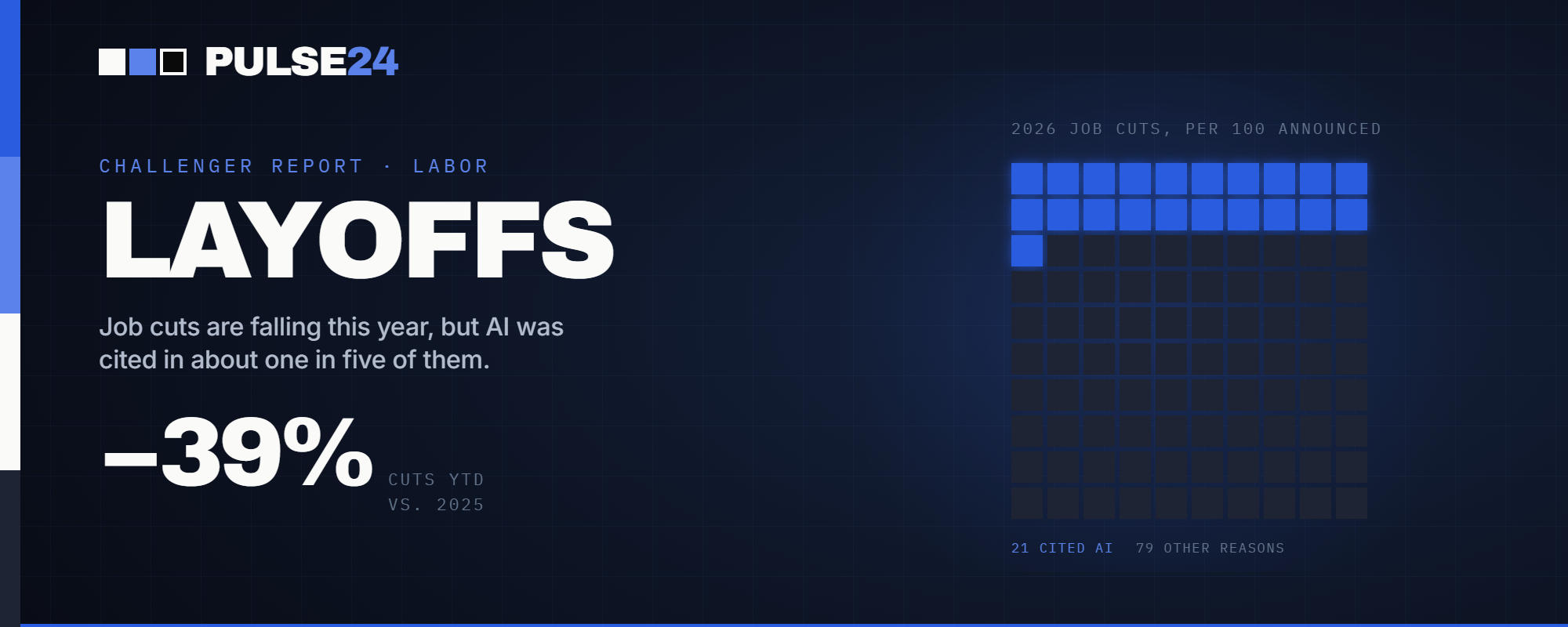
Companies have announced 39% fewer layoffs through September than at this point last year, and hiring plans are actually running ahead of 2025. But AI was still cited in roughly one in five of this year's job cuts, concentrated in tech, where the disruption looks structural rather than cyclical.
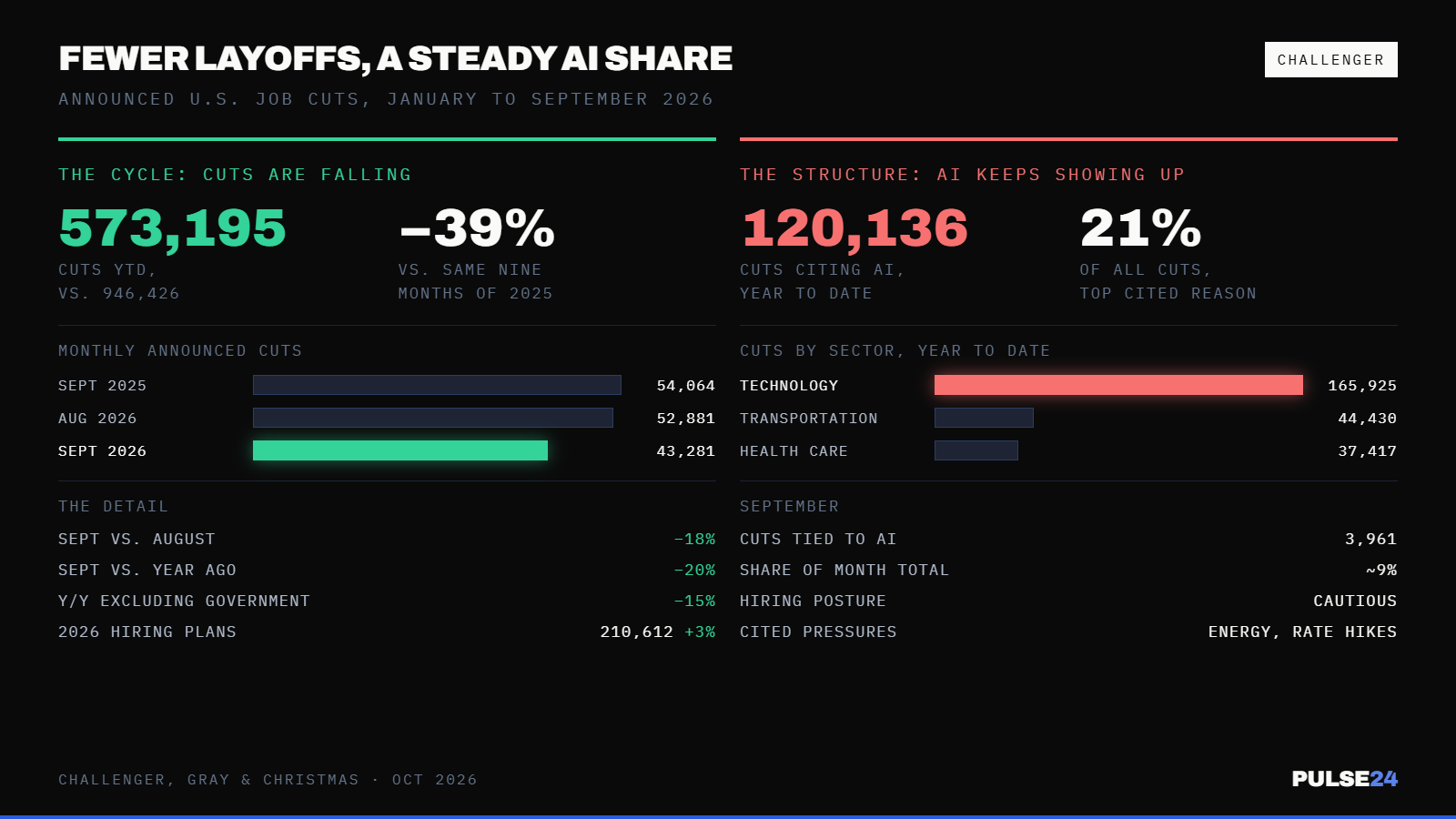
Employers announced 43,281 job cuts in September, Challenger, Gray & Christmas said this week. That's down 18% from August's 52,881 and down 20% from the 54,064 cut in September a year ago. Broaden the lens to the full year and the pattern holds: 573,195 job cuts have been announced through September, 39% below the 946,426 recorded over the same nine months of 2025.
What Changed
The headline number is reassuring on its face. Layoffs are down across almost every comparison available, hiring plans for 2026 have edged up 3% to 210,612 workers, and even excluding government cuts tied to this year's funding fights, the year-over-year decline still runs 15%. Stop reading there and the conclusion is simple: the labor market is cooling in an orderly way, exactly the kind of story that lets a cautious Fed stay cautious.
But the reason companies give for the cuts they are making tells a second story sitting underneath the first. AI was cited in 120,136 of this year's layoffs, roughly one in five, more than any other single reason on Challenger's list. Technology remains the sector doing most of the cutting, with 165,925 announced job cuts so far this year, well ahead of transportation's 44,430 and health care's 37,417. September alone saw 3,961 cuts tied directly to AI, about 9% of that month's total.
Why It Matters
Two trends sitting side by side like this are easy to flatten into one story, and that would miss the point. Overall layoffs falling is a cyclical signal. It tracks how nervous companies feel about near-term demand, financing costs, and the broader economy. AI-driven cuts look structural instead. They keep showing up steadily, month after month, regardless of whether the headline total is rising or falling. Andy Challenger, the firm's senior vice president, described companies as being in "a wait-and-see period right now," citing elevated energy costs and the possibility of further rate hikes as reasons hiring has stayed "very cautious."
That split matters for how investors read the labor market this earnings season. A falling headline layoff number supports the market's working theory that the economy is landing softly even as the Fed weighs another hike rather than a cut. But a persistent, rising AI component inside that falling total is a separate signal entirely, one about which jobs get rebuilt once the cycle turns and which don't. Technology companies have managed to be simultaneously the biggest source of job cuts this year and the biggest source of capital spending growth, a combination that would have looked contradictory in any previous cycle.
What To Watch Next
Watch whether AI's share of total cuts keeps climbing as a percentage even if the raw number of layoffs keeps falling. A rising share alongside a falling total would be the clearest sign yet that AI-driven restructuring has become a permanent fixture of corporate cost management rather than a one-time adjustment. Also worth tracking: whether hiring plans, currently running ahead of last year, actually convert into filled positions outside of technology. Challenger's data counts announced hiring intentions, not completed hires, and the gap between the two has widened before.
The Pulse24 Take
Numbers that move in opposite directions inside the same report are usually more informative than numbers that move together. A falling layoff total and a rising AI share aren't contradicting each other. They're describing two different processes that happen to be running at the same time. One is the ordinary business cycle easing off after a stretch of caution. The other is companies rebuilding how they staff entire functions, and that process doesn't reverse just because GDP picks up next quarter. Investors pricing AI purely as a capex story, more chips, more data centers, more electricity demand, are only getting half of it. The other half shows up in reports like this one, in the quiet reallocation of nearly a quarter million jobs a year toward a technology that barely existed as a line item five years ago.
How we read the data
Curious how we get from raw data to a take like this? Our Trader's Toolkit walks through the tools we lean on.
Explore the Toolkit