Pulse24 Original
September Payrolls Came In at 29,000, Not 90,000. October Rate Hike Odds Fell to 17%.
October 2, 2026
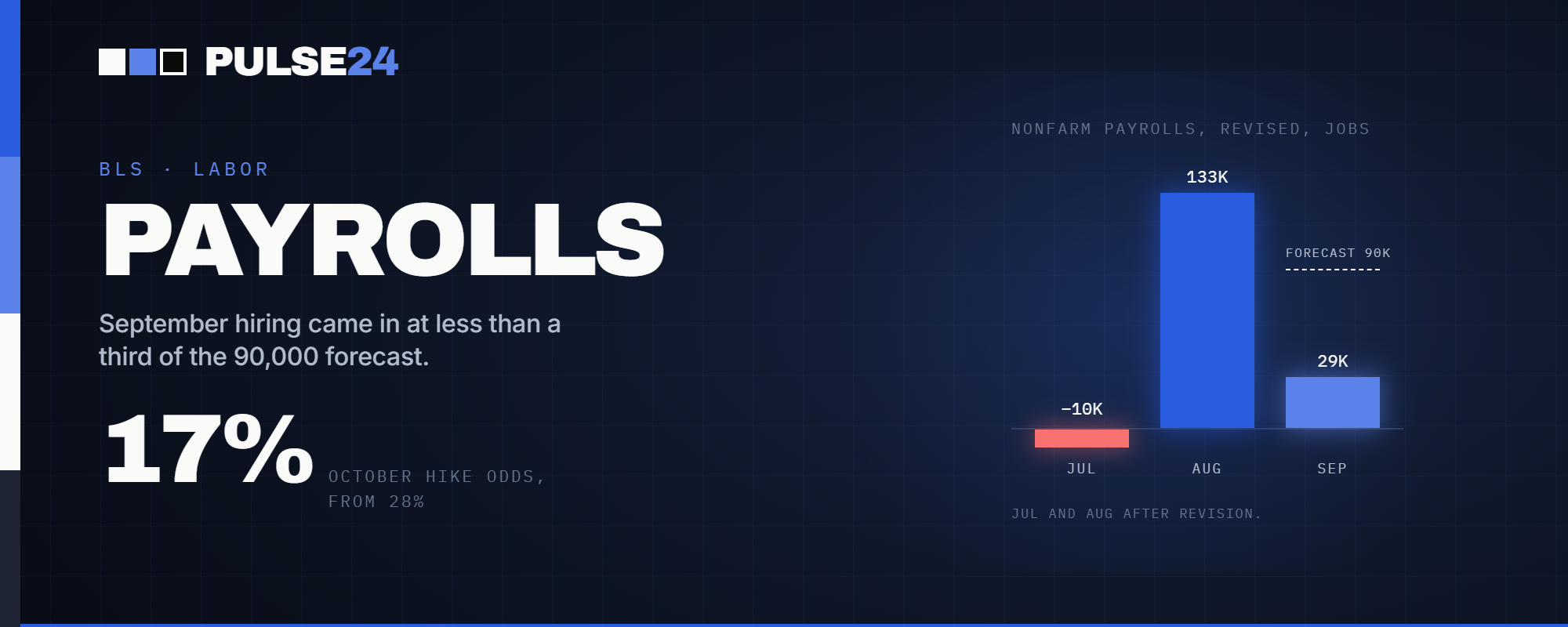
September payrolls came in at just 29,000 against a forecast of 90,000, and two months of revisions erased another 60,000 jobs from the books. October rate hike odds fell to 17% within minutes, while gold, Bitcoin, and Treasury yields all moved to price in a Fed that's done tightening.
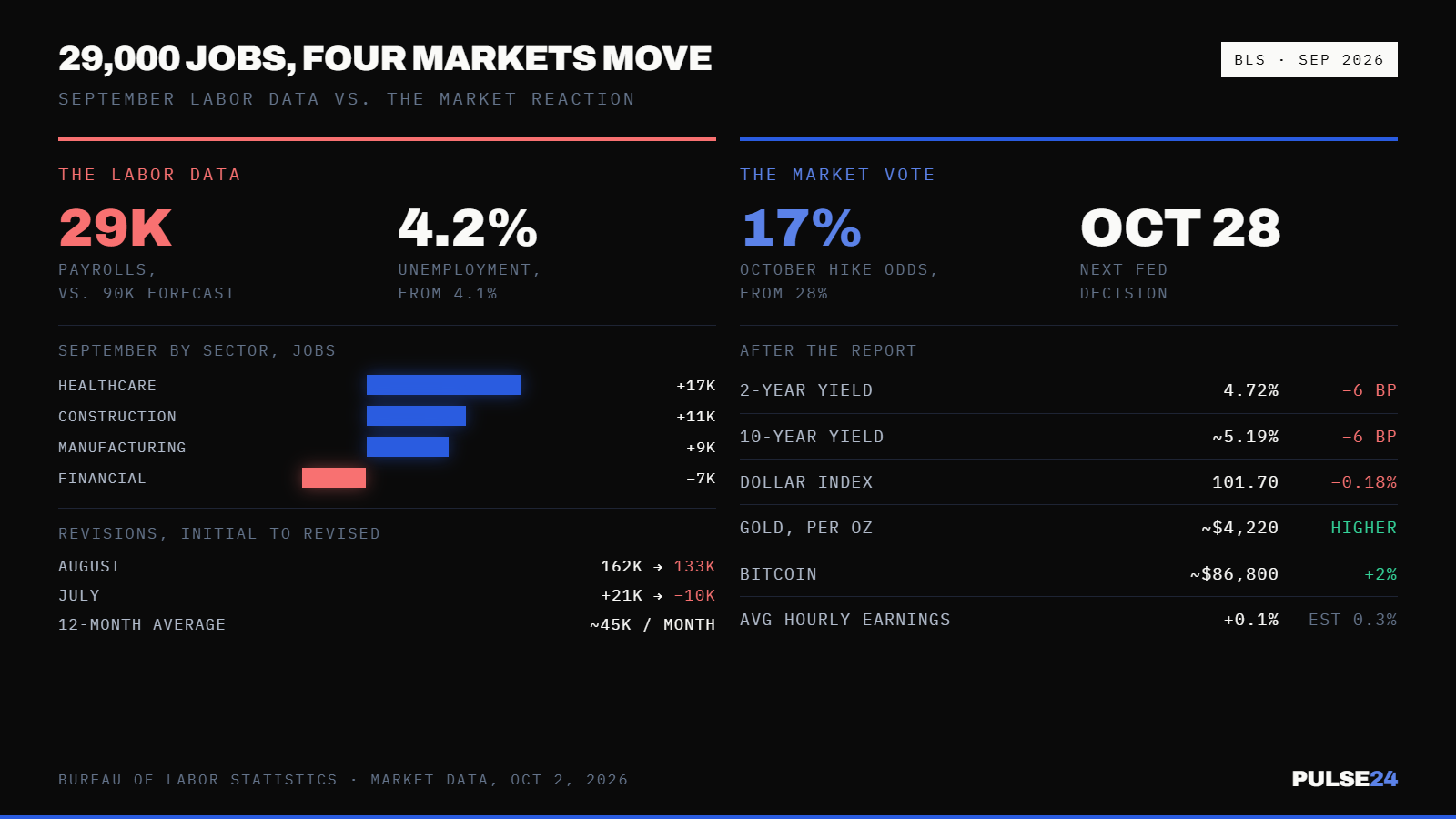
The U.S. economy added 29,000 jobs in September, the Bureau of Labor Statistics reported Friday, less than a third of the 90,000 economists had forecast. Unemployment rose to 4.2% from 4.1%, and wage growth cooled too, with average hourly earnings up just 0.1% on the month against an expected 0.3% gain. Within minutes, traders cut the odds of an October Fed rate hike from 28% to 17%.
What Changed
Private payrolls told a similarly weak story, rising 46,000 against a forecast of 85,000. Healthcare added 17,000 jobs and construction added 11,000, continuing to carry the headline number the way they have most of this year. Financial activities lost 7,000 positions, and manufacturing managed only 9,000, a sign that the sectors most exposed to higher borrowing costs are still shedding workers even as the broader economy avoids outright contraction.
The revisions hurt more than the headline miss. August's initial estimate of 162,000 new jobs was cut to 133,000, and July's reading flipped from a positive 21,000 to a negative 10,000. Combined, that's 60,000 fewer jobs than previously reported across two months, pulling the trailing 12-month average down to roughly 45,000 a month, a pace that would have looked recessionary at almost any point in the last decade.
Rates markets reacted quickly. Six basis points came off the 2-year Treasury yield, the maturity most sensitive to Fed policy, pulling it down to 4.72%. A similar move took the 10-year to roughly 5.19%, a retreat from the 24-year high it touched two days earlier, when ISM's prices-paid index jumped nearly seven points and Minneapolis Fed President Neel Kashkari argued current policy still isn't providing much restraint. The dollar index eased 0.18% to 101.70, giving back a sliver of its own multi-year highs.
Why It Matters
A weak jobs report landing one day after a dovish Fed signal builds on a trend rather than breaking from it. October rate-hike odds had already fallen from 70% to 51% earlier in the week after New York Fed President John Williams said there's no rush to move again, and Friday's payroll miss gave that argument fresh ammunition. Markets had spent much of September pricing in another hike even as hiring slowed beneath them. Today's data makes that bet look increasingly out of step with the underlying economy.
Both gold and Bitcoin read the data as dovish. The metal climbed toward $4,220 an ounce on the news, while Bitcoin jumped roughly 2% to near $86,800, finally clearing the $85,000 level that eight straight days of ETF inflows couldn't push it through earlier in the week. Lower hike odds mean a lower real-rate headwind for both assets, and today's miss looks like the clearest signal yet that the Fed's hiking cycle is closer to its end than its middle.
What to Watch Next
The Fed's next decision lands October 28. A 17% chance of a hike is not zero, and a single jobs report, however weak, rarely settles a debate this close on its own. Watch for public remarks from Fed officials between now and then, particularly whether policymakers who have argued more hikes are still needed change their tone in light of today's numbers.
Next week's data will matter more than usual. Confirmation of this pace of softening in jobless claims or the next ADP report could push the 17% hike odds lower still. A rebound, on the other hand, would make today's report look like a single soft print inside an otherwise resilient labor market, the kind every expansion produces a few times without it marking a turn.
The Pulse24 Take
A payrolls miss this size, paired with 60,000 in downward revisions, is the kind of data that changes minds slowly and then all at once. The Fed had spent September signaling it still had room to tighten, and gold, Bitcoin, and the Treasury curve all leaned the other way the moment the number hit the tape. Whether this becomes the moment the Fed pauses for good or just a pause in the pause, the next few data points matter more than this one does by itself. For now, the message from four different markets, at the same time, is hard to read as anything but a vote for a central bank that is done hiking, or very close to it.
How we read the data
Curious how we get from raw data to a take like this? Our Trader's Toolkit walks through the tools we lean on.
Explore the Toolkit