Pulse24 Original
Bitcoin ETFs Have Pulled In $3 Billion Over Eight Straight Days. The Price Still Can't Clear $85,000.
September 30, 2026
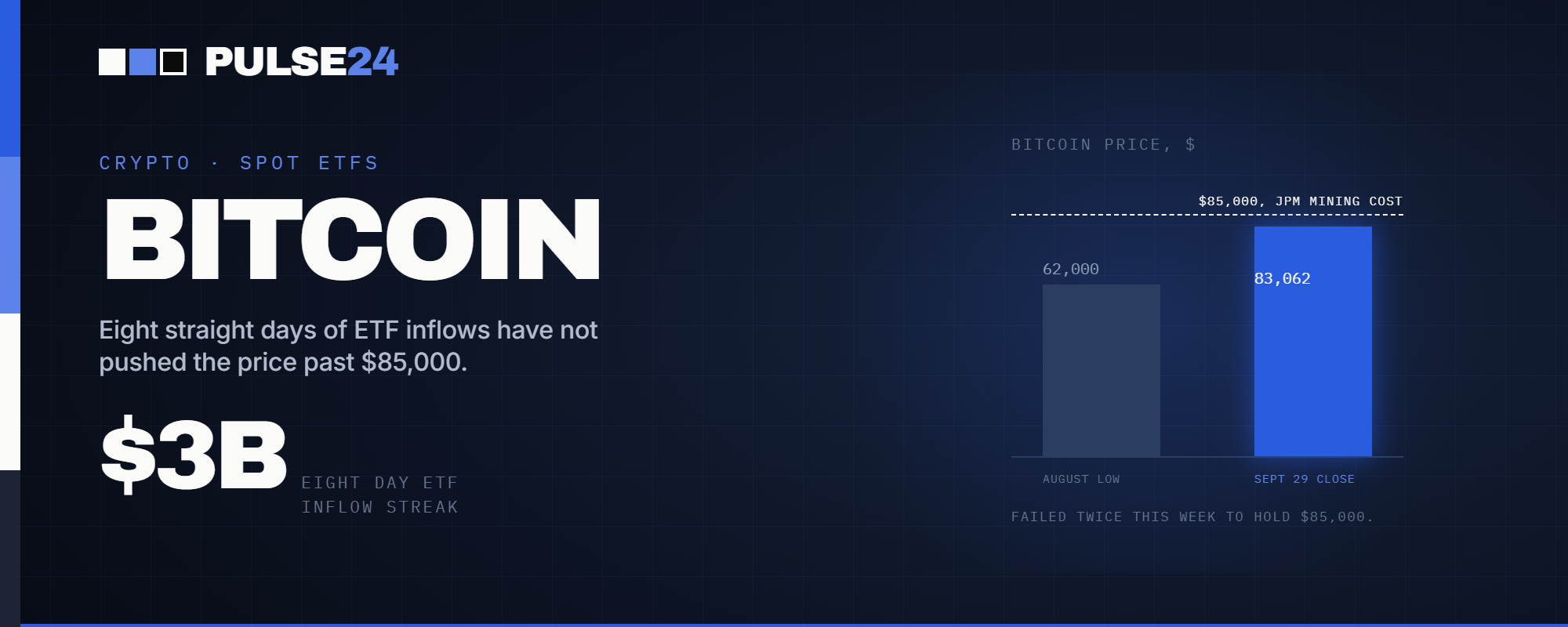
Eight straight days of Bitcoin ETF inflows have added up to roughly $3 billion, but Monday's addition was just $31 million, a fraction of the $2.39 billion the funds pulled in the week before. The price still can't close above $85,000, the same level JPMorgan pegs as the average cost to mine one coin.
Eight consecutive trading days of net inflows into U.S. spot Bitcoin ETFs have added up to close to $3 billion since September 17. The pace has slowed considerably from where it started. Monday brought in just $31.07 million, a small fraction of the $2.39 billion the same group of funds absorbed in the single week ending September 25, itself the strongest weekly haul since October 2025. A streak this long is unusual. One that keeps shrinking by the day is the more interesting part of the story.
What Changed
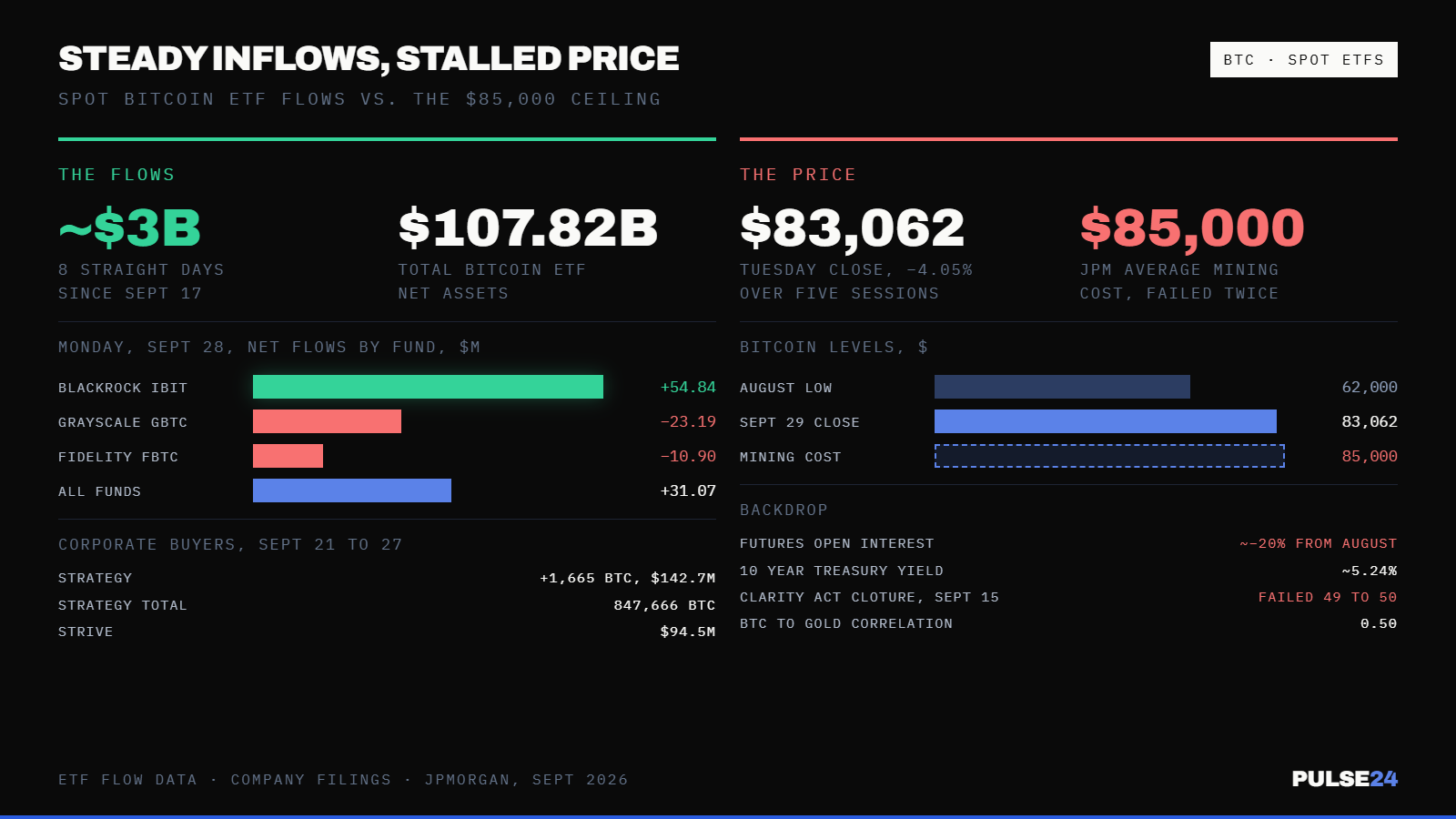
The money isn't spread evenly. BlackRock's IBIT took in $54.84 million on Monday alone, while Grayscale's GBTC gave back $23.19 million and Fidelity's FBTC lost $10.90 million. Total net assets across the Bitcoin ETF complex now sit at $107.82 billion. That concentration matters: a streak driven mostly by one fund reads differently than one spread across the whole product category, and it suggests the newest money is following a narrower set of institutional mandates rather than broad retail enthusiasm.
Corporate buyers kept pace alongside the funds. Strategy, the software company that has rebuilt itself around a Bitcoin treasury, added 1,665 BTC for roughly $142.7 million between September 21 and 27, on top of 950 BTC the week before. Its holdings now stand at 847,666 BTC, still the largest Bitcoin position held by any public company. Strive, a smaller asset manager pursuing a similar strategy, added $94.5 million of its own over the same stretch.
None of that buying has been enough to push the price through resistance. Bitcoin closed Tuesday near $83,062, down 0.51% on the day and 4.05% over five sessions, and has twice failed this week to hold above $85,000. That figure isn't arbitrary. JPMorgan estimates the average cost to mine a single Bitcoin at close to $85,000, which means every mining operation with above-average costs is currently unprofitable at the margin and under pressure to sell existing reserves to cover electricity and financing bills. Futures open interest has fallen nearly 20% from August levels, a sign that leveraged speculative positioning has thinned out even as spot demand from ETFs and corporate buyers has held up.
Why It Matters
A hawkish Federal Reserve is normally bad news for an asset that pays no yield. The Fed has been raising rates rather than cutting them this year, and the 10-year Treasury yield sits near 5.24%, its highest level since 2007 that Pulse24 has tracked as October rate hike odds climbed past 70%. Higher real yields usually pull money out of non-yielding assets and into bonds. Bitcoin's ETFs are doing the opposite right now, and the explanation on offer from strategists leans less on short-term liquidity and more on a longer-horizon hedge: the U.S. national debt crossed $40 trillion in August, and a growing number of institutional allocators appear to be treating Bitcoin the way they'd treat gold, as insurance against a currency that keeps getting printed against a debt load that keeps growing.
That framing lines up with how Bitcoin has been trading relative to other assets. Its correlation with gold climbed to 0.50 this month while its link to the Nasdaq fell to 0.30, a shift that points toward Bitcoin behaving more like a macro hedge and less like a leveraged bet on tech earnings. Two weeks ago the same ETFs were shedding money. Bitcoin funds lost $746 million over two sessions in mid-September right after that month's Fed hike, and the price barely moved while it happened. The swing from that outflow to this inflow streak, without a matching swing in the price, says the flows and the spot price are being driven by different clocks: fast institutional rebalancing on one side, a slower tug-of-war between miner economics and hedging demand on the other.
What to Watch Next
September 30 marks month-end, a point where funds sometimes rebalance positions regardless of their view on the asset, so a soft final session shouldn't be read as a verdict on the streak by itself. The more durable question is whether IBIT's outsized share of the inflows continues, or whether Grayscale and Fidelity stabilize and broaden the base of demand. A streak concentrated in a single product is more fragile than one spread across the category.
Regulation remains the wild card. The CLARITY Act failed its Senate cloture vote 49 to 50 on September 15, short of the 60 votes needed to advance, and lawmakers are still arguing in public over whether the bill is dead or can be revived this session. Until that resolves, the same institutions adding to ETF positions are doing so without the market structure clarity the bill was designed to provide. Beyond that, the Fed's October decision is the next obvious catalyst. If the hike that futures markets are pricing at better than 70% odds actually lands, watch whether Bitcoin can hold its current range or whether higher yields finally start pulling on crypto the way textbook logic says they should.
The Pulse24 Take
The headline number here, eight days and $3 billion, undersells how much the composition of that money has shifted underneath it. A week that started with $2.39 billion in five days is now adding barely $31 million in a single session, and nearly all of that is coming from one fund. Call it a return to a more normal, grinding pace of accumulation after an unusually strong week, especially with Strategy and Strive still buying through the same stretch. Demand hasn't disappeared. It has settled into a lower gear. The more useful test isn't the length of the streak, whether it reaches nine days, ten, or breaks tomorrow. Can spot demand keep absorbing the supply coming from miners near their breakeven cost and from long-term holders taking profit, without any help from lower yields? Right now it's doing that job alone, against a Fed that shows no sign of making it easier.
How we read the data
Curious how we get from raw data to a take like this? Our Trader's Toolkit walks through the tools we lean on.
Explore the Toolkit