Pulse24 Original
For the First Time Since 2021, Every Sector in the S&P 500 Is Set to Post Earnings Growth. AI Capex Is the Reason Why.
September 28, 2026
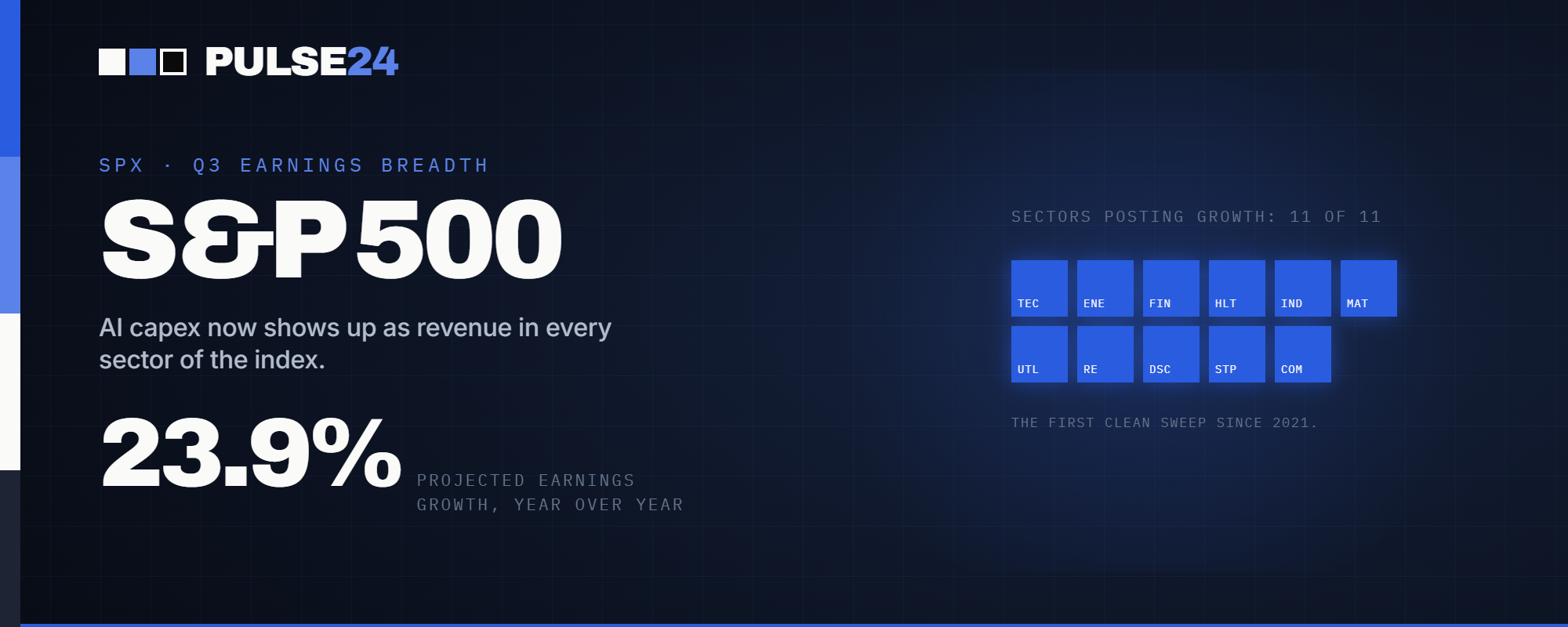
Every one of the S&P 500's eleven sectors is projected to post earnings growth this quarter, a breadth the index hasn't shown since 2021. Strategists at Wells Fargo and Barclays say the common thread is AI capital spending large enough to show up as revenue everywhere from data center catering contracts to industrial parts suppliers.
Eleven for eleven. That's how many of the S&P 500's sectors Bloomberg Intelligence expects to post earnings growth this quarter, the first time every sector has cleared that bar since 2021, when corporate profits were climbing back from the pandemic floor. Technology is carrying the biggest number, but it isn't carrying the index alone anymore. Energy earnings are projected up 111.5% year over year. Banks are expected to post double-digit gains. Healthcare, which had been shrinking for much of the past year, is set to return to growth.
What Changed
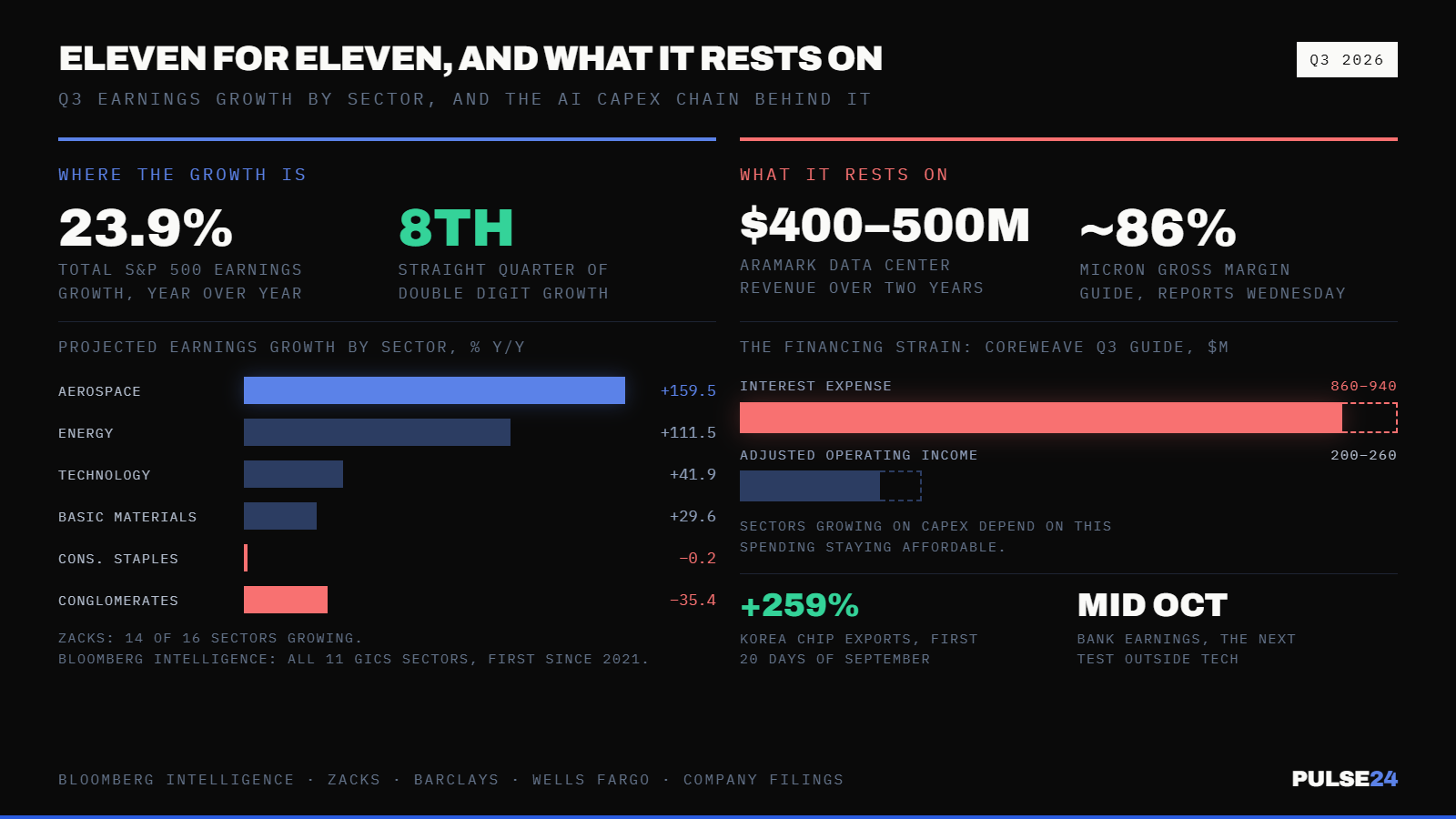
Wells Fargo's chief equity strategist, Ohsung Kwon, has been watching this shift build for two quarters. He has noted that last quarter's earnings beats were no longer concentrated in the handful of AI-exposed megacaps that carried the market through 2024 and 2025. Non-AI companies were beating estimates too, and by comparable margins. Zacks Investment Research's own numbers, published September 28, back that up: of the 16 sectors it tracks, 14 are projected to post earnings growth this quarter, led by Aerospace at 159.5% and Energy at 111.5%, with Technology up 41.9% and Basic Materials up 29.6%. Total S&P 500 earnings are projected to rise 23.9% year over year, which would make this the eighth consecutive quarter of double-digit growth for the index.
Barclays' head of U.S. equity strategy, Venu Krishna, points to a specific mechanism behind the broadening. Hyperscaler AI capital spending has grown so large, he argues, that it now functions as direct revenue for entire industries that have nothing to do with building chatbots. Storage suppliers, hardware makers, industrial parts manufacturers, energy producers and utilities are all picking up business that traces back to a handful of companies building data centers. Aramark is the clearest example so far: the food-service company raised its own earnings guidance twice this year after signing catering and facilities contracts tied to new data center campuses, deals expected to bring in $400 million to $500 million in additional revenue over two years. That's a services company benefiting from an AI buildout it has no direct stake in, simply because someone has to feed the people building and running the data centers.
Why It Matters
If the earnings growth were still confined to a handful of chipmakers and cloud platforms, the bull case for this market would rest on a narrow foundation: a few companies would have to keep beating already-elevated expectations quarter after quarter. Broader participation changes that math. It means the market's gains have more support underneath them, spread across sectors that don't share the same valuation risk or the same dependence on capex budgets staying at current levels.
That last point is also the catch. The mechanism Krishna describes only works as long as the capital spending keeps flowing. Some of that spending is now being financed with debt that costs more than it used to. SoftBank is paying record yields to fund its OpenAI-related commitments, and CoreWeave's own third-quarter guidance already puts its interest expense several times higher than its projected operating income. If AI infrastructure financing gets meaningfully more expensive, or capex growth simply slows from its current pace, the sectors now benefiting as secondary beneficiaries would feel it, not just the AI platforms themselves. Zacks' own numbers already show two sectors moving the other direction: Conglomerates are down 35.4% and Consumer Staples are down 0.2% this quarter, evidence that the broadening has a floor, not that every corner of the economy is participating equally.
What to Watch Next
Micron reports fiscal fourth-quarter results Wednesday, and its guidance already points to one of the more extreme examples of this dynamic: roughly $50 billion in revenue and gross margins near 86%, levels the memory business has rarely if ever posted. Wall Street's price targets on the stock span an unusually wide range heading into that print, which says as much about how fast this earnings cycle is moving as it does about Micron specifically. Bank earnings, due in mid-October, will be the next real test of whether double-digit growth outside tech is holding up or just tracking one strong quarter. Investors watching the broader AI capex story have another marker worth tracking: Korea's chip exports, a rough proxy for how tight memory supply remains, jumped 259% in the first 20 days of September alone, which is either confirmation the supercycle has room to run or a sign the whole chain is getting ahead of itself.
The Pulse24 Take
Breadth is usually treated as a good sign, and there's a reasonable argument that it is one here too. A market rally resting on eleven sectors is structurally different from one resting on three or four, and Krishna's point about AI capex functioning as other industries' revenue line is a specific, checkable claim rather than a vague notion that a rising tide lifts every boat. What it doesn't do is make this growth immune to the thing that started it. Every sector currently benefiting is, to varying degrees, downstream of hyperscaler spending decisions that could change faster than an earnings season can reflect. The eighth straight quarter of double-digit growth is a real number. Whether there's a ninth depends on capex budgets that get set in boardrooms most of these companies don't sit in.
How we read the data
Curious how we get from raw data to a take like this? Our Trader's Toolkit walks through the tools we lean on.
Explore the Toolkit