Pulse24 Original
China's Yuan Broke Through 6.70 to the Dollar This Week. A Record Rate Gap Was Supposed to Stop It.
September 21, 2026
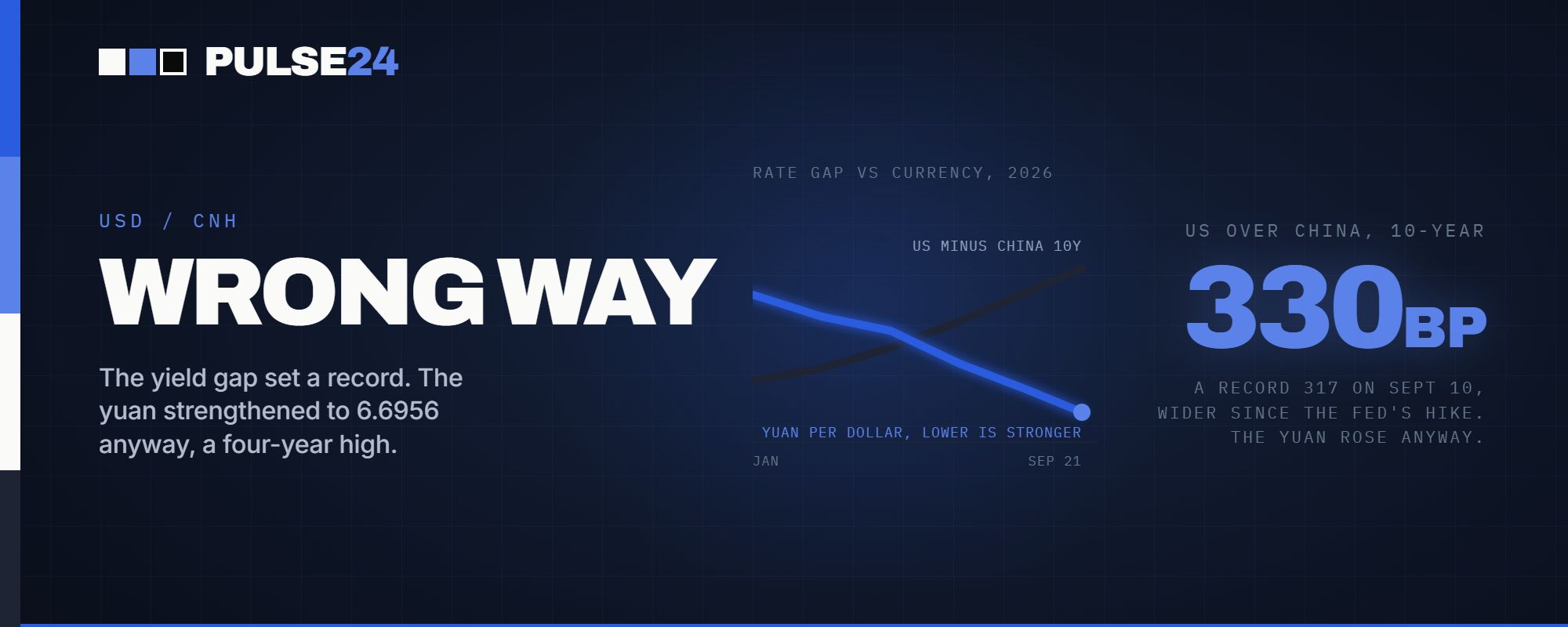
China's currency hit its strongest level since February 2023 this week, even as the gap between US and Chinese bond yields set a record that should have pushed it the other way. Trade surpluses and a deliberately cautious PBOC are winning out over interest-rate math, at least for now.
The offshore yuan traded at 6.6956 per dollar on Monday, the strongest reading in roughly four years, while the onshore rate touched 6.6983, its own strongest level since January 2023. Four years is a long stretch for a currency to sit still, and the timing is what makes this move worth explaining rather than just noting.
Standard currency logic says a currency should weaken, not strengthen, when the interest-rate gap against the dollar widens. The premium investors earn by holding Treasuries over Chinese government bonds hit a record 317 basis points on September 10, and it has kept widening since the Fed raised its benchmark rate to 3.75%-4.00% on September 16. A wider gap normally pulls capital toward the higher-yielding currency. The yuan went the other direction anyway.
What Changed
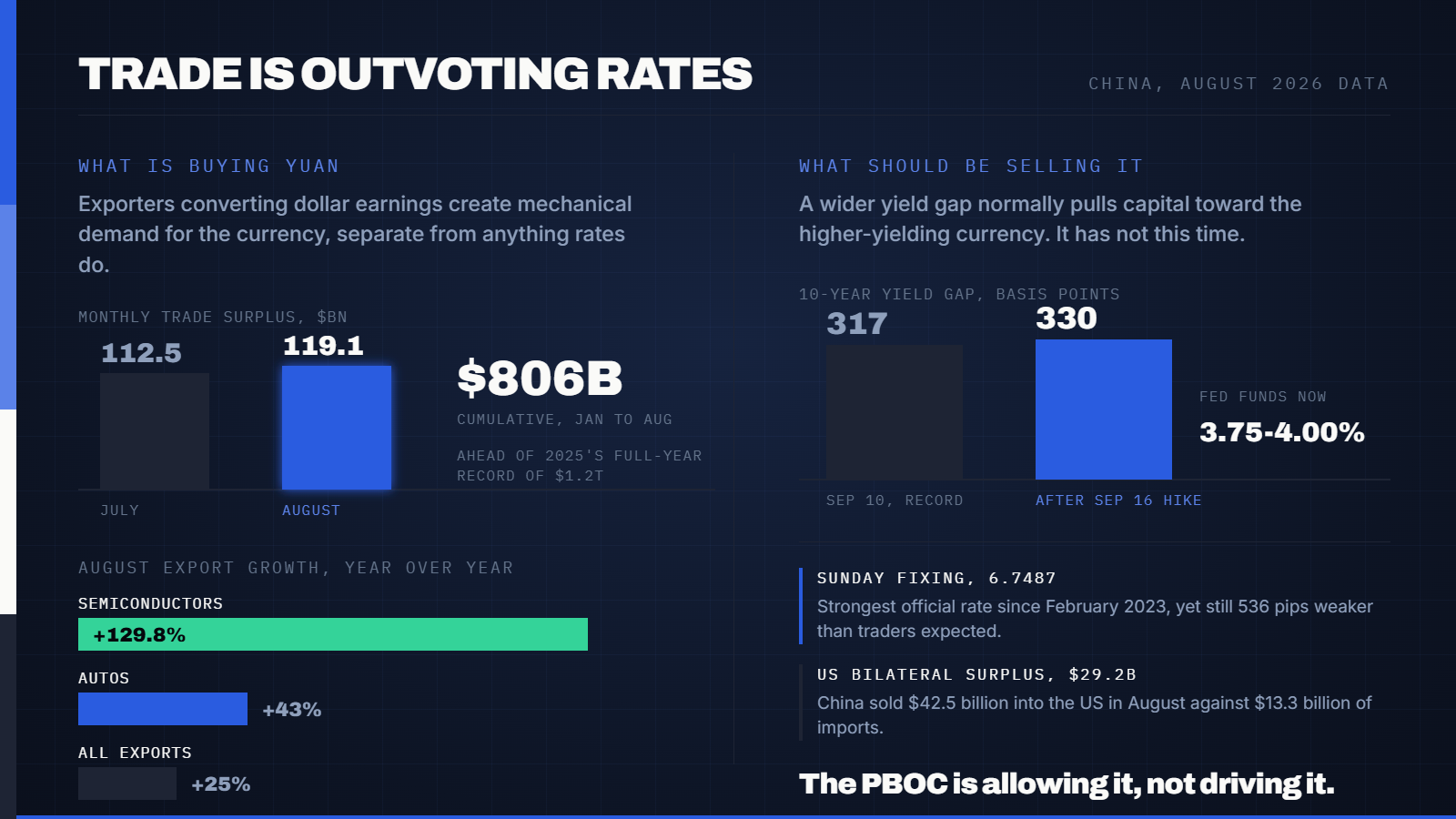
China's trade numbers explain most of the divergence. The country posted a $119.1 billion trade surplus in August, up from $112.5 billion in July, and the first eight months of 2026 have produced a cumulative surplus near $806 billion. That pace already tracks ahead of 2025's full-year record of $1.2 trillion. Exports rose 25% year over year in August, with semiconductor shipments up 129.8% and auto exports up 43%, categories where China has built genuine cost and scale advantages rather than simply undercutting on price.
The United States is a growing piece of that surplus, not a shrinking one. China sold $42.5 billion of goods to American buyers in August, a 34.4% jump from a year earlier, against $13.3 billion of imports from the US. That left a bilateral surplus of roughly $29.2 billion for the month, even as trade negotiators from both countries kept talking. Exporters converting those dollar earnings back into yuan create real, mechanical demand for the currency, separate from anything a central bank does with interest rates.
The PBOC has leaned into the move without fully endorsing it. Sunday's fixing came in at 6.7487 per dollar, the strongest official rate since February 2023, but still 536 pips weaker than what traders expected, a gap that suggests the central bank is comfortable with a stronger yuan as long as it doesn't happen too fast. Pulse24 covered China's August data before this, when bank lending hit a record low even as factory output beat every forecast. Trade strength and credit weakness are sitting side by side in the same economy right now, and the currency is trading off the former.
Why It Matters
A stronger yuan sitting on top of a record yield gap signals that trade fundamentals, not rate differentials, are setting the exchange rate for now. That's worth tracking for anyone positioned in Asian currencies more broadly. The yen weakened even after the Bank of Japan's own hike to a 31-year high last week, the opposite pattern from what's playing out in China. Two central banks raising or holding steady, two very different currency outcomes, and the difference has more to do with trade balances and capital flows than with monetary policy alone.
The move also complicates the dollar's own story. The Dollar Index climbed above 100 for the first time in seven weeks after the Fed's hike, closing Friday near 100.2, close to its highest level since late July. A dollar gaining against most currencies while losing ground specifically against the yuan points to China-specific flows, trade settlement and positioning ahead of Thursday's summit, rather than a broad shift in dollar sentiment.
Timing adds another layer. Treasury Secretary Scott Bessent and Chinese Vice Premier He Lifeng wrapped up preparatory talks in New York on Sunday, ahead of a Trump-Xi meeting scheduled for Thursday. Goldman Sachs analysts noted that the PBOC's pattern of stronger fixings ahead of past US-China summits is repeating here, and that it leaves room for the offshore yuan to strengthen further into the meeting. Whether that holds depends on what, if anything, comes out of Thursday beyond an extended trade truce.
What to Watch Next
Watch the PBOC's daily fixing for the rest of this week. The gap between the official rate and where traders expect it to land is a rough gauge of how much the central bank wants to slow the yuan's rise without reversing it outright. A narrowing gap would suggest Beijing is comfortable letting the currency run into the summit; a widening one would suggest the opposite.
Also watch whether China's September trade data, due out in the second week of October, keeps pace with August's numbers. Semiconductor and auto export growth at last month's rates isn't guaranteed to continue, and a slowdown would remove the main force offsetting the yield gap. If that happens, the usual relationship between interest-rate differentials and currency direction could reassert itself quickly.
The Pulse24 Take
The easy read here is that a strong currency means a strong economy. The same week that produced record exports also produced the weakest bank lending China has recorded, which complicates that story. Growth is uneven right now, concentrated in trade-facing sectors that benefit from a base effect against last year's tariff-depressed numbers and from real competitiveness in chips and EVs. The yuan is pricing that export strength accurately. The domestic economy underneath it is a separate, messier question.
For now, trade flows are winning the argument against interest-rate math, and Beijing appears willing to let that happen at a controlled pace heading into a high-stakes meeting with Washington. That's a specific, temporary alignment of forces, not a new rule about how the yuan trades. When the yield gap eventually narrows, or when export growth cools from its current pace, it's worth checking whether the currency keeps defying the textbook or finally falls back in line with it.
How we read the data
Curious how we get from raw data to a take like this? Our Trader's Toolkit walks through the tools we lean on.
Explore the Toolkit