Pulse24 Original
Central Banks Bought a Record 289 Tonnes of Gold Last Quarter. Gold's Price Kept Falling Anyway.
September 14, 2026
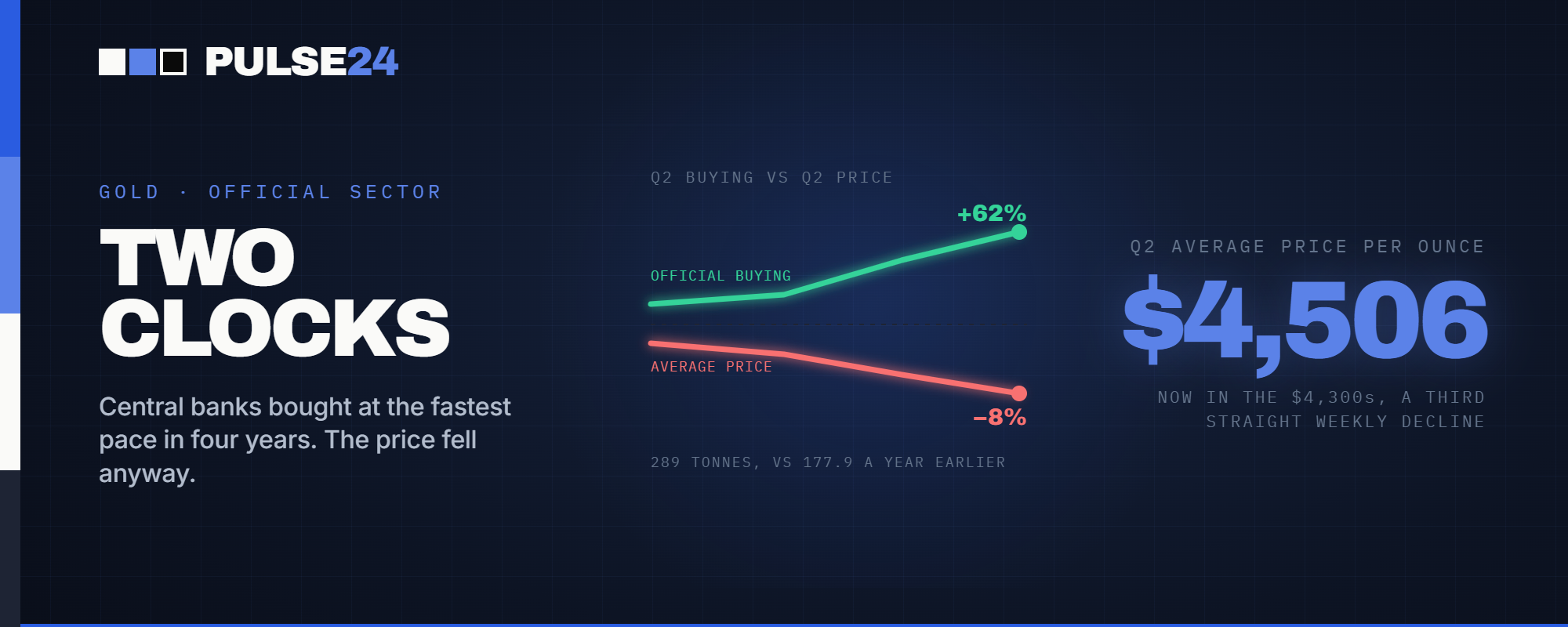
Central banks bought 289 tonnes of gold in the second quarter, the fastest pace in years, while the metal's average price fell 8% over the same three months. Gold is now down for a third straight week as Fed rate-hike bets climb toward Wednesday's decision, showing two very different buyers are setting two very different prices.
Central banks bought 289 tonnes of gold in the second quarter of 2026. That's the World Gold Council's official count, and it works out to 62% more than the 177.9 tonnes they bought in the same quarter of 2025. Over that same three months, gold's average price fell 8%, sliding to $4,506.29 an ounce.
Central banks were buying more gold, at the fastest pace in four years, while the price of the thing they were buying went down. That runs counter to how most market participants behave. Retail investors tend to sell into weakness and buy into strength. Central banks, at least this year, have been doing something closer to the opposite.
The pattern hasn't stopped. Gold was trading in the $4,300s an ounce on September 14, its third straight weekly decline, down from $4,415 a week earlier. It remains up sharply over the past year, a reminder that a few weeks of selling doesn't erase the broader trend even when it dominates the headlines that week.
What Changed
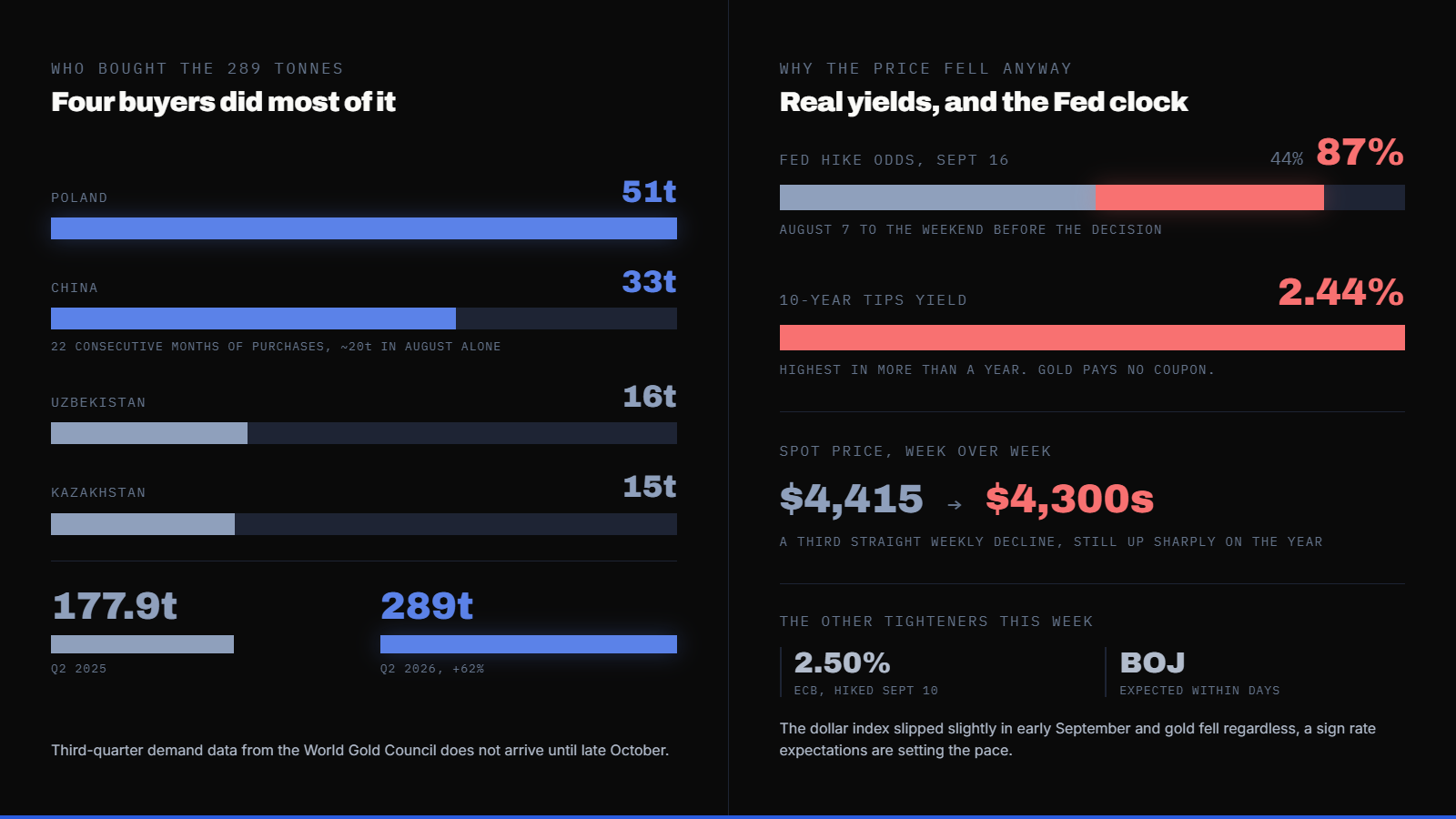
Four countries did most of the buying. Poland added 51 tonnes, more than any other central bank in the quarter. China's central bank bought 33 tonnes, extending a streak that reached 22 consecutive months of purchases by August, when it added roughly 20 tonnes on its own. Uzbekistan and Kazakhstan bought 16 tonnes and 15 tonnes, respectively. None of these are speculative funds chasing a trade. They're finance ministries and central banks making multi-year decisions about how much of their reserves should sit in dollars versus something no foreign government can freeze or dilute by printing more of it.
Gold fell for a different reason than central banks bought it, and that gap is worth sitting with. Ten-year Treasury Inflation-Protected Securities, the bond market's cleanest read on real, inflation-adjusted yields, pushed toward 2.44% by early September, their highest level in more than a year. Gold pays no coupon and no dividend, so every basis point of real yield raises the cost of holding it instead of a bond. That mechanical relationship, more than geopolitics or reserve flows, has done the most to move gold's price week to week this year. The dollar didn't even need to strengthen much to help the case against gold. The DXY dollar index actually slipped slightly in early September, yet gold kept sliding anyway, a sign that rate expectations, not currency moves, are setting the pace right now.
Why It Matters
The rate backdrop turned more hawkish through August and September. Futures-implied odds of a quarter-point Fed hike on September 16 stood at just 44% on August 7. They climbed to roughly 90% within hours of August's hotter-than-expected core CPI report, the kind of move that tends to hit gold harder than stocks, since gold has no earnings outlook to fall back on when the discount rate rises. Fed Chair Kevin Warsh added to the pressure in a Jackson Hole speech on August 28, saying the central bank's "predominant focus right now should be on prices" and that inflation needs to return to target "at sufficient speed." A Fed chair emphasizing urgency over patience is exactly the kind of signal futures markets price in immediately, and they did.
The European Central Bank hiked its own rate to 2.50% earlier this week, with the Fed and Bank of Japan both expected to weigh in within days, which reinforces the broader theme working against gold. Developed-market central banks are tightening in unison rather than cutting, and gold has historically struggled in that kind of environment no matter who else is accumulating it in the background.
What to Watch Next
Wednesday's Fed decision is the next real test. A hike paired with hawkish forward guidance, another reference to staying focused on inflation "at sufficient speed," would likely extend gold's slide regardless of what central banks do with their reserves this quarter. A hike paired with any hint that policymakers see this as close to the top of the cycle could work the other way, since gold has tended to find a floor once markets start pricing the end of a tightening cycle rather than the middle of one.
The World Gold Council's third-quarter demand data won't arrive until late October, so the more immediate signal on official-sector buying will come from monthly reserve disclosures out of Beijing, Warsaw, and Tashkent, the kind of data point that turned into a headline earlier this year when a wave of central banks moved to repatriate gold reserves entirely. If those purchases keep showing up during a falling market the way they did in the second quarter, that tells you more about central banks' multi-year intentions than the price does on any single Monday.
The Pulse24 Take
Two different clocks are running inside the gold market right now, and they rarely agree. One belongs to central banks, buying for reasons measured in years: reserve diversification, discomfort with concentrating reserves in a single currency, and a form of caution that doesn't show up cleanly in a quarterly report. The other belongs to traders pricing Wednesday's Fed meeting, and that clock moves by the hour.
Gold sold off sharply on a similar rate repricing earlier this summer, and central banks kept buying gold through that stretch too, even as odds of a Fed hike swung hard in a single weekend. The lesson isn't that one clock is right and the other is wrong. It's that gold's price on any given Monday mostly reflects what leveraged, short-term money thinks about the next Fed meeting, while the metal's slow accumulation by finance ministries reflects what patient, structural money thinks about the next decade. Both views can be correct at once, and lately, both have been.
How we read the data
Curious how we get from raw data to a take like this? Our Trader's Toolkit walks through the tools we lean on.
Explore the Toolkit