Pulse24 Original
86 Tonnes of Dutch Gold Left US and Canadian Vaults This Year. Central Banks Bought a Record Amount the Same Quarter.
September 5, 2026
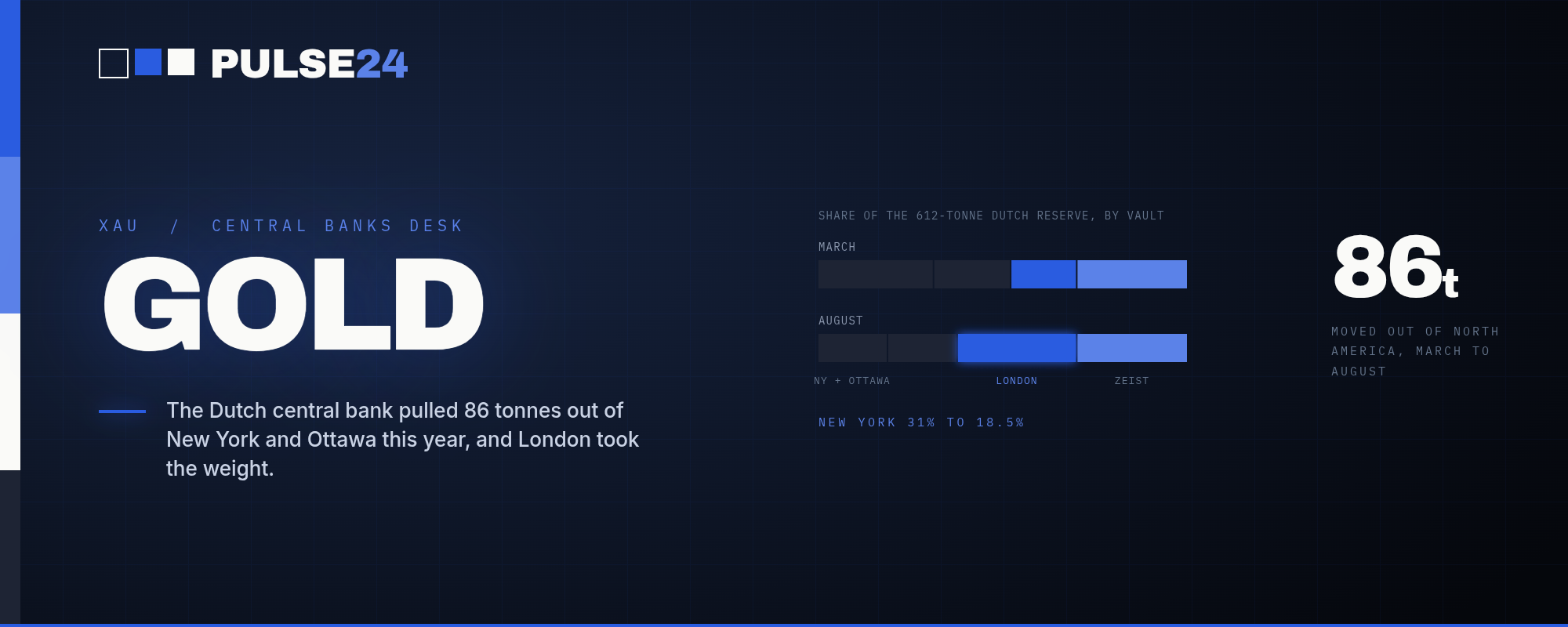
The Dutch central bank moved 86 tonnes of gold out of vaults in New York and Ottawa this year, citing crisis preparedness, following a path France walked in January. The relocation lands in the same quarter central banks bought a record 289 tonnes of gold worldwide, led by Poland and China.
Eighty-six tonnes of gold left vaults in New York and Ottawa this year, headed for London and a cash center outside Amsterdam. The mover was De Nederlandsche Bank, the Dutch central bank, and the relocation wrapped up quietly in August after transfers that began back in March. On its own, that barely registers as news. It matters more once you notice who else has made a similar move recently, and why they're all doing it at once.
DNB's total gold reserve sits at 612.4 tonnes, worth about $83.8 billion at current prices. Roughly a third of it had sat in the Federal Reserve Bank of New York for decades, with another fifth held at the Bank of Canada in Ottawa, arrangements that trace back to Cold War-era thinking about where a small European country's reserves would be safest. That calculus has now shifted. New York's share of the reserve dropped to about 18.5%, Ottawa's fell to roughly the same level, and London's share climbed to around 32%, alongside the Zeist vault outside Amsterdam holding steady near 31%.
What Changed
DNB President Olaf Sleijpen framed the move in blunt terms. "We expect that we will never need to use them, but we do need to strengthen our resilience and preparedness," he said. The bank's own explanation for singling out North America wasn't access in normal times. It was speed in an abnormal one: gold sitting in New York or Ottawa, DNB said, "cannot be utilised as quickly and directly" if the Netherlands ever needed to mobilize reserves fast. London's deep, liquid bullion market made it the practical alternative, faster to tap than shipping bars home to Zeist and less exposed than leaving them across the Atlantic.
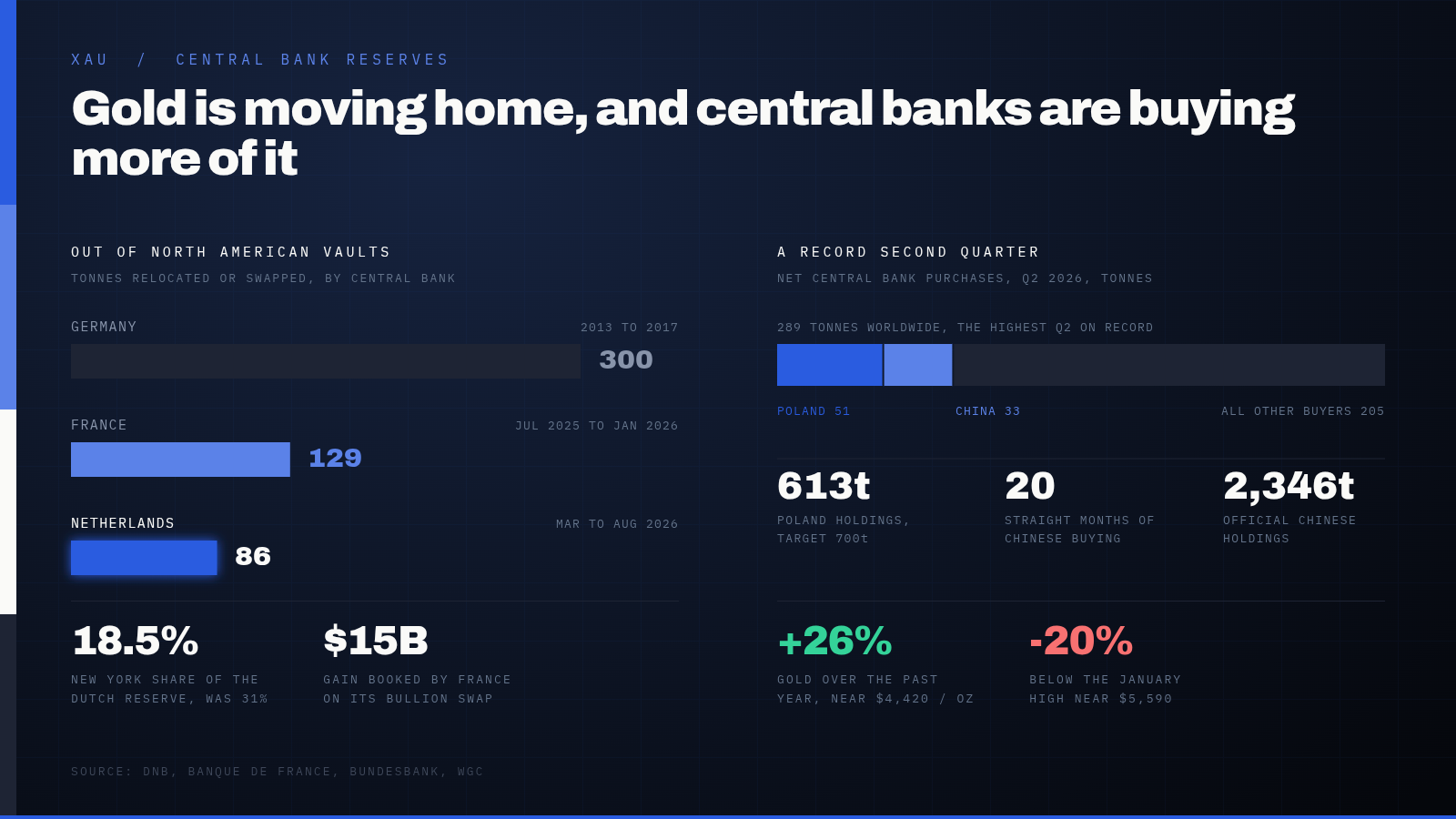
The Dutch aren't improvising here. The Banque de France spent from July 2025 to January 2026 selling 129 tonnes of older bullion out of the New York Fed and buying back an equal weight of exchange-standard bars in Europe, a swap that brought its last US-held gold home to Paris and, helped by gold's runup in price along the way, booked the French central bank a $15 billion accounting gain. Germany ran a more literal version of the same idea a decade earlier, physically hauling 300 tonnes out of New York between 2013 and 2017, on top of a separate transfer from Paris, after years of pressure from domestic lawmakers who wanted proof the gold was really there. Each move has its own local politics, but the destination logic keeps repeating: closer to home, or closer to a market that can move fast.
Why It Matters
Gold's own price action makes the timing notable. The metal fell $103 in a single session earlier this week as traders priced in higher odds of a September Fed rate hike, yet it's still up roughly 26% over the past year, even sitting about a fifth below the all-time high near $5,590 it touched in January. Central banks reshuffling reserves in the middle of a multi-year rally isn't the classic buy-the-dip trade. It looks more like insurance shopping that happens to coincide with a bull market, not a bet driven by one.
That reading lines up with the buying data. The World Gold Council recorded 289 tonnes of net central bank gold purchases in the second quarter, its highest total for a Q2 on record. Poland led everyone, adding 51 tonnes in the quarter and 82 tonnes so far this year, pushing its reserves to around 613 tonnes as it closes in on a stated 700-tonne target its governor set in January. China added 33 tonnes in the quarter, its largest single-quarter addition since the fourth quarter of 2023, extending a buying streak that reached 20 straight months by June, the longest since 2015, and pushing its official holdings to 2,346 tonnes. Beijing has described the accumulation as part of a broader push to diversify its foreign-exchange reserves away from dollar-denominated assets. Uzbekistan, Kazakhstan, Jordan, and the Czech Republic rounded out the list of active buyers.
None of this is really about a war or an imminent crisis. It's a slower story about where the world's reserve managers want their safety net sitting, and how much they still trust the plumbing of the dollar-based financial system to make good on it during a squeeze. A gold bar in London is still a gold bar. What changed is how much central bankers are willing to pay, in convenience during normal times, to know exactly who can freeze access to it during a bad one.
What to Watch Next
The World Gold Council's next quarterly report, due in November, will show whether Q2's pace held into the third quarter or whether it was a one-off driven by a handful of large buyers. Poland's climb toward 700 tonnes is worth tracking on its own, since it would make gold a meaningfully larger share of its reserves than most European peers carry today. It's also worth watching whether other mid-sized reserve holders follow the Dutch and French lead out of North American vaults, and whether the Fed or the Treasury ever comments publicly on the pattern, something both have historically avoided doing.
Closer to home, gold's next major test comes with the Fed's September 16 rate decision. A hike, or even hawkish language without one, would likely pressure the price the way this week's rate-hike bets already have. Central bank buying, though, tends to look through short-term rate moves in a way that private investors don't, which is part of why 2026's purchases have kept climbing even as gold's rally has cooled.
The Pulse24 Take
Strip away the vault logistics and this is a story about trust, not conflict. Central banks aren't pulling gold out of America because they expect tanks to roll or trading to freeze tomorrow. They're pulling it because reserve managers plan for decades, not headlines, and a growing number of them have decided that convenience in a crisis is worth more than convenience today. Watch the World Gold Council's numbers alongside stories like this one rather than in isolation. A single country moving bullion is a data point. Two countries doing it within months of each other, against a backdrop of record quarterly buying, starts to look like a shift in how the world prices safety itself.
How we read the data
Curious how we get from raw data to a take like this? Our Trader's Toolkit walks through the tools we lean on.
Explore the Toolkit