Pulse24 Original
The Diesel Crack Spread Just Hit a Record $102 a Barrel. Three Refiners Pocketed $12.6 Billion in Profit Last Quarter While Distillate Stockpiles Sank to Their Lowest Level Since 1996.
August 21, 2026
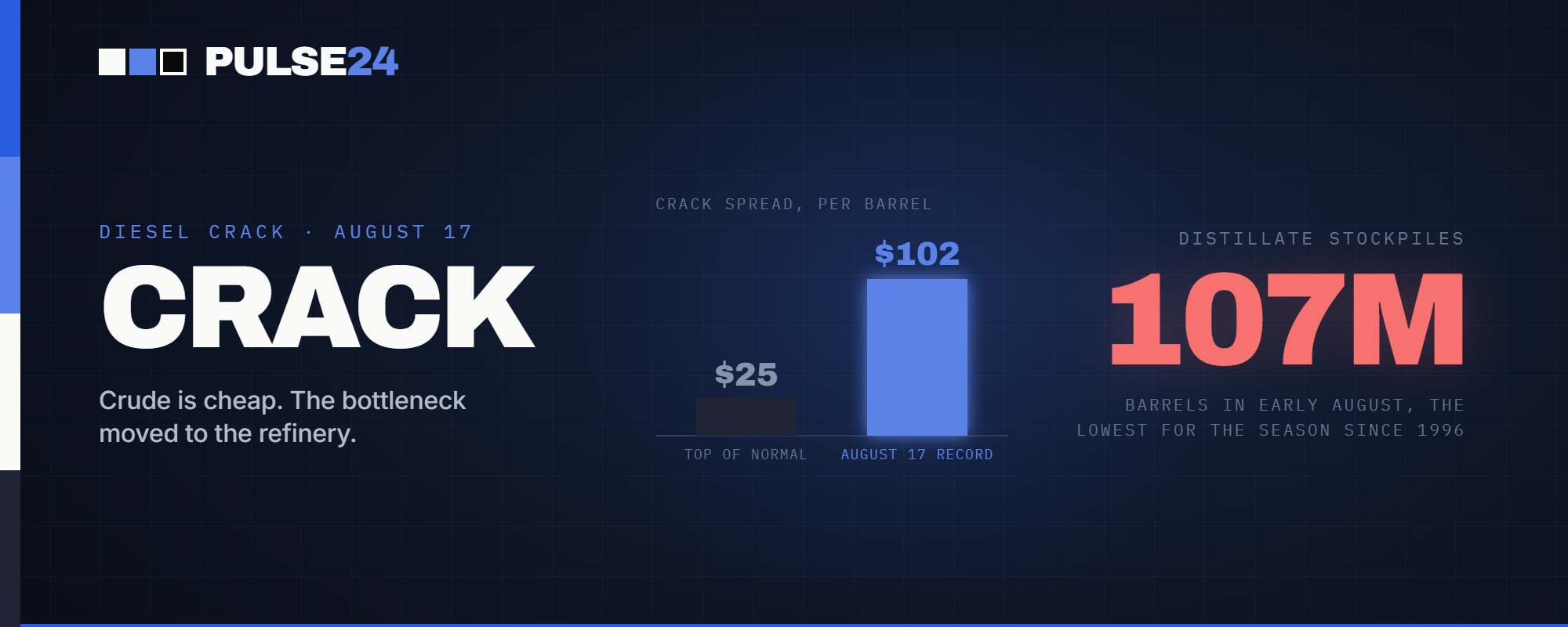
The premium refiners earn turning crude into diesel jumped to $102 a barrel this month, roughly five times its normal range, as distillate inventories fell to their lowest level for this time of year since 1996. Marathon Petroleum, Valero, and Phillips 66 turned that squeeze into a combined $12.6 billion quarterly profit, and diesel's climb toward $5.26 a gallon is starting to show up in freight costs and grocery bills.
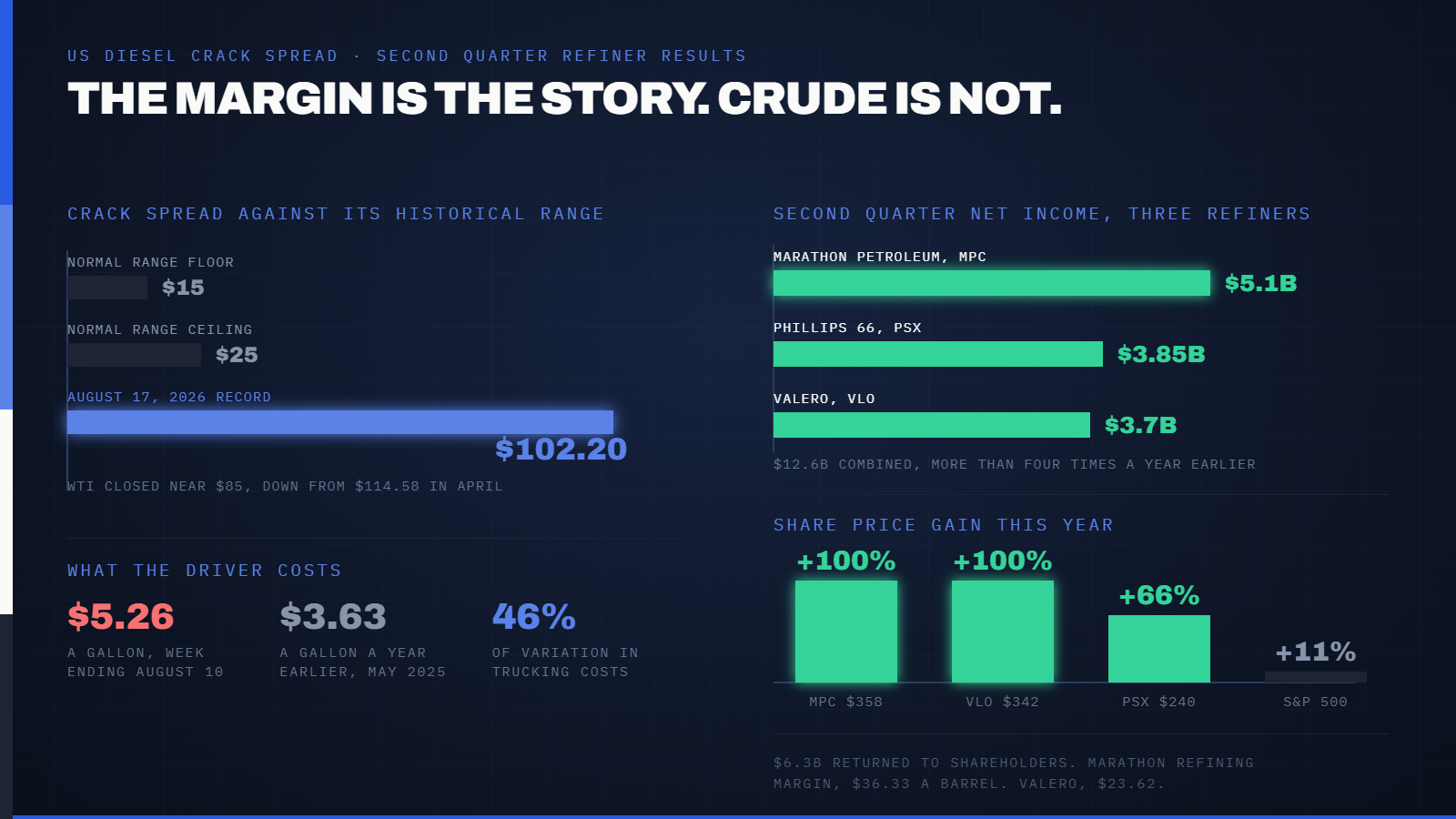
Crude oil itself isn't behaving unusually. West Texas Intermediate closed near $85 a barrel in mid-August, well below the $114.58 peak it touched back in April. What's unusual is what refiners are charging to turn that crude into diesel. The crack spread, the gap between the price of crude and the price of the diesel refined from it, hit $102.20 a barrel on August 17. That's an all-time record, sitting roughly four to six times above the $15 to $25 range the spread has occupied through most of its history.
What Changed
Two forces are colliding here. On the supply side, distillate inventories, the category that includes diesel and heating oil, fell to 107.1 million barrels in early August, the lowest level for this time of year since 1996. Years of refinery closures across the US and Europe have permanently trimmed how much diesel the world can produce, even as crude supply itself has stayed comparatively loose. That looseness is visible elsewhere: OPEC+ finished unwinding 1.65 million barrels a day of production cuts this summer, adding crude back to the market at the same time the Strategic Petroleum Reserve sat near its lowest level since 1982. Crude supply has room. Refining capacity does not.
On the demand side, robust export demand for US diesel is pulling on the same shrinking pool of barrels, and the timing is bad. Harvest season is ramping up, which means farm equipment burning through diesel, and winter heating demand is only a couple of months away. Bank of America's Francisco Blanch wrote that diesel markets appear poised to stay tight, volatile, and expensive well into next year. Goldman Sachs, Citi, and Jefferies have published similar warnings this month.
Why It Matters
The refiners sitting on the other side of that spread are having their best quarter in years. Marathon Petroleum reported $5.1 billion in second quarter net income on a refining margin of $36.33 a barrel, more than double what it earned a year earlier. Valero posted $3.7 billion in net income on a $23.62 margin, and Phillips 66 brought in $3.85 billion. Combined, the three companies earned roughly $12.6 billion last quarter, more than four times their year ago total, and returned $6.3 billion of it to shareholders through buybacks and dividends.
Portfolio manager Simon Wong summed up the quarter bluntly: to say the refiners made a lot of cash is an understatement. The stock market agrees. Marathon Petroleum and Valero have each roughly doubled this year, closing near $358 and $342 respectively on August 20, while Phillips 66 has gained roughly two thirds to around $240, all comfortably outpacing the S&P 500's 11% gain over the same stretch.
That profit is coming out of somebody else's pocket. National average diesel prices reached $5.257 a gallon in the week ending August 10, up from $3.63 a gallon at the same point last year. Diesel accounts for roughly 46% of the variation in trucking costs, and trucking still moves the large majority of goods around the country, so the squeeze tends to show up first in freight rates and later on store shelves. Walmart's own CFO already pointed to gas prices above $4 a gallon, not anything on the retailer's shelves, as the reason behind its first same store sales miss in at least five years.
July's headline CPI landed at 3.4%, matching every forecast on the Street, but that reading predates diesel's latest run to a record. Producer prices were already up 6% year over year back in April, before this month's crack spread record, and food at home inflation is tracking near 2.7% for the year according to USDA estimates. A sustained diesel shock tends to arrive with a lag, first in producer costs, then in the goods that ride trucks to reach consumers.
What to Watch Next
Analysts expect the crack spread to ease somewhat as second half seasonal demand softens, though few think it snaps back to the old $20 to $30 range anytime soon. Jason Gabelman projects Marathon and Valero could each repurchase close to a fifth of their market value through the end of 2027 if margins hold anywhere near current levels, with Phillips 66 targeting roughly a tenth. Watch the weekly distillate inventory report for whether stockpiles start rebuilding ahead of winter, and watch whether the next CPI and PPI releases start showing diesel's fingerprints in transportation and food costs.
The Pulse24 Take
Crude oil is trading well below its spring peak, which on its own would normally read as a disinflationary signal. But the bottleneck sits between the wellhead and the pump, in refining capacity that took years to shrink and won't rebuild in a single quarter. That means this squeeze can outlast the headlines about cheap crude. Investors might do better treating refiners less like a pure play on crude prices and more like companies benefiting from a structural capacity shortage that isn't closing anytime soon. Consumers should expect the price at the pump and the cost of a truckload of groceries to keep drifting from what crude oil alone is doing, possibly for months at a stretch.
How we read the data
Curious how we get from raw data to a take like this? Our Trader's Toolkit walks through the tools we lean on.
Explore the Toolkit