Pulse24 Original
OPEC+ Just Completed a Three-Year Unwind of 1.65 Million Barrels in Cuts. Brent Crude Is Still Trading Near $89.
August 12, 2026
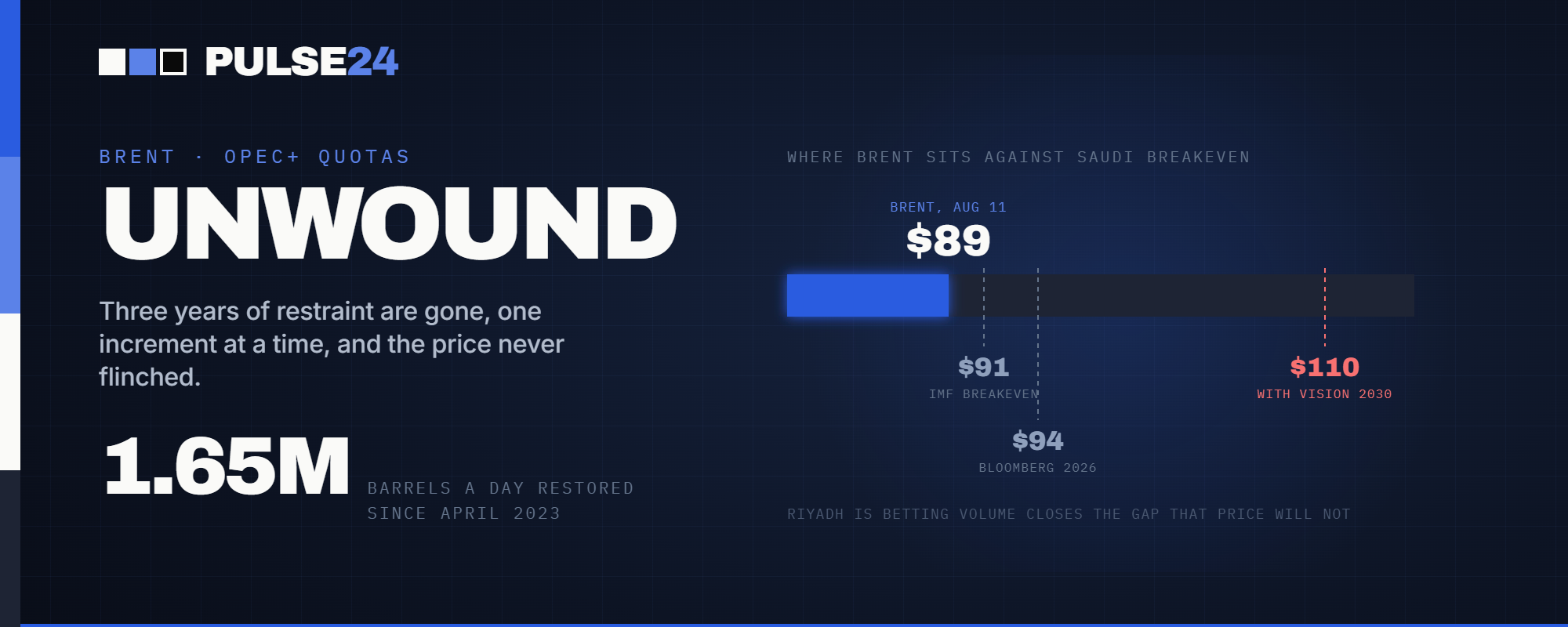
OPEC+ approved a final 188,000 barrel-a-day increase for September, closing the book on the 1.65 million barrels a day of cuts it first announced back in April 2023. Oil prices barely reacted, which says as much about the market's mood as the decision itself.
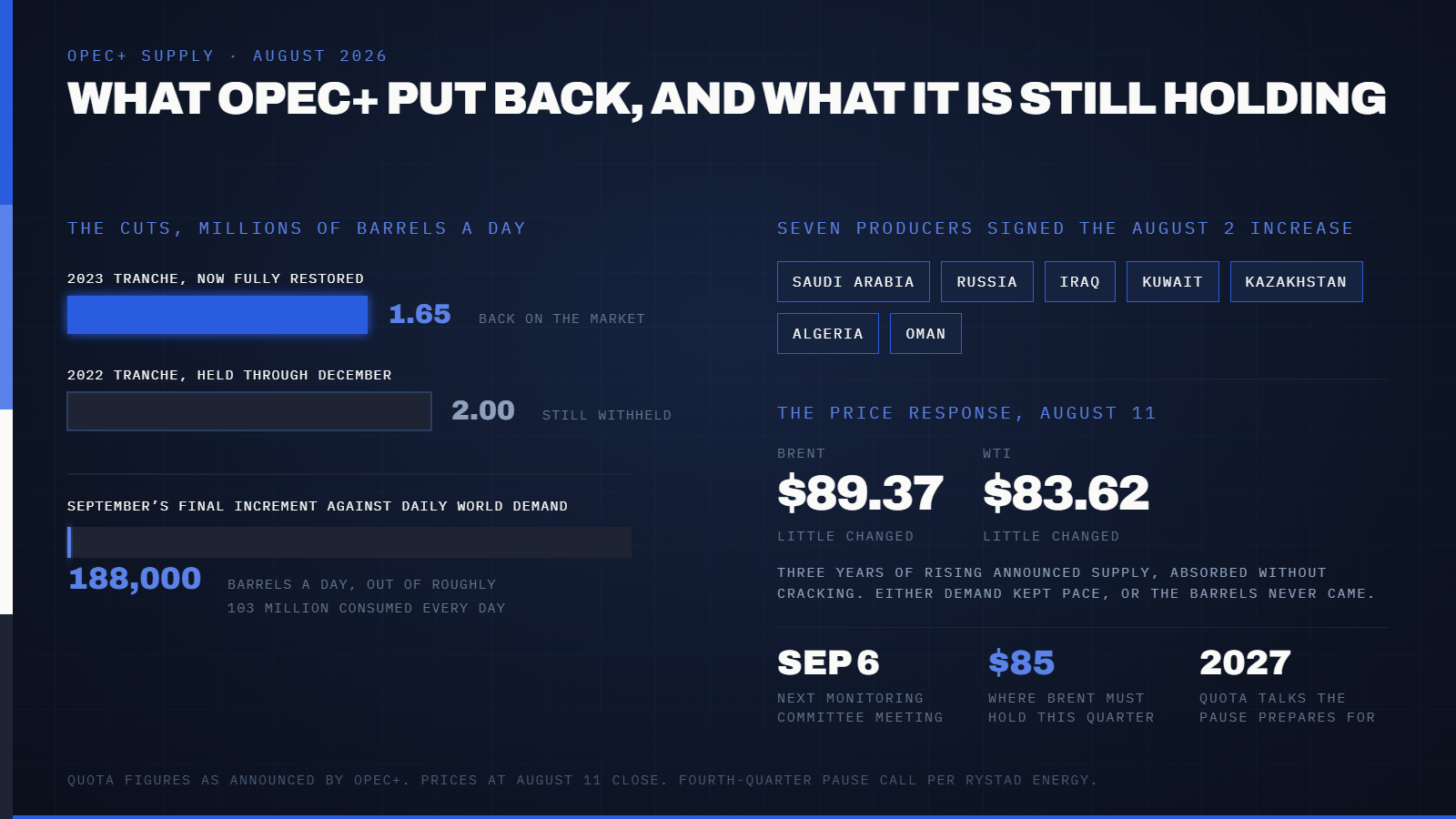
One hundred eighty-eight thousand barrels a day. Against a global market that consumes something like 103 million barrels every single day, the increase seven OPEC+ producers approved on August 2 barely moves the needle on its own. What makes it worth a second look is what it finishes, not what it adds.
Saudi Arabia, Russia, Iraq, Kuwait, Kazakhstan, Algeria and Oman agreed to raise output by that amount starting in September, and with it, the group has now fully unwound the 1.65 million barrels a day it voluntarily pulled off the market back in April 2023. Three years of restraint, undone one incremental hike at a time.
The Three-Year Retreat, in Reverse
The 2023 cuts were meant to be temporary from the start, a way to prop up prices while OPEC+ waited for demand to catch up with supply. They ended up lasting far longer than anyone at the time expected, extended and re-extended as prices kept sliding below where Gulf producers wanted them. What finally changed wasn't a demand breakthrough. It was OPEC+ deciding the cost of holding barrels off the market had exceeded the benefit.
A second, older tranche of cuts, roughly 2 million barrels a day going back to 2022, stays in place through the end of this year. The group's Joint Ministerial Monitoring Committee reconvenes September 6, and if the pattern of the last several meetings holds, that gathering will mostly be about confirming a decision the market has already priced in rather than debating a new one.
Why Barrel Counts Aren't Moving Prices Much
What's actually notable about the September increase is that prices didn't react to it much at all. WTI sat near $83.62 a barrel and Brent near $89.37 on August 11, both up slightly on the day and not far from where they've traded for weeks. A market absorbing three straight years of rising announced supply without cracking lower points to either demand growth keeping pace, or a lot of that announced supply simply not landing in physical hands as fast as the quota changes suggest.
Rystad Energy's Jorge Leon leans toward the latter read. "Having completed the restoration campaign, OPEC+ has little incentive to rush into further supply changes," he said. "Our base case is a fourth-quarter pause while the group prepares for the 2027 quota negotiations." Those talks tend to expose how much daylight exists between what members promise to pump and what they actually deliver.
The Market-Share Bet Underneath the Numbers
The more interesting story here isn't any single barrel count. It's the strategy shift underneath it. Saudi Arabia has spent much of the past two years watching non-OPEC producers, chiefly US shale operators and Guyana, take market share it once considered its own. Riyadh appears to have concluded that its long-run revenue depends on volume as much as price, and that a swing producer that keeps shrinking its own output to defend a price umbrella eventually has less market left to defend.
That bet comes with real fiscal tension attached. The IMF puts Saudi Arabia's fiscal breakeven oil price at roughly $91 a barrel, the level needed for the kingdom's oil and non-oil revenue to cover government spending, and Bloomberg Economics' 2026 estimate lands close by, near $94. Factor in Vision 2030's investment commitments through the Public Investment Fund, and estimates push the true breakeven above $110. Brent near $89 doesn't clear even the narrower estimate, let alone the broader one, and that gap is what Riyadh is betting it can close with volume instead of price.
What to Watch Next
September 6 is the next checkpoint, though few expect fireworks there given Rystad's pause call. The bigger tell will be whether Brent holds above $85 through the rest of the third quarter as the full September increase works through the system. A meaningful slide below that level would test how much appetite Saudi Arabia actually has for a prolonged stretch of lower prices, versus how much of this is posturing aimed at discouraging shale producers from growing output further.
Energy costs also feed directly into the inflation data the Fed is watching. Wednesday's July CPI report, expected to show headline inflation easing toward the mid-3% range year over year, will be one more data point on whether cheaper, more abundant oil is starting to show up in the numbers that actually move Fed policy, or whether the pass-through has simply been too small so far to matter.
The Pulse24 Take
The headline number here, 188,000 barrels a day, was never going to move markets by itself. What matters is that OPEC+ just closed the book on a three-year defensive posture and is now openly betting that volume beats price as a long-term strategy. That's a bigger wager than any single quota change, and Saudi Arabia can only sustain it if oil stays comfortably above its narrower fiscal breakeven for a while.
Watch the gap between rhetoric and barrels here. OPEC+ has a long history of announcing production increases that individual members don't fully deliver, which is part of why prices haven't cracked further despite three years of headline supply growth. If Riyadh is serious about defending market share this time, the real test won't be what gets announced at the next meeting. It will be what actually leaves the ground.
How we read the data
Curious how we get from raw data to a take like this? Our Trader's Toolkit walks through the tools we lean on.
Explore the Toolkit