Pulse24 Original
The Strategic Petroleum Reserve Just Fell to 293.4 Million Barrels, Its Lowest Level Since December 1982. Five Straight Months of Releases Have Drained It to Roughly 40% of Its 2009 Peak.
August 18, 2026
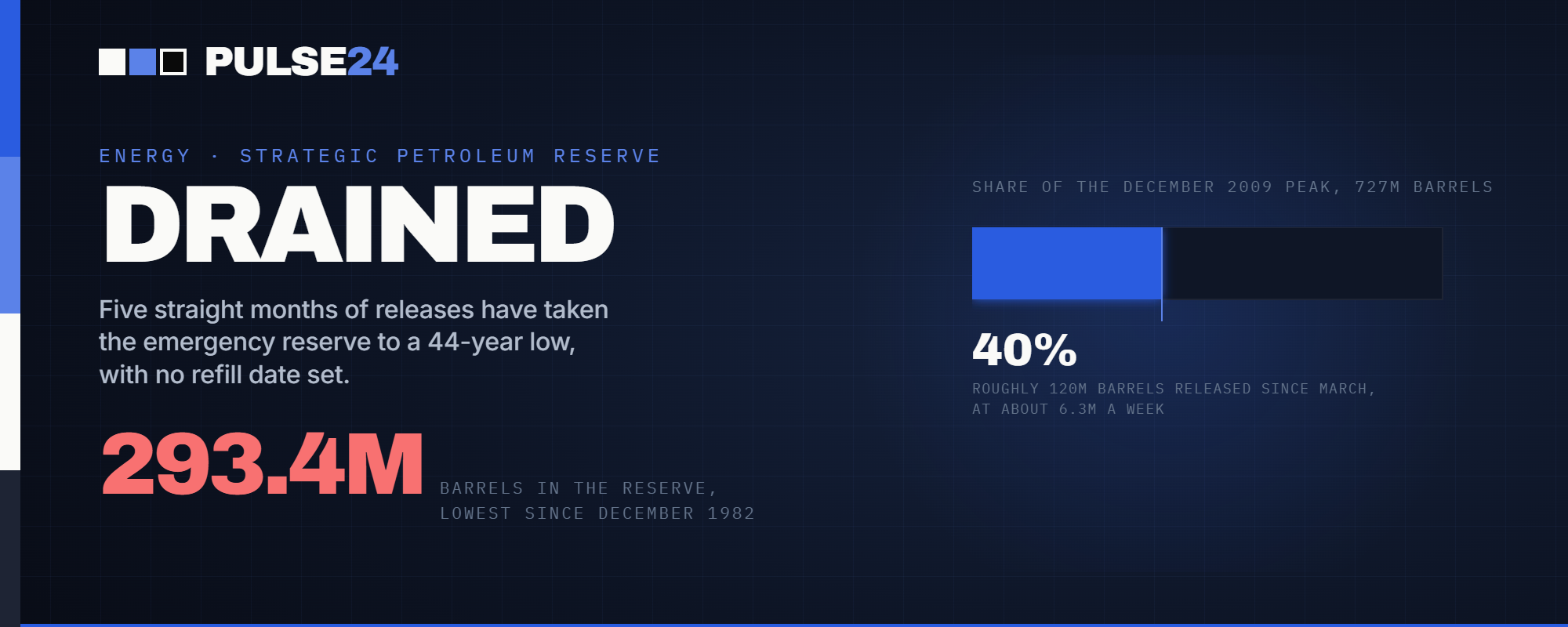
The Strategic Petroleum Reserve just fell to its lowest level since 1982, and releases haven't stopped. A thinner emergency cushion carries risks that go well beyond what today's gas prices suggest.
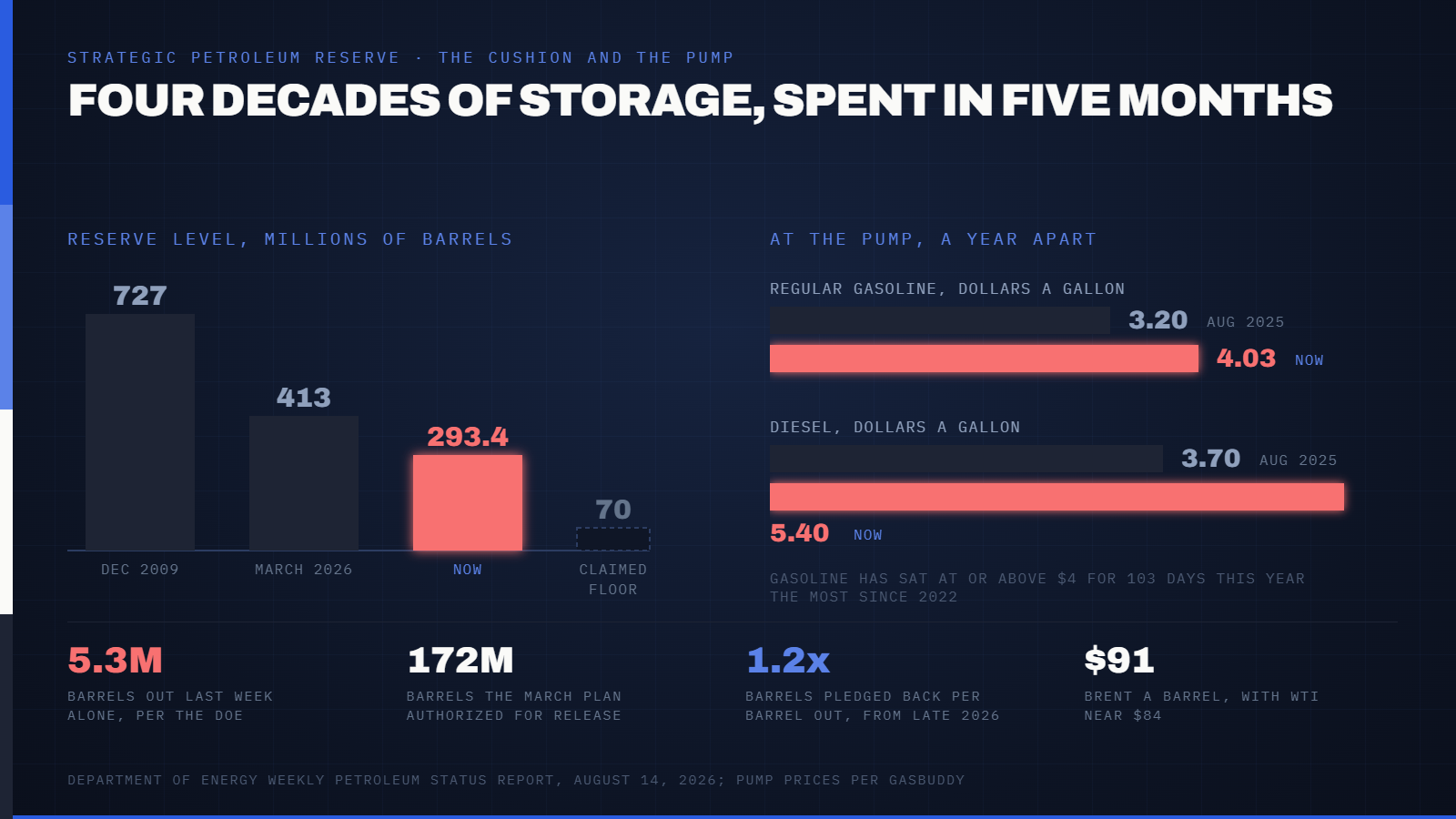
293.4 million barrels. That's what sat in the U.S. Strategic Petroleum Reserve as of last Friday, according to Department of Energy data, down 5.3 million barrels in a single week and the lowest total since December 1982. Ronald Reagan's administration was still filling the reserve for the first time back then. Today it's been draining for five straight months, and the barrels going out haven't been coming back in.
The reserve was built after the 1970s oil embargoes for exactly this kind of moment: a stretch where global supply gets tight and prices climb. Crude has moved up this month on renewed tension in the Middle East and concerns about tanker traffic through the Strait of Hormuz, with Brent trading near $91 a barrel and WTI around $84. But the SPR's decline predates that latest flare-up. It traces back to a White House plan announced in March to release as much as 172 million barrels to hold down fuel costs, and the reserve has now given up roughly 120 million of those barrels at a pace of about 6.3 million a week.
What Changed
The reserve now holds about 40% of the 727 million barrels it had at its December 2009 peak, and the pace of the current drawdown hasn't slowed. Energy Secretary Chris Wright has framed the releases as a good trade for the country, pledging that the government will return more oil than it takes out, roughly 1.2 barrels back for every barrel released. The exchange structure behind that pledge requires the barrels to eventually be returned plus a premium, with shipments back into the reserve expected to start late in 2026. No formal refill timeline exists yet beyond that.
Not everyone agrees on how low the reserve can safely go. The Trump administration has argued that hundreds of millions of barrels can still be released, with only about 70 million needing to stay in the ground as an operational floor. Amos Hochstein, who oversaw energy policy under the Biden administration, has pushed back hard on that number, calling claims that the SPR can run down to 70 million barrels nonsense and warning that further cuts risk damaging the reserve's salt caverns badly enough that it could never be fully restored. The 2022 Ukraine-related release remains the largest single drawdown in the reserve's history at 180 million barrels, and even that stopped well short of where officials are now suggesting the reserve could go.
Why It Matters
A thinner reserve means less of a cushion the next time global supply gets disrupted, whether that's a geopolitical flashpoint, a hurricane through Gulf Coast refineries, or a shipping bottleneck somewhere else entirely. The SPR exists specifically to soften those shocks by adding barrels to the market fast. Every barrel already sold is a barrel that isn't available for the next emergency, at least not until the exchange program actually delivers on its promised returns.
Consumers are feeling the current tightness regardless of the reserve's role in it. The national average for regular gasoline hit $4.03 a gallon in mid-August, the highest reading ever recorded that late in the season according to GasBuddy, up from $3.20 a year earlier. Diesel is running $5.40 a gallon, versus $3.70 last August. Prices have sat at or above $4 a gallon for 103 days this year, the most since 2022, and that kind of sustained pressure at the pump feeds directly into headline inflation. July's CPI print came in at 3.4%, matching forecasts and barely moving markets, but a fresh leg up in energy costs is exactly the kind of input that could change that calculus heading into the Fed's next meeting.
There's also a fiscal angle. Refilling the reserve to anywhere near its old capacity would cost tens of billions of dollars at current prices, money that has to come from somewhere even under an exchange program that promises more barrels back than went out. And the drawdown is happening while OPEC+ has been unwinding its own supply cuts. The group completed a three-year unwind of 1.65 million barrels a day in cuts earlier this year, adding barrels back to the market even as Brent has stayed stubbornly close to $90. A shrinking strategic reserve and a supply picture that's tighter than expected aren't a great combination heading into a season when heating oil demand typically climbs.
What To Watch Next
The Department of Energy publishes SPR inventory alongside its weekly petroleum status report, so the next update will show whether releases are slowing as the reserve nears whatever floor officials ultimately settle on. Watch for any formal announcement on when exchange barrels start flowing back in, since that's the detail that turns this from an open-ended drawdown into something with a defined bottom. Gas prices into the fall matter too. They usually ease once summer driving season winds down, but a reserve with less spare capacity to lean on means any new supply scare could hit pump prices harder and faster than it would have a year ago.
The Pulse24 Take
The debate over how low the SPR can go isn't really about a specific barrel count. It's about what the reserve is for. Used as an emergency buffer, it's meant to sit mostly full and get tapped rarely. Used as a price-management tool, the way it's been deployed for much of the past five months, it gets drawn down more often and for longer stretches, and the cushion available for a genuine emergency gets thinner every time. Both uses are legitimate policy choices, but they can't both be true at once without eventually testing where the real floor is. With the reserve already at a 44-year low and no refill timeline locked in, that test may not be far off, and it will likely come at the worst possible moment: right when the market actually needs the barrels.
How we read the data
Curious how we get from raw data to a take like this? Our Trader's Toolkit walks through the tools we lean on.
Explore the Toolkit