Pulse24 Original
Japan's Currency Markets Go Dark for Three Days This Week. Twice Already in 2026, That's Exactly When Tokyo Intervened.
September 21, 2026
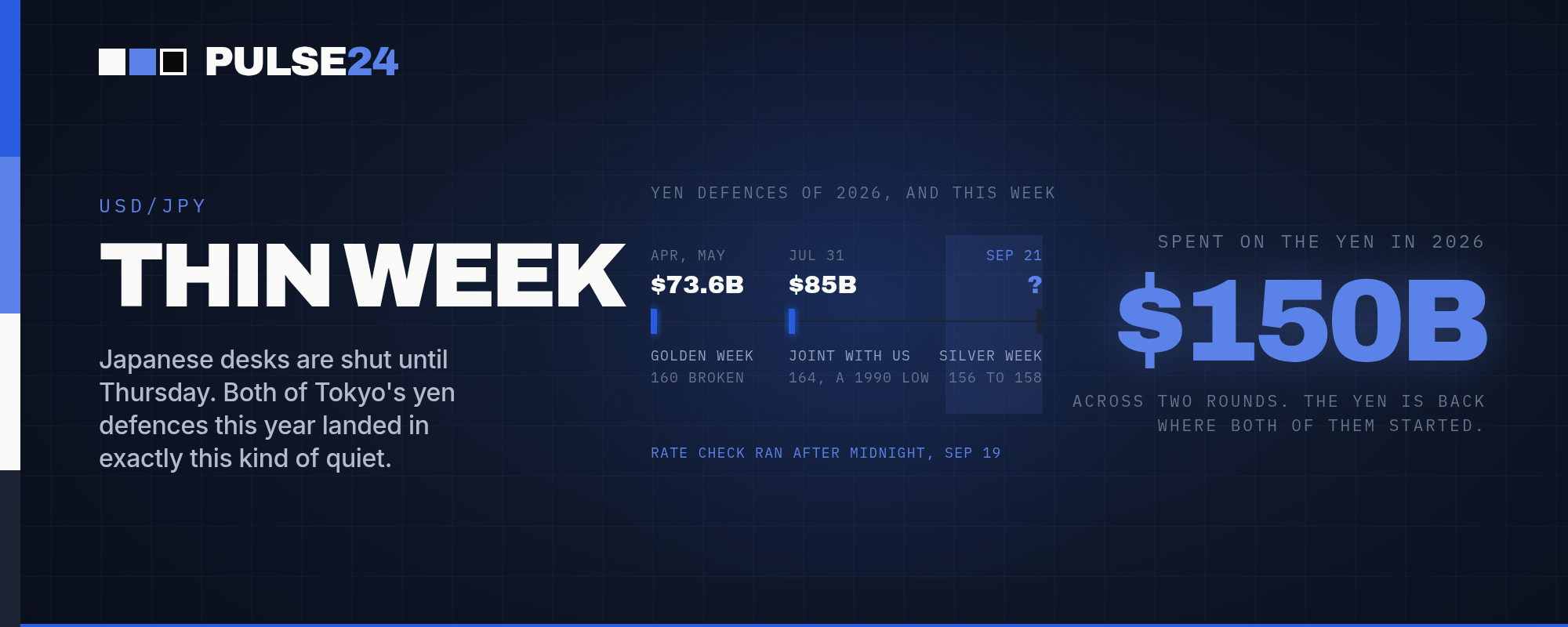
Japan's stock, bond, and currency desks close for three days this week, and traders are watching to see if Tokyo uses the quiet to defend the yen again. Two interventions and a rate hike to a 31-year high haven't stopped the currency from drifting back toward its weakest levels of the year.
Tokyo's currency and bond markets go dark this week. Monday is Respect for the Aged Day, Wednesday is the Autumnal Equinox, and a Citizens' Holiday bridges the two. The Tokyo Stock Exchange, the Osaka Exchange, and the government bond market all stay shut until Thursday. Traders who cover Japan have learned to treat this stretch, known locally as Silver Week, as more than a scheduling quirk. Twice already this year, Japanese authorities have used exactly this kind of thin, holiday-thinned liquidity to push the yen back from levels they found uncomfortable.
What Changed
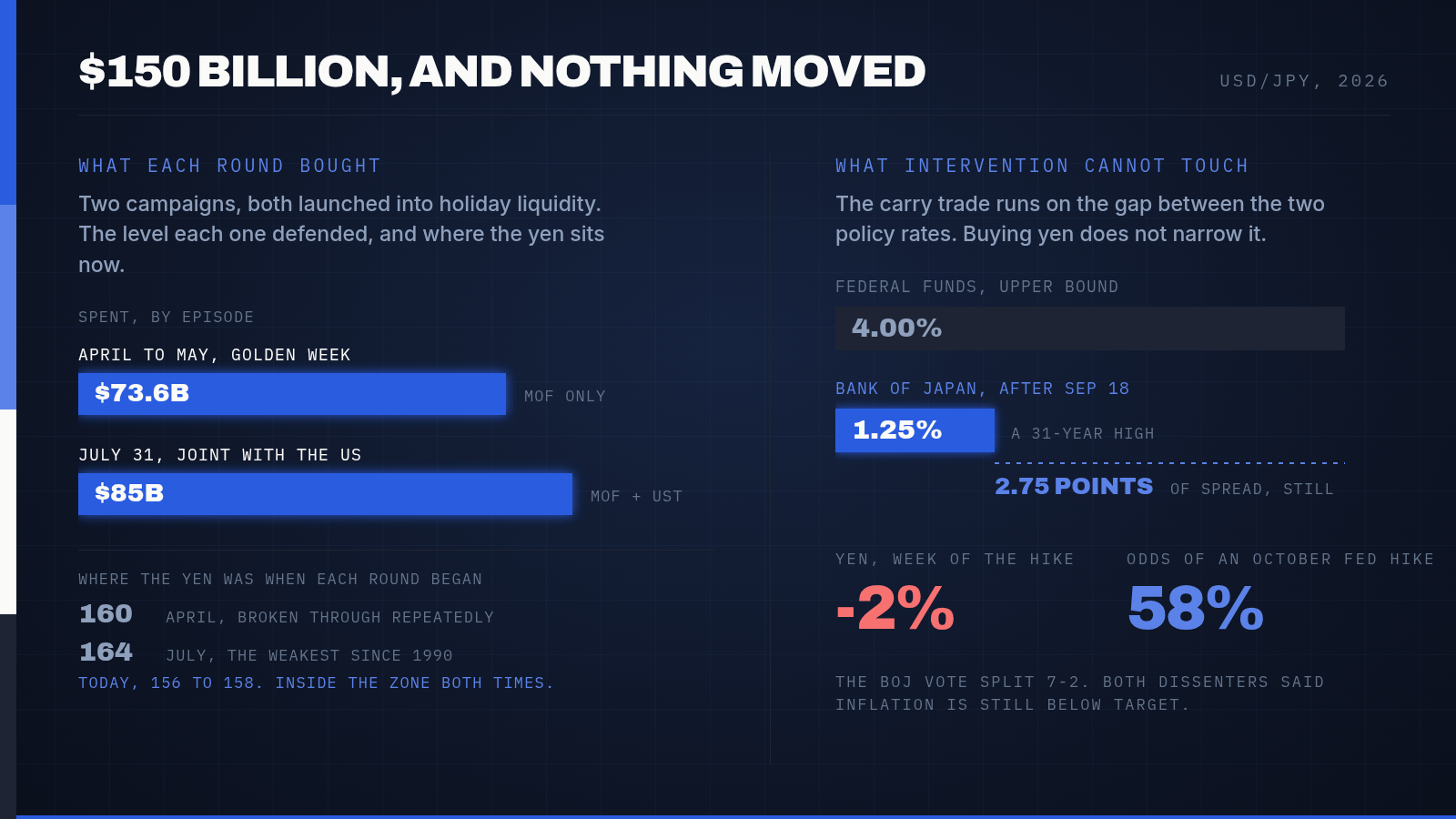
Pulse24 noted going into this month's Fed and BOJ decisions that the yen's early-September strength looked fragile. That read held up. The Bank of Japan raised its benchmark rate to 1.25% on September 18, a 31-year high, and the vote showed how contested that move was: it split 7-2, with board members Toichiro Asada and Sato Ayano dissenting on the grounds that inflation excluding fresh food remains below the BOJ's 2% target.
A rate hike is supposed to make a currency more attractive to hold. This one didn't. The yen weakened as much as 1.3% on decision day, touching roughly 158 per dollar, then slid further into the weekend, losing more than 2% for the week even with the higher rate in place. Just after midnight Tokyo time on September 19, the Ministry of Finance and the BOJ ran a rate check, calling banks to ask about their yen-dollar quotes and trading conditions. It isn't intervention itself, but traders treat it as the step that usually comes right before intervention. The yen ticked back to around 156 afterward.
Why It Matters
A weak yen next to a rising Japanese rate looks contradictory until it's set against the other side of the trade. The Federal Reserve raised its own rate to a range of 3.75% to 4% earlier this month, its first hike in more than three years, and futures markets have since pushed the odds of another quarter-point move in October toward 58%, a jump Pulse24 traced to a single Kevin Warsh comment. A BOJ rate of 1.25% next to a Fed funds rate roughly three points higher keeps the classic carry trade intact: borrow cheap yen, buy higher-yielding dollar assets, collect the spread. Morgan Stanley's FX strategists have put the fix in blunt terms. Meaningfully strengthening the yen requires either lower U.S. rates or a much faster pace of BOJ tightening than Ueda has signaled so far. Intervention doesn't change either input. It only changes the price for a few days.
That gap is expensive to fight. Finance Ministry data show a record $73.6 billion went toward yen support over a single month this spring, deployed as USD/JPY repeatedly approached and broke through 160 during the April-May Golden Week holidays. A second, larger episode followed in late July, when the pair touched roughly 164, the yen's weakest level since 1990. Japan and the US intervened jointly on July 31, their first coordinated yen-buying operation since 1998, spending a combined total near $85 billion, split roughly $53 billion to $59 billion from Japan's Ministry of Finance and up to about $26 billion from the US Treasury. Combined with the spring campaign, the two rounds of intervention this year add up to more than $150 billion, and neither one touched the interest rate gap that keeps drawing the currency lower.
What to Watch Next
The immediate question is whether Tokyo uses this week's holiday window the way it has twice before. USD/JPY was trading in the 156 to 158 range heading into the break, inside the zone where officials have acted this year but short of the 160 line that preceded the two largest interventions. A push toward that level during Monday through Wednesday's thin liquidity, with far fewer Japanese desks around to absorb the move, would raise pressure on the Ministry of Finance to repeat the rate-check-then-intervene pattern once markets reopen Thursday.
The other variable sits in Washington, not Tokyo. If the Fed's October meeting delivers the hike futures markets are now pricing at better than even odds, dollar strength could overwhelm whatever Japan does in the meantime. Treasury yields and USD/JPY have tracked each other closely through 2026, so a fresh push higher in yields is worth watching as a leading signal for the next leg in the currency.
The Pulse24 Take
Currency intervention gets covered like a dramatic, one-off event, and the headline dollar figures make that easy to justify. The more useful way to read this year's pattern is as a symptom, not a cure. Japan has spent more than $150 billion across two episodes, and the yen sits close to where it started both of them: weak, trading in the high 150s against the dollar, and once again facing a stretch of thin holiday liquidity. A wide, stable rate differential will keep attracting exactly this kind of test regardless of how far the BOJ pushes its own rate in isolation. Until the Fed cuts, the BOJ hikes considerably faster, or both happen together, a third intervention this year would surprise no one, and it could easily land during a holiday week much like this one.
How we read the data
Curious how we get from raw data to a take like this? Our Trader's Toolkit walks through the tools we lean on.
Explore the Toolkit