Pulse24 Original
Congress Couldn't Pass a Crypto Bill. The SEC Approved Tokenized Stocks Anyway.
September 19, 2026
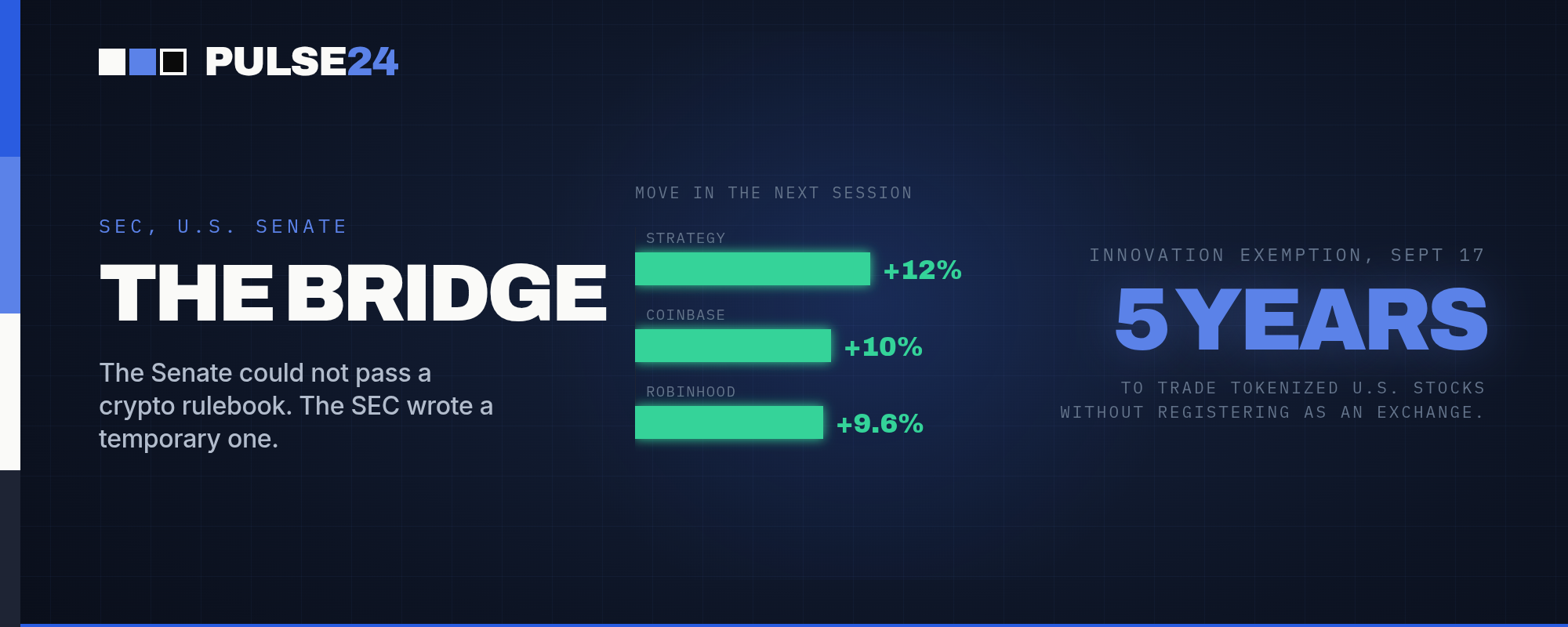
The SEC gave tokenized stock trading a five-year runway on September 17, two days after the Senate's own crypto bill failed without a single Democratic vote. Coinbase, Robinhood, and Strategy all jumped on the news, though Bitcoin's own breakout above $80,000 did some of the lifting too.
Paul Atkins signed off on a five-year experiment on September 17. His SEC will let a new kind of trading venue, called a Tokenized Securities Venue, trade tokenized versions of ordinary US stocks through automated market makers and liquidity pools, all without registering as a stock exchange. The order calls itself an "Innovation Exemption," and it is deliberately temporary: a bridge, in Atkins' words, toward rulemaking that hasn't been written yet.
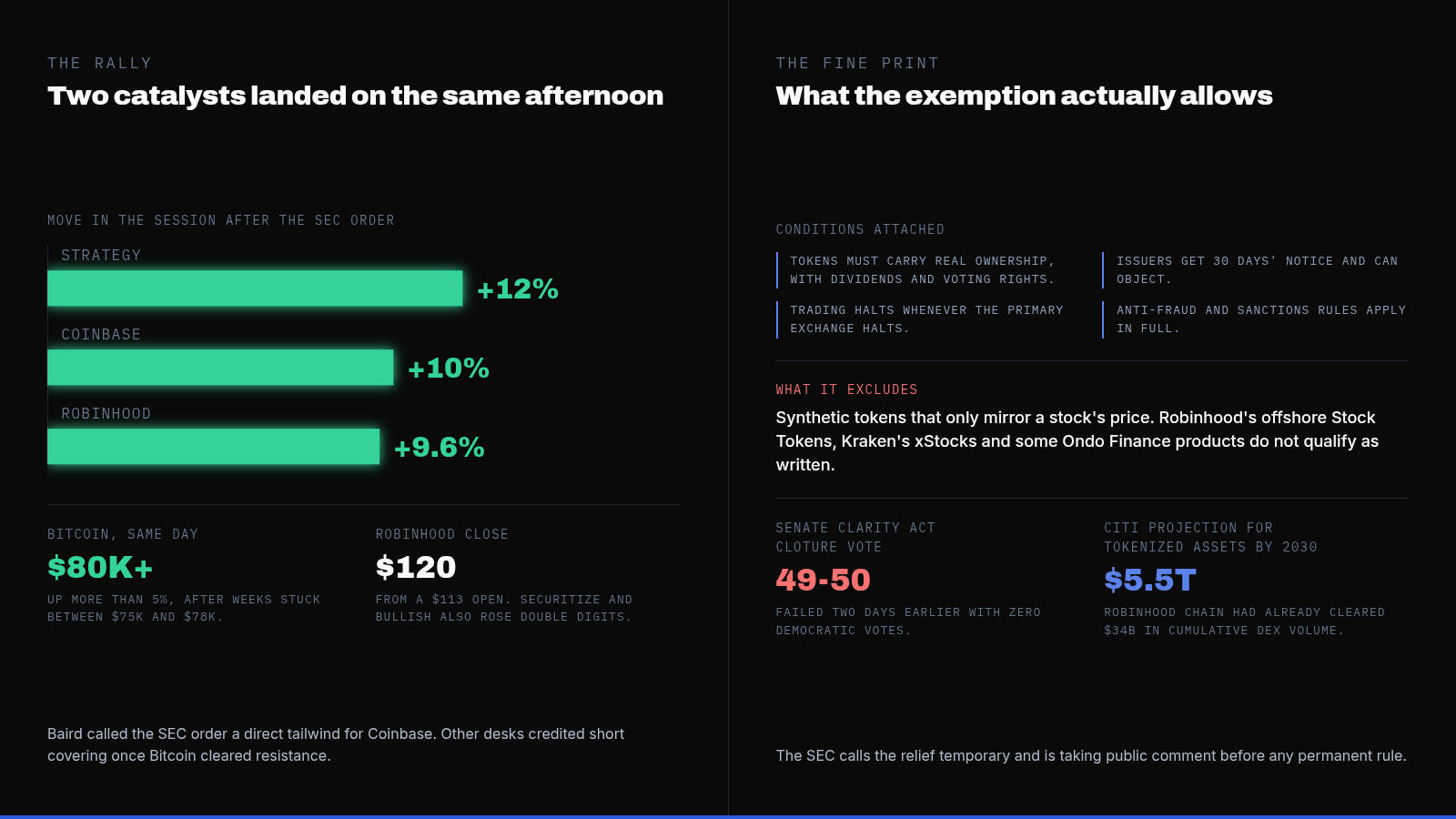
Wall Street reacted before most investors had time to read the conditions attached. Coinbase gained close to 10% in the next session. Strategy, the software company that holds more Bitcoin than any other public firm, climbed 12%. Robinhood added roughly 9.6%, closing near $120 after opening at $113. None of that happened in isolation. Bitcoin itself broke above $80,000 the same day, up more than 5%, after weeks stuck between $75,000 and $78,000. Separating the two catalysts is genuinely hard. Baird called the SEC news a direct tailwind for Coinbase specifically. Other desks pointed to short covering, once Bitcoin cleared its resistance level, as the bigger force behind the broader crypto-equity move.
What the Exemption Actually Allows
The mechanics matter more than the headline. Tokens traded under this exemption have to represent real ownership of the underlying stock, not a synthetic contract that just tracks its price. Holders get the same dividends and voting rights as anyone holding the traditional shares. Companies get 30 days' notice before a third party tokenizes their stock, and they can object. Trading has to halt whenever the primary exchange halts, liquidity providers get a temporary pass from dealer-registration rules, and every platform using the exemption has to comply with US sanctions programs. Atkins was explicit that none of this loosens existing fraud protections: "the anti-fraud and anti-manipulation provisions of the federal securities laws apply in full to all securities activities," he wrote in his public statement.
Why It Landed Now
Timing is the part of this story that doesn't show up in a stock chart. Two days earlier, the Senate's own crypto market-structure bill failed a cloture vote 49-50, with every Democrat voting no. Congress has now tried and failed to write federal rules for digital-asset markets for more than a year. The SEC's exemption fills that vacuum administratively rather than legislatively, which is exactly why Atkins called it a bridge rather than a destination: an agency can grant exemptive relief today and revoke or reshape it tomorrow, in a way that a statute passed by Congress cannot.
It also isn't the first step toward onchain stocks, just the biggest one so far. Nasdaq won a narrower SEC approval back in March to test tokenized stocks and ETFs settled through the Depository Trust & Clearing Corporation, keeping the actual trading inside familiar exchange infrastructure. Critics called that approach ring-fenced: blockchain rails bolted onto the existing system rather than a real change in market structure. September's exemption goes further. It lets permissioned automated-market-maker venues, not just exchange-run pilots, handle the trading itself.
The Catch the Stock Price Didn't Reflect
The exemption specifically excludes synthetic tokens, meaning products that merely mirror a stock's price without carrying its underlying rights, and that detail makes the stock reaction look a little premature in hindsight. Robinhood's existing offshore Stock Tokens product falls into exactly that category, and so do Kraken's xStocks and some of Ondo Finance's offerings. Robinhood's own crypto head acknowledged as much, framing the SEC's move as a signal rather than a solution: the company's current offshore product would need real structural changes before it could operate under this exemption. That didn't stop the stock from popping anyway. CEO Vlad Tenev called it "a good day for US innovation," and investors seemed to agree with the direction even if Robinhood's present product doesn't yet qualify. Its head start helps explain why: the company's Ethereum layer-2 network, Robinhood Chain, had already processed more than $34 billion in cumulative decentralized exchange volume by early September, giving it real infrastructure to build a compliant version once it wants to.
What to Watch Next
The SEC is taking public comment on the exemption, and five years is a long runway that can still be shortened or rewritten well before it expires. Watch whether large exchanges try to match the AMM-based model instead of defending the narrower, DTCC-style approach Nasdaq took in March. Watch whether smaller, purpose-built tokenization platforms like Securitize and Bullish, both up double digits the same day, end up capturing more of this market than the household names investors reacted to. And treat Bitcoin's own price action with some caution: Bitcoin shrugged off $746 million in ETF outflows just days before this rally, a reminder that crypto-adjacent prices have been moving on their own momentum lately, independent of any single regulatory headline.
The Pulse24 Take
None of this makes tokenized stocks a mainstream product yet. Five years is the SEC's own admission that it doesn't fully know what this market should look like, and the exemption's guardrails, real ownership, issuer veto rights, sanctions compliance, read like an agency trying to keep pace with technology without repeating past mistakes. What's more interesting is the sequencing: Congress couldn't get sixty votes for a crypto rulebook, and within 48 hours a financial regulator built a working version of the outcome anyway, at least temporarily. That's a pattern worth watching beyond crypto. When legislation stalls, agencies increasingly fill the gap with exemptions and no-action letters instead, and those tools can move markets just as fast as a new law, without the same permanence. The rally in Coinbase, Robinhood, and Strategy reflected genuine optimism about that shift. It also reflected Bitcoin clearing $80,000 on the same afternoon, and separating those two forces will take more than one trading session to sort out.
How we read the data
Curious how we get from raw data to a take like this? Our Trader's Toolkit walks through the tools we lean on.
Explore the Toolkit