Pulse24 Original
Japan Holds $1.14 Trillion in Treasuries. Bessent Wants a Bigger Fed Credit Line So It Never Has to Sell Them to Defend the Yen.
August 8, 2026
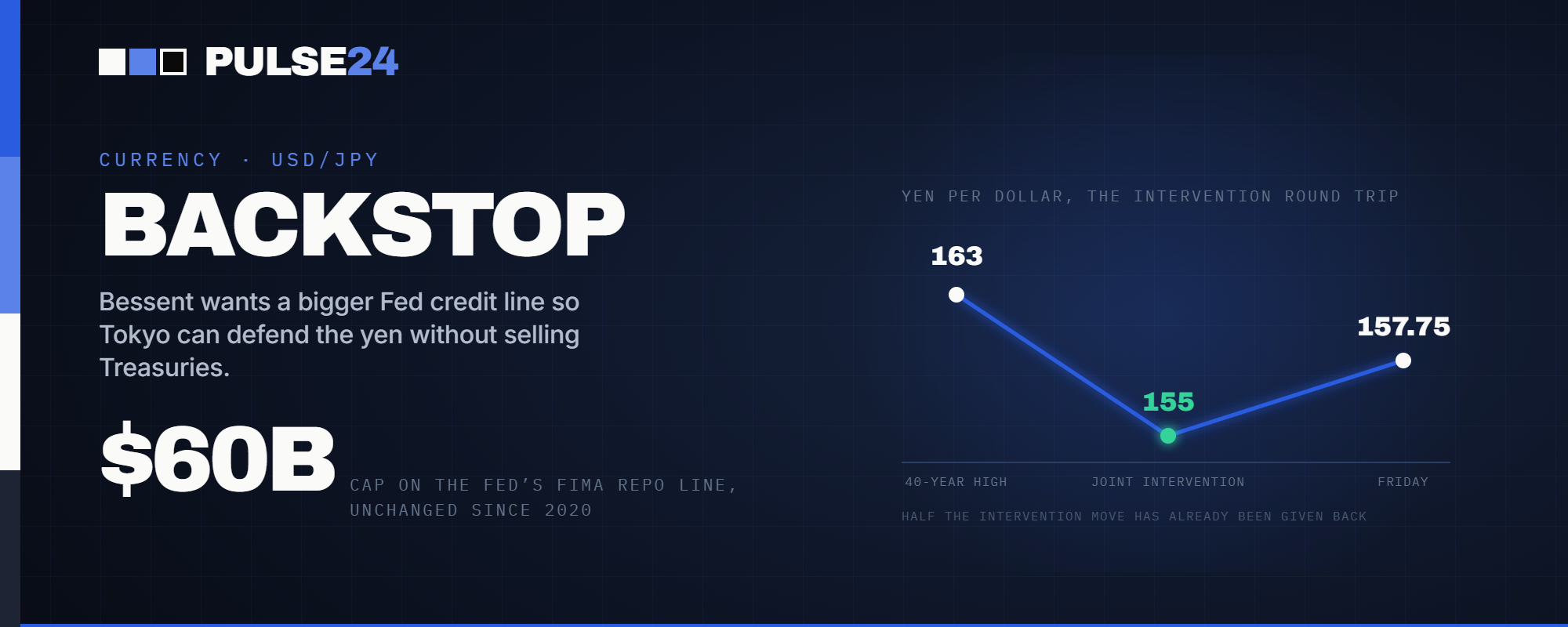
Treasury Secretary Scott Bessent wants the Fed to expand a $60 billion emergency lending facility so Japan can keep defending the yen without selling its Treasury holdings. The Fed hasn't touched the facility's size since 2020, and expanding it now would test how far Kevin Warsh's balance sheet goals bend to a currency fight.
Sixty billion dollars. That's the ceiling on the Federal Reserve's Foreign and International Monetary Authorities repo facility, a lending line most traders had no reason to think about until this week. It was created in 2020, made permanent the following year, and left untouched since. Treasury Secretary Scott Bessent wants that number raised, and he's made the case twice in four days: first in a social media post on Sunday, then in a CNBC interview the following Tuesday, arguing the Treasury market has grown so much since the facility launched that a bigger cushion would be "reasonable."
The request grows directly out of the joint intervention Washington and Tokyo carried out to defend the yen, the first time the two governments have bought the currency together since 1998. It also lands right as traders reset their expectations for how soon the Bank of Japan moves again, after Bank of America shifted its own forecast to a September hike instead of October days later.
What Changed
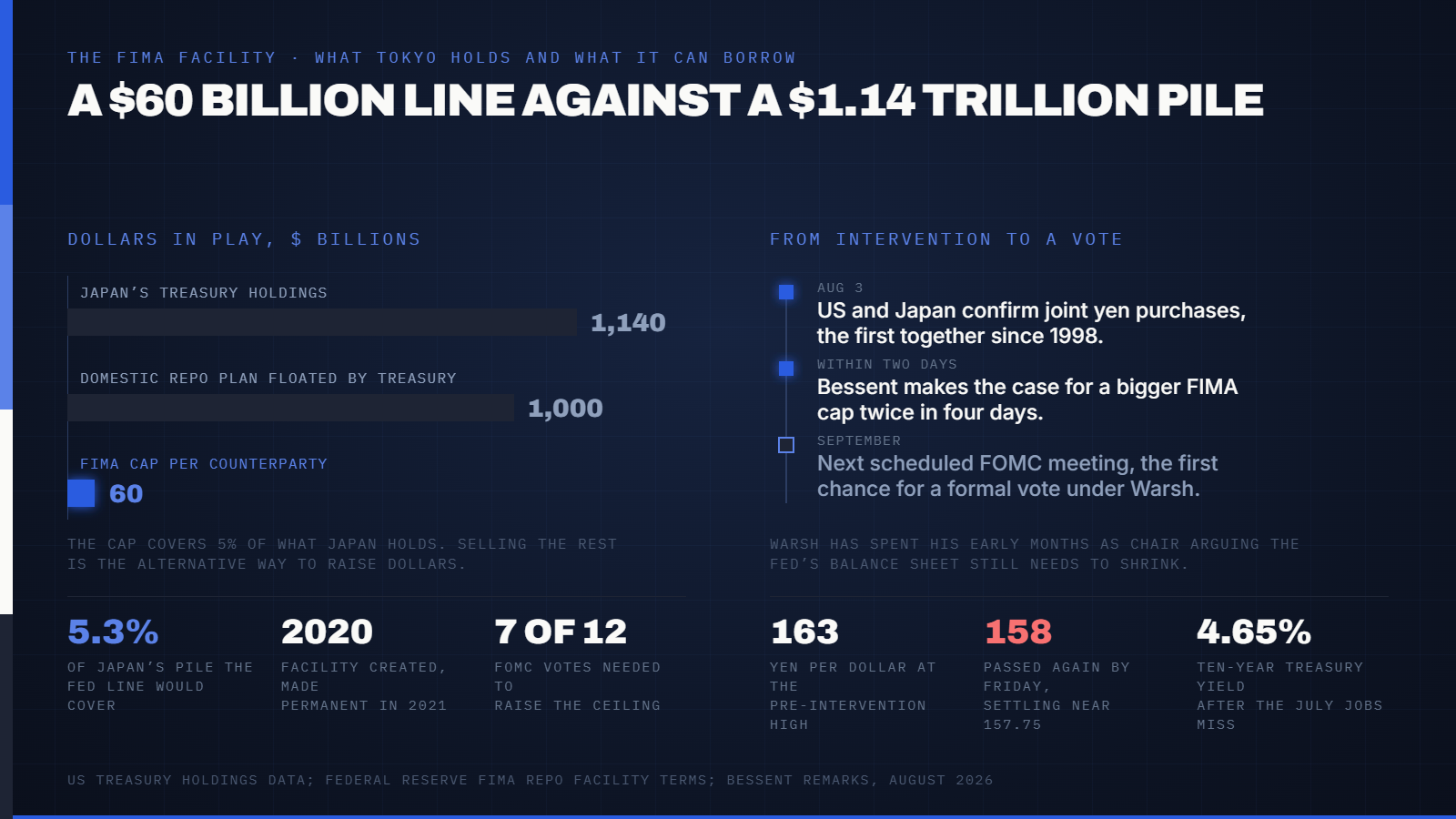
The FIMA facility lets foreign central banks and monetary authorities post their US Treasury holdings as collateral for short-term dollars, instead of dumping those bonds on the open market when they need cash in a hurry. It matters here because Japan is sitting on roughly $1.14 trillion of Treasuries, the largest stockpile held by any government outside the US. If Tokyo needs dollars to keep buying yen, it currently has two options: sell some of that debt outright, which risks pushing up the yields the Fed and Treasury are both trying to keep contained, or draw on FIMA, which caps Japan's access, like every other counterparty, at $60 billion at a time.
Raising that cap isn't Bessent's call to make. It requires sign off from a majority of the Fed's 12-member Federal Open Market Committee, currently chaired by Kevin Warsh, who took over the Fed this year promising to keep shrinking the balance sheet built up since the pandemic. A bigger FIMA facility works against that goal on paper, since it's a Fed liability that grows whenever a foreign central bank taps it. The FOMC's next scheduled meeting isn't until September, which leaves weeks of debate before there's an actual vote.
Bessent's timing wasn't subtle. The US and Japan confirmed their coordinated yen purchases on August 3, and Bessent brought up the FIMA facility within two days of that confirmation. The message reads less like routine plumbing and more like Washington signaling it's prepared to keep the intervention option open for as long as it takes.
Why It Matters
A bigger backstop changes the credibility math around currency intervention. Central banks that step in without enough visible ammunition tend to get tested by traders willing to bet against them, and once that happens the intervention usually fails. PGIM Fixed Income's Daleep Singh, a former deputy US national security advisor who now serves as the firm's chief global economist, called the proposal "a positive signal" for Treasury market functioning, the kind of standing infrastructure that makes future stress episodes less chaotic. Monetary Policy Analytics' Derek Tang framed it more bluntly, saying a bigger facility is meant to project something close to "infinite firepower" so speculators don't bother testing the yen's floor in the first place.
Not everyone reads it as a clean win. Evercore ISI has warned that upsizing the facility could do the opposite of what Bessent intends, inviting markets to probe exactly how far the US and Japan commitment extends rather than discouraging the bet altogether. There's also a balance sheet tension sitting underneath all of it. Warsh has spent his early months as chair arguing the Fed's asset holdings still need to shrink, and a larger FIMA facility, even if rarely drawn at full size, sits awkwardly next to that message. The weak July jobs report that knocked ten-year Treasury yields down to 4.65% last week already eased some of the pressure Bessent is trying to head off, which raises the question of whether this fight is being picked right as it matters least.
What to Watch Next
The yen itself is the simplest gauge. USD/JPY dropped to roughly 155 right after the intervention, then drifted back past 158 by Friday, giving back a real chunk of the move before settling near 157.75. A sustained slide back toward 160 would be the clearest test yet of whether Washington and Tokyo's follow-through matches their words, FIMA facility or not. Also worth tracking: the Bank of Japan's September meeting, where a hike would do more to close the underlying rate gap than any amount of intervention capacity, and whether the FOMC even takes up Bessent's request formally before then. A separate proposal floated earlier this month, to lend as much as $1 trillion directly into the domestic repo market, suggests officials are thinking about backstop liquidity on more than one front right now.
The Pulse24 Take
Currency defense is mostly a game of nerve, and the facility Bessent is asking for reads like a nerve play more than a cash play. Sixty billion dollars was never going to be the number that funds a sustained yen defense on its own; Japan's own reserves and Treasury holdings dwarf that figure many times over. What a bigger FIMA cap does is remove the excuse for hesitation, telling markets both governments have built the plumbing to keep doing this without straining anyone's balance sheet in a hurry. Whether that message lands probably won't be decided by a Fed vote in September. It will be decided the next time the yen drifts toward 160 and traders find out, again, whether the two governments actually show up.
How we read the data
Curious how we get from raw data to a take like this? Our Trader's Toolkit walks through the tools we lean on.
Explore the Toolkit