Pulse24 Original
The US Treasury Is Weighing Whether to Lend $1 Trillion Into the Repo Market. Wall Street Hasn't Forgotten What Happened There in September 2019.
August 2, 2026
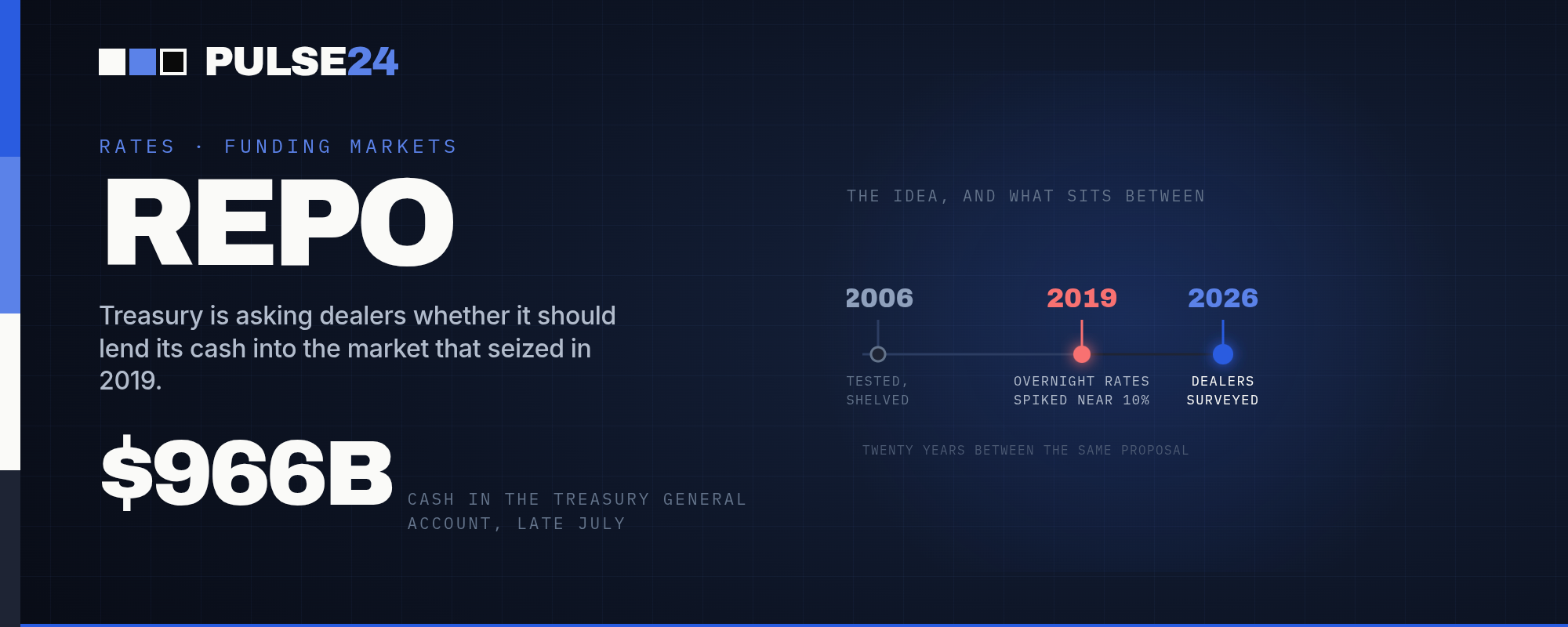
The U.S. Treasury is quietly asking bond dealers whether it should lend its own cash into the $13 trillion repo market, an idea last tried in 2006. It's a plumbing fix aimed at a funding system that already cracked once this decade, in September 2019.
Treasury officials are asking Wall Street's largest bond dealers a question the department hasn't seriously raised since 2006: should the government start lending its own cash into the repo market? Bloomberg reported this week that Treasury surveyed primary dealers in July about investing a portion of its cash balance, currently near $966 billion sitting in the Treasury General Account, directly into repurchase agreements. It sounds like a plumbing question. In a market where roughly $13 trillion changes hands every day just to keep banks and money managers funded overnight, plumbing questions are the ones that eventually show up in mortgage rates and credit spreads.
What Changed
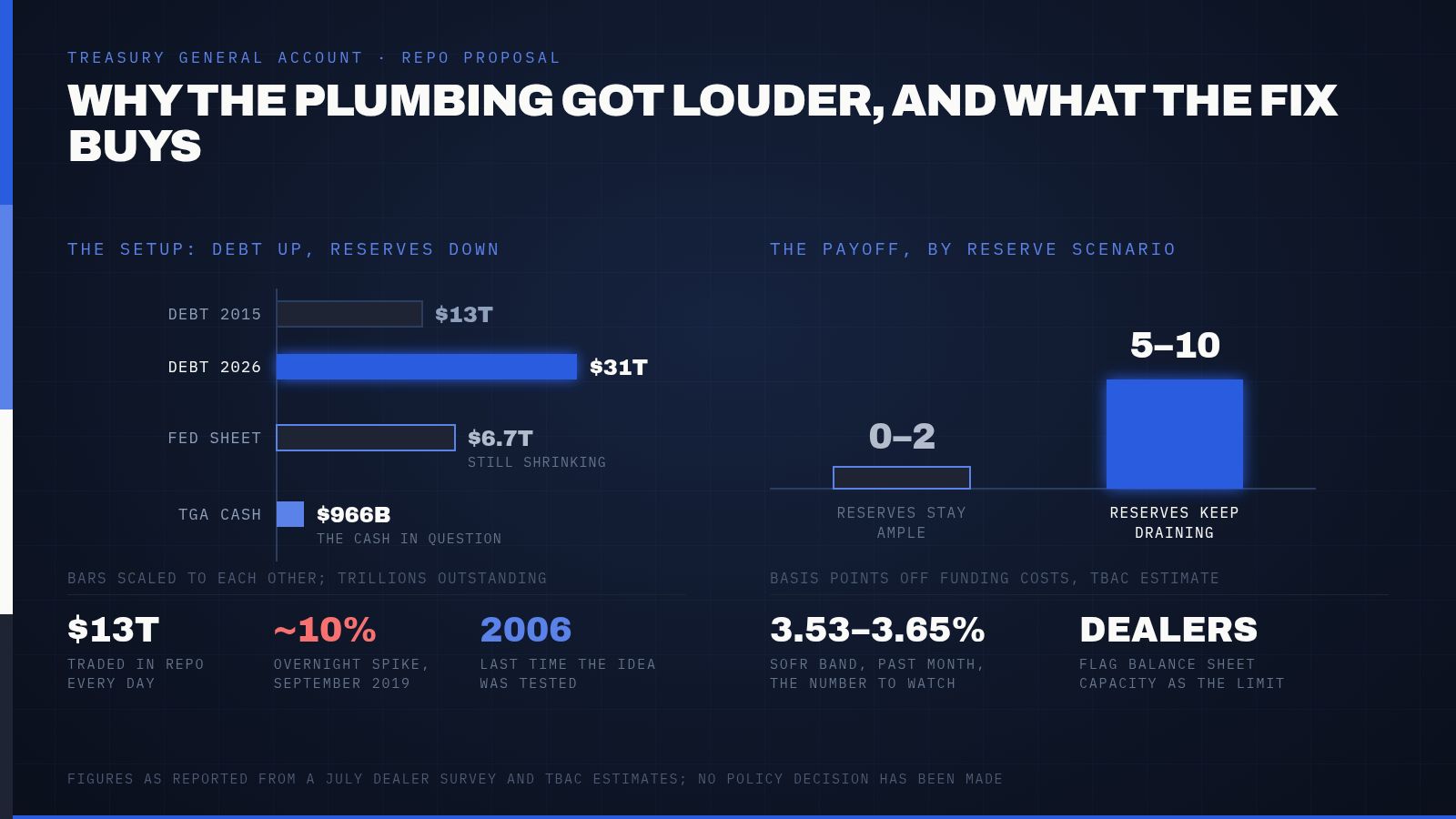
The repo market is where banks, hedge funds, and money market funds borrow and lend cash overnight, using Treasury securities as collateral. It is the plumbing underneath nearly every other market, and it usually runs quietly enough that nobody outside a trading desk thinks about it. Two things have made that plumbing louder lately. First, Treasury's own debt pile has swollen to $31 trillion, more than double the $13 trillion outstanding in 2015, and the department's cash balance now swings by enough on its own to jolt short-term rates when money moves in or out of its account at the Fed. Second, the Fed has spent more than three years shrinking its balance sheet, which now sits at $6.7 trillion, and bank reserves are edging toward the point that officials and outside economists describe as no longer "ample."
TD Securities' Gennadiy Goldberg described the proposal plainly: it is a way for Treasury to make the footprint of its own cash swings less pronounced on front-end funding markets. Bank of America's Mark Cabana went further, calling the idea the equivalent of adding another systemically important bank as a cash lender to the system. Not everyone is convinced it is worth the effort. JPMorgan's Jay Barry called it a lot of work for very little money, and dealers surveyed in July raised real concerns about whether they have the balance sheet capacity to intermediate the extra flow.
Why It Matters
This isn't happening in a vacuum. Treasury yields have already been on a wild ride this summer: the 30-year yield spiked to its highest level since 2007 after Fed Chair Kevin Warsh's dovish tone at the July 29 press conference rattled bond markets. Volatile long-end yields and a Fed that is simultaneously trying to shrink its balance sheet are pulling in opposite directions: one makes funding markets twitchier, the other drains the reserves that usually cushion the twitchiness. Treasury stepping in as a repo lender would not fix either problem directly, but it would give the Fed more room to keep shrinking its balance sheet without tripping into the kind of funding scramble that hit repo rates in September 2019, when overnight borrowing costs briefly spiked toward 10% and forced the Fed to start buying Treasury bills again within weeks.
History is doing a lot of the explaining here. Treasury tested a nearly identical idea back in 2006, two years before Lehman Brothers collapsed, and set it aside once the financial crisis rewrote every assumption about how much cash the government needed on hand. Reviving it now says something about how seriously officials are taking the current squeeze in reserves, even if the Treasury Borrowing Advisory Committee's own estimate of the benefit, 5 to 10 basis points in a tighter-reserves scenario, sounds modest next to the scale of the market it is meant to steady.
What to Watch Next
Three things determine whether this goes from survey to policy. Dealer capacity is the first: banks would need balance sheet room to actually intermediate Treasury's cash into the market, and several dealers already flagged that as a constraint. The Fed's own runoff pace is the second; if officials slow or pause balance sheet reduction, the case for Treasury stepping in weakens on its own. And the SOFR-to-fed-funds spread is the number worth watching week to week. SOFR has held in a tight band, mostly between 3.53% and 3.65% over the past month, but that band is exactly what widens first when reserves get scarce. A sustained move above the Fed's interest on reserve balances rate would be the clearest signal yet that Treasury's cash question has stopped being theoretical.
The Pulse24 Take
Nothing here reads as urgent, and that's sort of the point. Maintenance stories rarely feel important until the day they suddenly are. What stands out is the pairing: a new Fed chair leaning dovish while the balance sheet keeps shrinking, a Treasury department managing a debt load that's more than doubled since 2015, and a repo market that already broke once this decade under less pressure than it's facing now. Treasury lending its own cash into that market wouldn't resolve the tension between rate policy and balance sheet policy. It would buy the system more room to operate before that tension forces an actual choice. There's no action item here for individual investors. The SOFR spread is worth watching anyway, because in this market it tends to move before the headlines catch up.
How we read the data
Curious how we get from raw data to a take like this? Our Trader's Toolkit walks through the tools we lean on.
Explore the Toolkit