Pulse24 Original
Tokyo Core Inflation Hit 1.9% in July, Beating Every Forecast on the Street. At Least Three Bank of Japan Board Members Now Want to Hike Rates Faster Than Twice a Year.
August 11, 2026
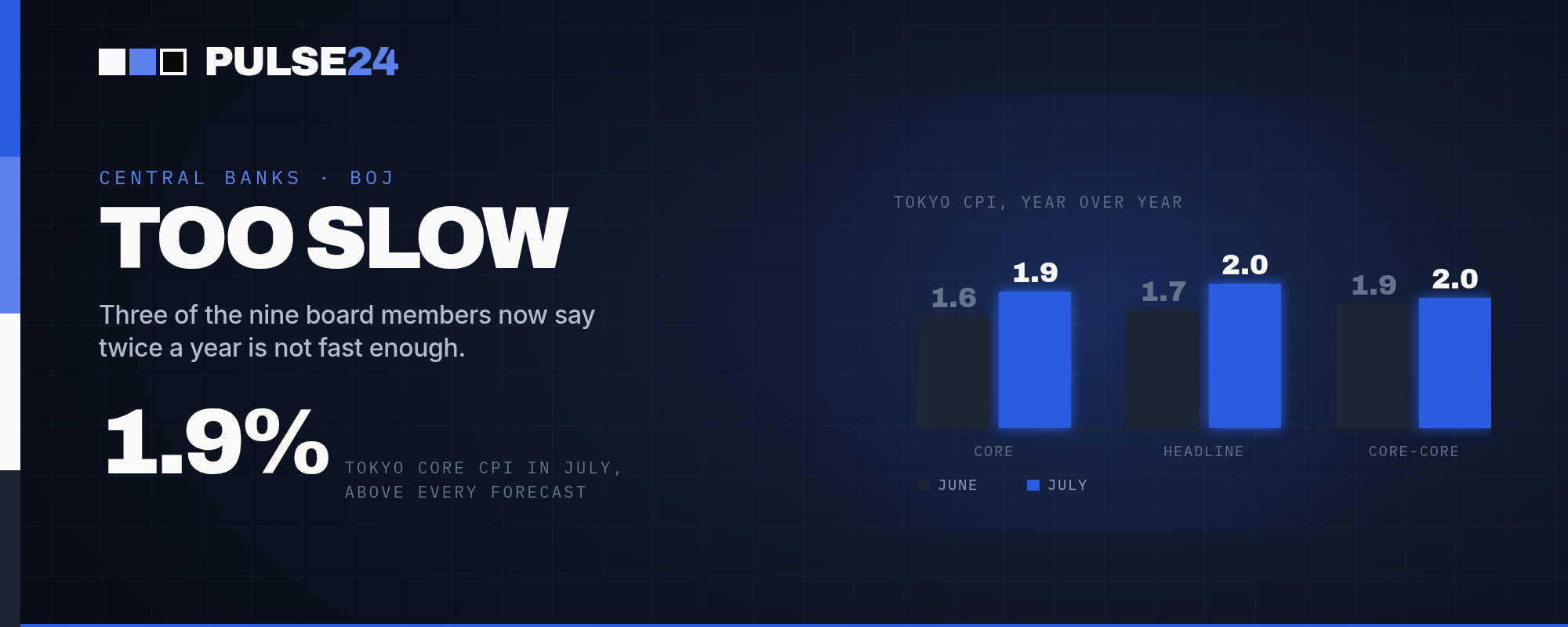
Tokyo's core inflation topped every forecast in July, and a summary of the Bank of Japan's July meeting released this week shows its own policymakers debating whether twice a year is fast enough. Markets are now pricing close to even odds on a September hike, the central bank's most aggressive stretch since it first moved off negative rates.
Tokyo's core consumer price index rose 1.9% year over year in July, topping every forecast on the Street when the data landed on July 31. Tokyo prices run about three weeks ahead of the national reading, which makes that report Japan's earliest look at where inflation is headed nationally, and it would typically have faded from view within days. It didn't, because the Bank of Japan's own summary of opinions from that same policy meeting, published ten days later on August 10, showed board members are far more anxious about the inflation trend than the bank's public statement let on.
What Changed
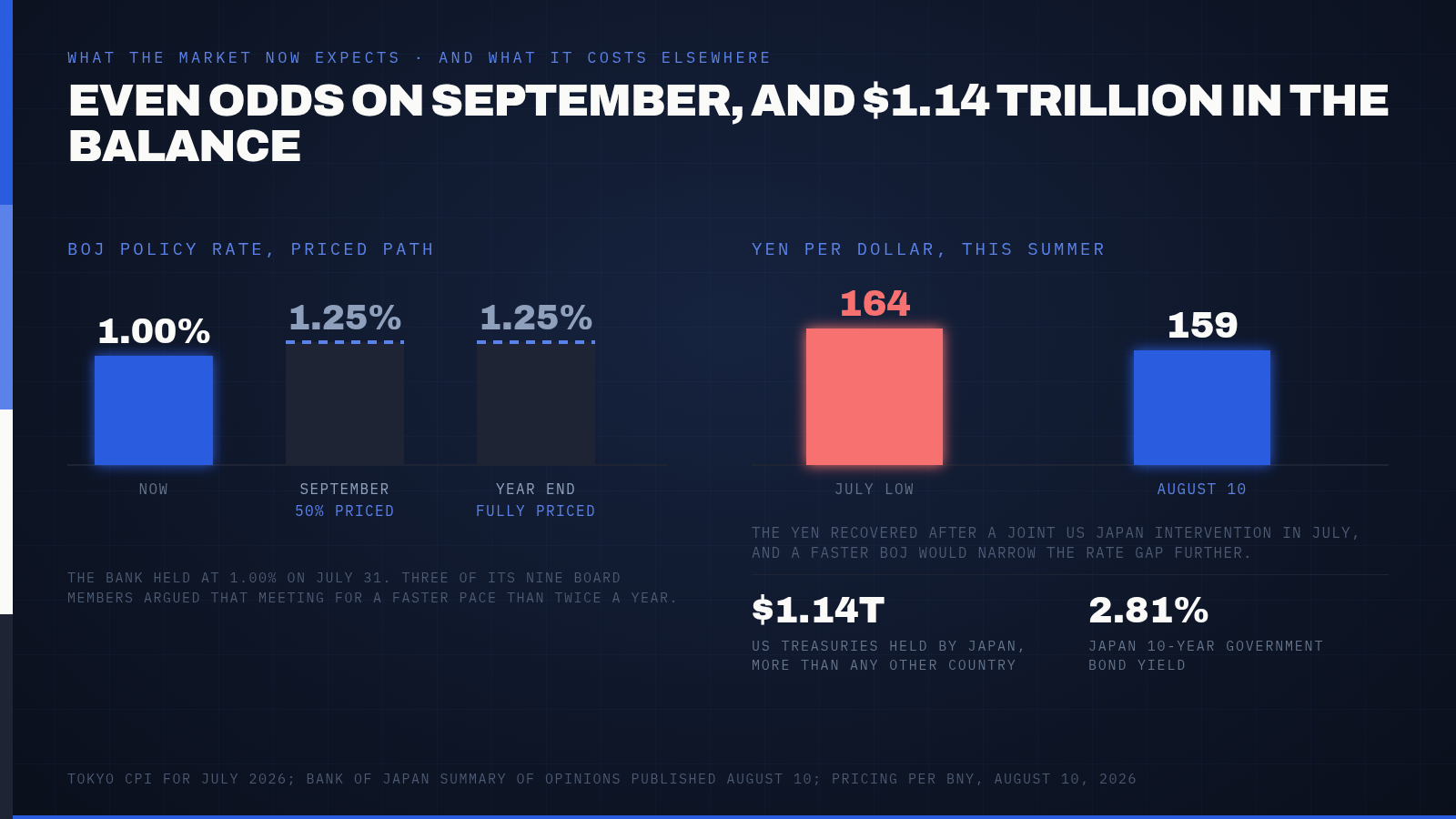
The Bank of Japan left its benchmark policy rate unchanged at 1.0% when it met on July 31. That part surprised no one. What came out this week did: a summary of opinions from that meeting, published August 10, showed at least three of the board's nine members arguing the bank should be willing to move faster than the roughly two hikes a year it has averaged since starting to normalize policy. One opinion in the summary put it plainly: "the pace of policy interest rate hikes will be faster than market expectations, depending on developments." Another argued the calculus has flipped: "it cannot be said that the risk of waiting is marginal, and it is therefore necessary for the Bank to accelerate" its pace of tightening. A third warned that delaying too long would "compel the Bank to later make rapid and substantial policy interest rate hikes, causing a double shock" to the economy.
The concern isn't hypothetical. Import costs tied to a weaker yen have been feeding into everything from food to fuel, and Tokyo's core-core measure, which strips out both fresh food and energy, still rose to 2.0% in July from 1.9% the month before. That's the reading the BOJ watches most closely for underlying price pressure, and it's now sitting above the bank's 2% target on a measure that's supposed to be the cleanest signal available. Bank of America moved its own yen forecast to 149 from 152 last month on a bet that the BOJ hikes in September rather than October. This week's summary gives that call more support than it had when BofA made it.
Why It Matters
A faster BOJ is a bigger deal outside Japan than the size of any single hike suggests. Japan holds $1.14 trillion in US Treasuries, more than any other country, and a good chunk of the world's cheap-yen funded carry trades run through Japanese rates staying low relative to everywhere else. When the BOJ moves faster than expected, that gap narrows faster than expected too, and unwinding those trades tends to happen abruptly rather than gradually.
The yen has already gotten one assist this summer. The US and Japan jointly bought yen in July for the first time since 1998, pulling the dollar down from a 40-year high near 164 to around 156. It's since drifted back to about 159, which suggests the intervention bought time rather than solved anything on its own. Treasury Secretary Scott Bessent has publicly backed the joint intervention and said he is confident Governor Kazuo Ueda will "do what is best" for Japan's economy. Bessent is due to meet Ueda at a G20 finance gathering later this month, and people close to the process have told reporters that meeting would make it hard for the BOJ to avoid raising rates in September. Markets are pricing it similarly: roughly 50-50 odds on a quarter point hike next month and a full hike priced in by year end, according to BNY's Wee Khoon Chong.
Japan's 10 year government bond yield has followed, rising to 2.81%, near the upper end of its recent range as investors price in both the inflation numbers and the prospect of tighter policy. None of this is dramatic on its own. A quarter point move from 1.0% to 1.25% is not a shock in most contexts. But it would be the BOJ's most aggressive stretch since it first climbed out of negative rates, and the internal debate around it, not just the decision itself, is what's moving markets.
What to Watch Next
Japan's national CPI for July, due later this month, will show whether Tokyo's pickup was broad-based or concentrated in a handful of categories the capital tends to see first. The BOJ's September meeting is the next real test, and board members who want to move faster will be watching the yen as much as the inflation data. A currency that keeps drifting back toward 160 despite last month's intervention makes the case for their argument; a yen that holds closer to 155 gives the more cautious members room to wait. Watch too for whether Bessent keeps talking publicly about Japan's rate path, since a US Treasury secretary weighing in on another country's monetary policy is unusual enough that it has become a data point of its own.
The Pulse24 Take
Central bank summaries of opinions rarely move markets on their own, but this one is doing real work because it tells a more honest story than the actual decision did. The BOJ held rates and said little that was new in its statement. It was the anonymous quotes from board members, published ten days later, that revealed how close the internal argument actually is and how nervous some of them are about waiting. That gap between what a central bank says publicly and what its own members are arguing behind closed doors tends to be where the real signal lives.
There is a rough parallel to July 2024, when the BOJ's own quarter point hike, small on paper, helped trigger a global unwind of yen funded trades that briefly knocked more than 10% off Japanese equities in a matter of days. Nobody is predicting a repeat, and this BOJ has spent two years signaling its intentions more carefully than it did back then. But the lesson from 2024 was that the market's assumption about how slowly Japan would move mattered more than the actual size of the hike. Right now, that assumption is shifting again, and it is shifting toward faster, not slower.
How we read the data
Curious how we get from raw data to a take like this? Our Trader's Toolkit walks through the tools we lean on.
Explore the Toolkit