Pulse24 Original
Amazon Locked In 20 Years of Nuclear Power From One Maryland Plant. Constellation's Stock Jumped as Much as 6.4%.
October 2, 2026
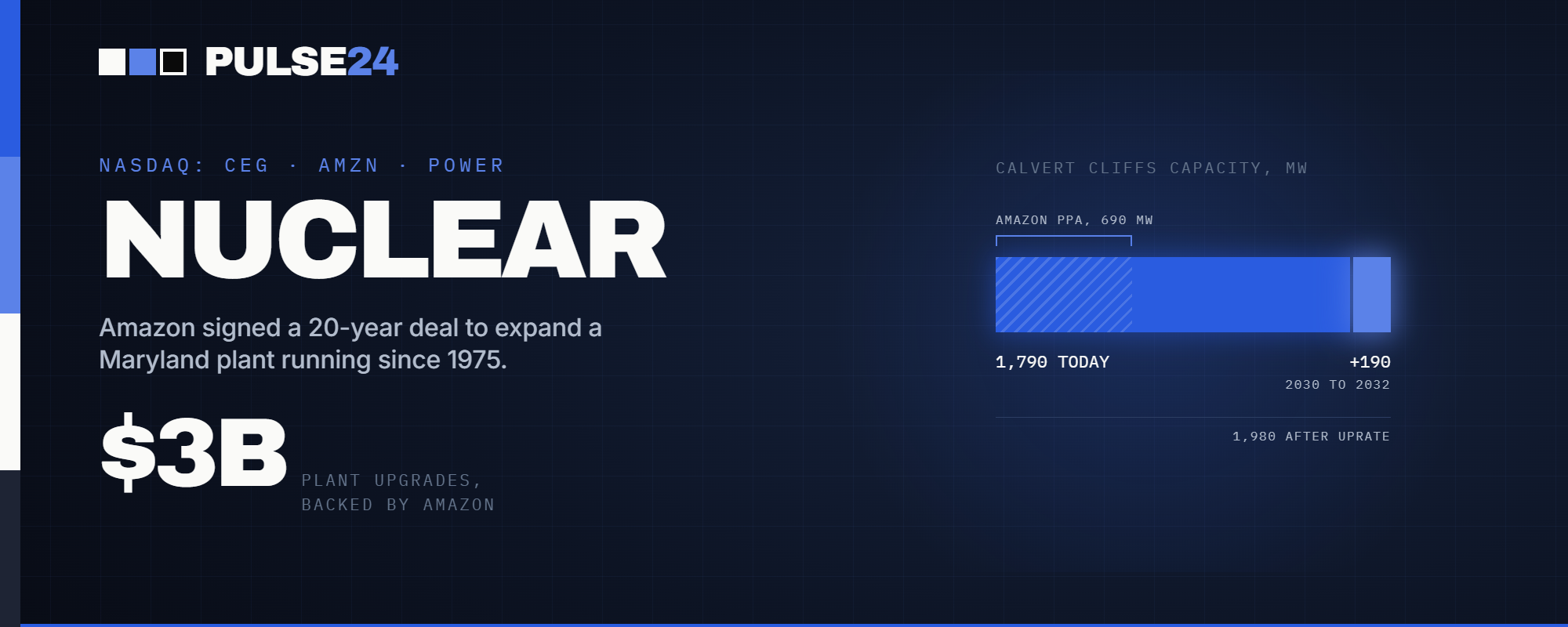
Amazon signed a 20-year, $3 billion power deal with Constellation Energy to expand a Maryland nuclear plant that's been running since 1975, and the stock jumped as much as 6.4% on the news. Uranium prices near 18-year highs show why nuclear power has become one of the tightest bottlenecks in the AI buildout.
Calvert Cliffs has been feeding Maryland's grid since 1975. Two pressurized water reactors, built when Gerald Ford was president, now sit at the center of one of the AI boom's more unusual trades. On October 1, Amazon agreed to keep the plant running for at least 20 more years, and to pay for the privilege.
The agreement has two parts. A 20-year power purchase deal covers 690 megawatts and underwrites $3 billion in facility upgrades, including a roughly 190-megawatt capacity expansion scheduled between 2030 and 2032 that would take Calvert Cliffs from 1,790 megawatts to 1,980 megawatts. A separate retail supply agreement covers Amazon's broader operations across the 13-state PJM market, the grid region that stretches from Illinois to the Mid-Atlantic. For Constellation, the revenue certainty is enough to justify relicensing the plant for another two decades and exploring next-generation reactors on the same site.
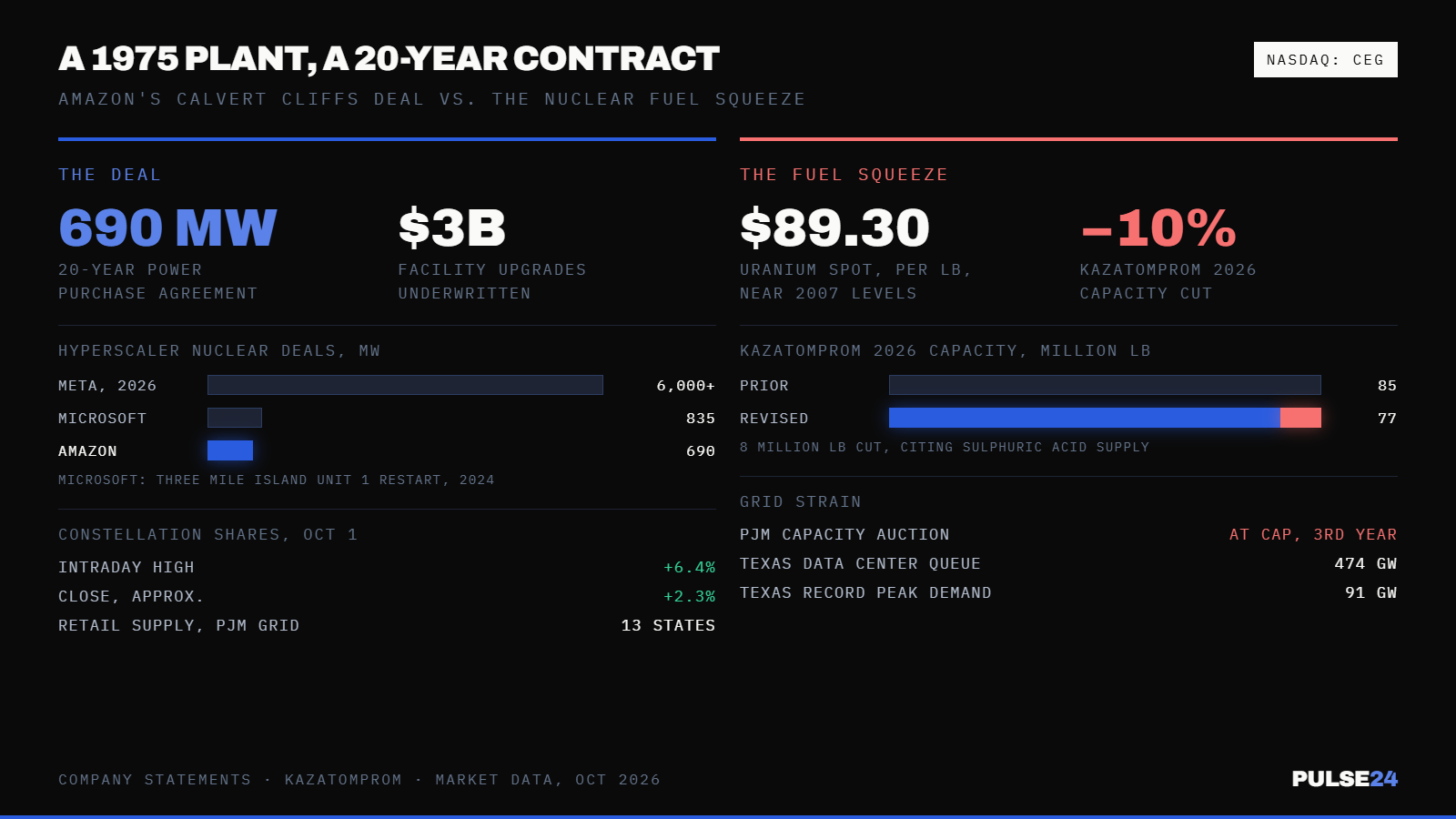
Investors reacted fast. Constellation shares jumped as much as 6.4% intraday before giving back some of the move to close up around 2.3%, a reminder that even a well-telegraphed nuclear deal can still surprise a market that's been pricing AI power demand for over a year now.
Why a 51-Year-Old Reactor Is Suddenly a Hot Stock Story
Nuclear power has quietly become one of the tightest links in the AI supply chain, arguably tighter than chips at this point. PJM's capacity auction hit its price cap for a third straight year running, a sign the grid operator serving Amazon's new deal is already strained before this agreement adds load. Natural gas prices have been catching up to that same auction pressure, and Texas has a separate data center queue requesting 474 gigawatts against a grid whose all-time peak demand record is 91 gigawatts, a mismatch that forced state regulators to consider a moratorium earlier this year.
Uranium is where the scarcity shows up most clearly in price terms. Spot uranium traded near $89.30 a pound on September 29, within striking distance of levels not seen since 2007. Kazatomprom, the Kazakh state miner and the world's largest uranium producer, trimmed its 2026 nominal production capacity from 85 million pounds to 77 million, citing sulphuric acid availability constraints and a shift toward what it calls a value-over-volume framework rather than any problem with its deposits. That's an 8-million-pound cut, roughly 10% of its own planned capacity, at the exact moment hyperscalers are signing multi-decade contracts that assume uranium will keep flowing. New mines take ten to twenty years to go from discovery to production, so this isn't a supply problem that gets solved by next quarter's capex guidance.
Why does a tech company want a 1970s reactor instead of just building more data centers and buying power on the open market? Reliability is the short answer. Nuclear plants run at capacity factors above 90%, a figure solar and wind rarely approach and that even natural gas struggles to match once maintenance and fuel logistics are counted. For a company running AI training clusters that can't tolerate rolling blackouts, that steadiness is worth paying a premium for, and worth locking in for 20 years rather than re-negotiating every few.
What to Watch Next
Calvert Cliffs still needs Nuclear Regulatory Commission approval for its uprate and eventual relicensing, a process that typically takes years rather than months. Watch whether Amazon's deal structure, a blend of direct power purchase and retail supply, becomes the template other hyperscalers copy, or whether Meta and Microsoft's more capacity-heavy commitments remain the preferred route. Uranium prices are worth tracking too: a sustained move back toward 2007 levels would be one of the clearer signals that AI electricity demand has outrun the nuclear fuel cycle's ability to respond, not just the grid's.
PJM's next capacity auction results and any further Kazatomprom guidance revisions are the two data points most likely to move this story before year-end.
The Pulse24 Take
This deal is less about Amazon and more about what happens when enormous capital meets a slow-moving physical system. AI compute can scale in months. Nuclear fuel supply chains and grid interconnection queues move in years, sometimes decades. That mismatch is why a 1970s power plant just became relevant to anyone trying to understand where AI capex actually goes once it leaves the chip layer.
The market reaction here, a 6% pop that settled closer to 2%, says investors are still working out how much of this story is already priced in. Nuclear stocks have had a strong run on AI demand narratives generally. The real test isn't whether another hyperscaler signs another power deal. It's whether uranium supply, reactor uprates, and grid interconnection can actually deliver the megawatts these contracts promise on the timeline they promise them.
How we read the data
Curious how we get from raw data to a take like this? Our Trader's Toolkit walks through the tools we lean on.
Explore the Toolkit