Pulse24 Original
Copper Hit a Record $6.78 a Pound in August. The Tariff Behind Much of the Rally Still Hasn't Been Decided.
August 29, 2026
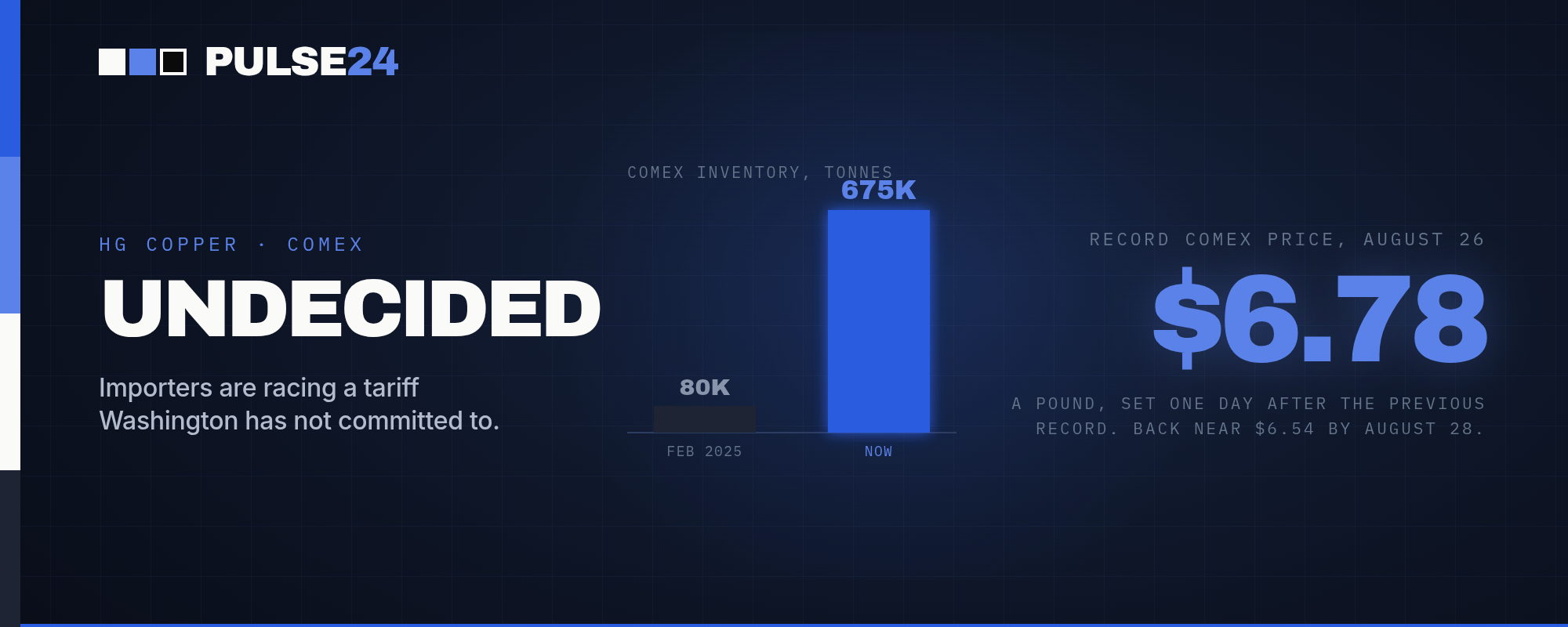
COMEX copper hit a record $6.78 a pound in late August as importers race to beat a proposed tariff on refined cathode, even though Washington missed its own deadline to decide whether that tariff happens at all. Inventories are piling up in U.S. warehouses while the rest of the world's copper market actually looks calmer than the record U.S. price alone would suggest.
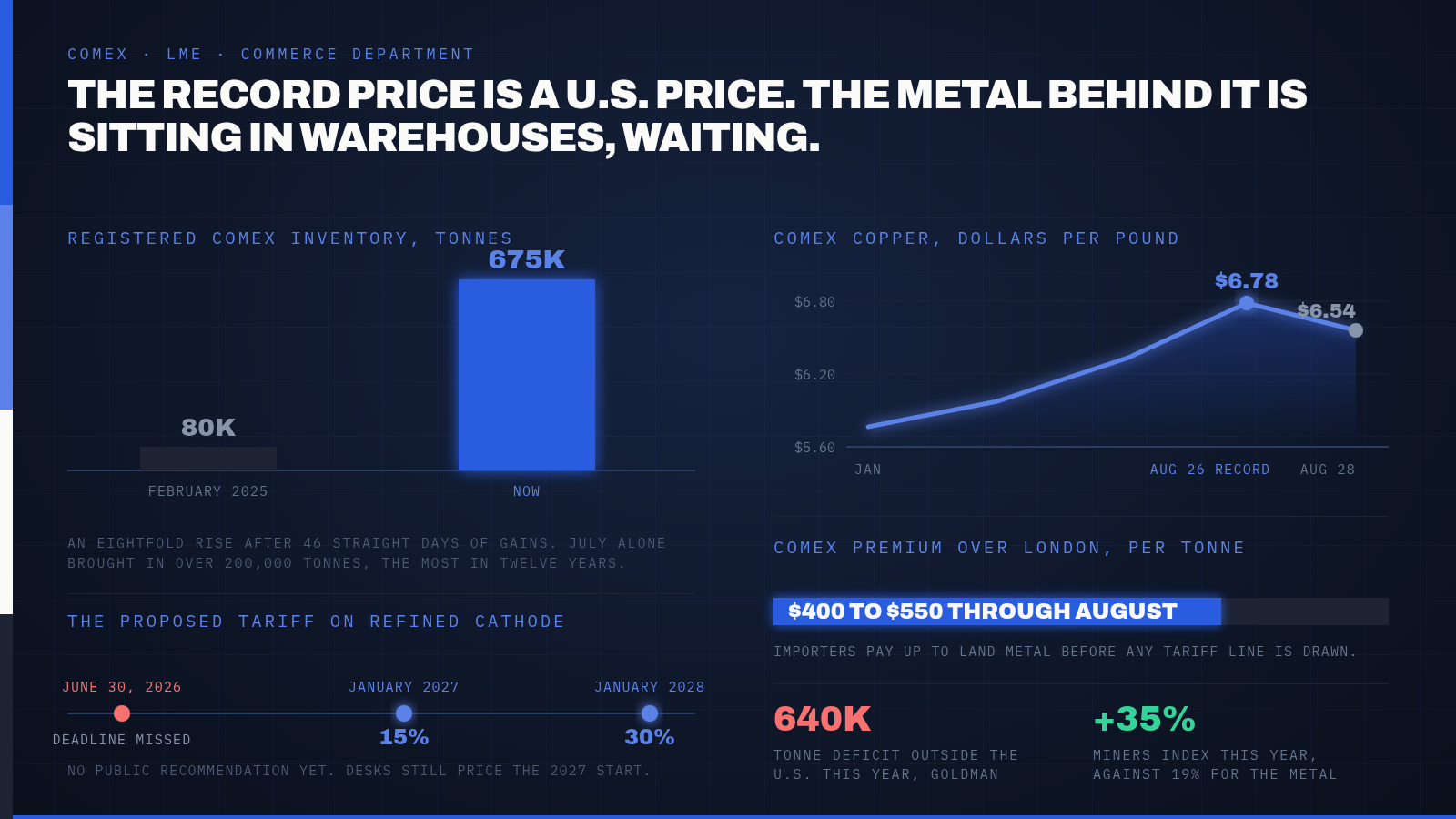
Copper touched $6.7775 a pound on the COMEX exchange on August 26, an all-time high set one day after the previous all-time high. By August 28 the price had drifted back to around $6.54, still one of the strongest years the metal has had in over a decade. Part of that move is a real story about power grids and AI data centers pulling more copper out of the ground than miners can supply. The rest of it is a tariff that Washington proposed more than a year ago and still hasn't decided whether to actually charge.
What Changed
The Commerce Department was due to tell the White House by June 30 whether a tariff on refined copper cathode should take effect, 15% starting January 1, 2027 and rising to 30% a year later. That deadline passed without a public recommendation, and as of the most recent update on August 21, no decision had been announced. Most research desks still treat the phased 2027 start as their base case, but a base case is not a confirmed policy, and traders have been positioning as though the tariff is coming regardless of what Commerce ultimately decides.
That positioning shows up most clearly in the warehouses. Registered COMEX inventories have climbed to roughly 675,000 tonnes, an eightfold increase from about 80,000 tonnes in February 2025, after 46 consecutive daily gains. July alone brought in more than 200,000 tonnes of imported copper, the strongest single month in twelve years. None of that metal has gone into new wiring or transformers yet. It is sitting in bonded warehouses on U.S. soil, waiting out a tariff deadline nobody can confirm.
The gap between COMEX and London Metal Exchange pricing shows how much of this is a U.S. story rather than a global one. COMEX has traded roughly $400 to $550 a tonne above LME through August, a premium that exists mostly because importers will pay extra to get copper onto U.S. soil before any tariff line gets drawn. The London exchange also closed at its highest level ever on Tuesday, August 25, though its January intraday peak of $14,527.50 a tonne still stands as the all-time high there. Strip out the U.S. premium and the global picture looks calmer: LME's cash premium, a separate gauge of how tight physical metal is outside the U.S., has fallen to about $248 a tonne from a five-year high of $434, meaning the rest of the world has more breathing room than the record U.S. price alone would suggest.
Why It Matters
Two separate demand stories are tangled together in this price, and mixing them up is an easy way to misread what happens next. The first is structural. S&P Global expects global copper demand to rise about 50%, from 28 million tonnes to 42 million tonnes by 2040, naming power grids, electric vehicles and AI data centers as the biggest incremental buyers. That demand curve is the same force sitting underneath Bloom Energy and GE Vernova's rough session last week, when a Wall Street Journal analysis found nine tech giants carrying $3 trillion in AI infrastructure commitments off their balance sheets. Data centers need copper for busbars, transformers and grid interconnects well before anyone gets to the chips running inside them.
The second story is policy uncertainty doing the work an actual shortage would otherwise do. CRU cut its 2026 global surplus forecast from 639,000 tonnes to what it now calls at best balanced, and Goldman Sachs models a 640,000-tonne deficit for the rest of the world this year, not because mines are producing less copper but because so much of it is being rerouted into U.S. warehouses ahead of a tariff that may or may not arrive on schedule. CRU analyst Robert Edwards put it plainly: "If imports keep coming in as they have been, then it's going to look like a deficit market in reality." The metal exists. It is simply sitting in the wrong place.
Investors have already drawn their own conclusion from this. The Solactive Global Copper Miners Index is up roughly 35% this year, nearly double copper's own 19% gain, and the pattern echoes what has already played out in memory chips, where Micron and SanDisk swung sharply on a single tariff-related headline rather than any change in underlying chip demand. Trade policy uncertainty is becoming its own market-moving input across physical commodities, running alongside whatever the demand curve itself is doing.
What to Watch Next
There is no scheduled date for the Commerce Department's refined-copper recommendation, and that absence is itself the main thing to track. Some desks think a decision could arrive before year-end given how far behind schedule the review already is, while the phased 2027 start remains the working assumption elsewhere. Either outcome, a confirmation or another delay, is likely to move the COMEX-LME spread more than it moves copper's actual global fundamentals.
Watch the inventory trend too. Forty-six straight days of gains in COMEX warehouses cannot continue forever, and the moment stockpiling slows or reverses is the moment to ask whether the rest of the rally can hold on demand growth alone. S&P Global's 2040 demand curve is a genuine long-term case for copper. It was never built to explain a jump from $6.49 to $6.78 a pound in two weeks.
The Pulse24 Take
Copper's record price is a real data point about the physical infrastructure AI is being built on top of, not just the chips getting all the headlines. Power grids and data center buildouts both run on the same red metal, and that demand isn't going anywhere regardless of what Washington eventually decides about tariffs. Reading $6.78 a pound as a clean signal of global copper scarcity would be a mistake, though. A meaningful piece of this move is importers front-running a policy decision that is now two months overdue, pulling metal into U.S. warehouses faster than anyone can use it. When a market's tightness is partly self-inflicted by policy uncertainty rather than pure supply and demand, the price can unwind as quickly as it built once that uncertainty resolves, in either direction. The AI-driven demand case for copper looks durable. The current price also carries a policy premium on top of it, and premiums attached to an undecided tariff have a way of being the first thing to go once Washington actually decides.
How we read the data
Curious how we get from raw data to a take like this? Our Trader's Toolkit walks through the tools we lean on.
Explore the Toolkit