Pulse24 Original
Tower Semiconductor's Silicon Photonics Business Just Grew 270% in a Year. The Stock Jumped 12% on Guidance That Now Trades at 88 Times Earnings.
August 9, 2026
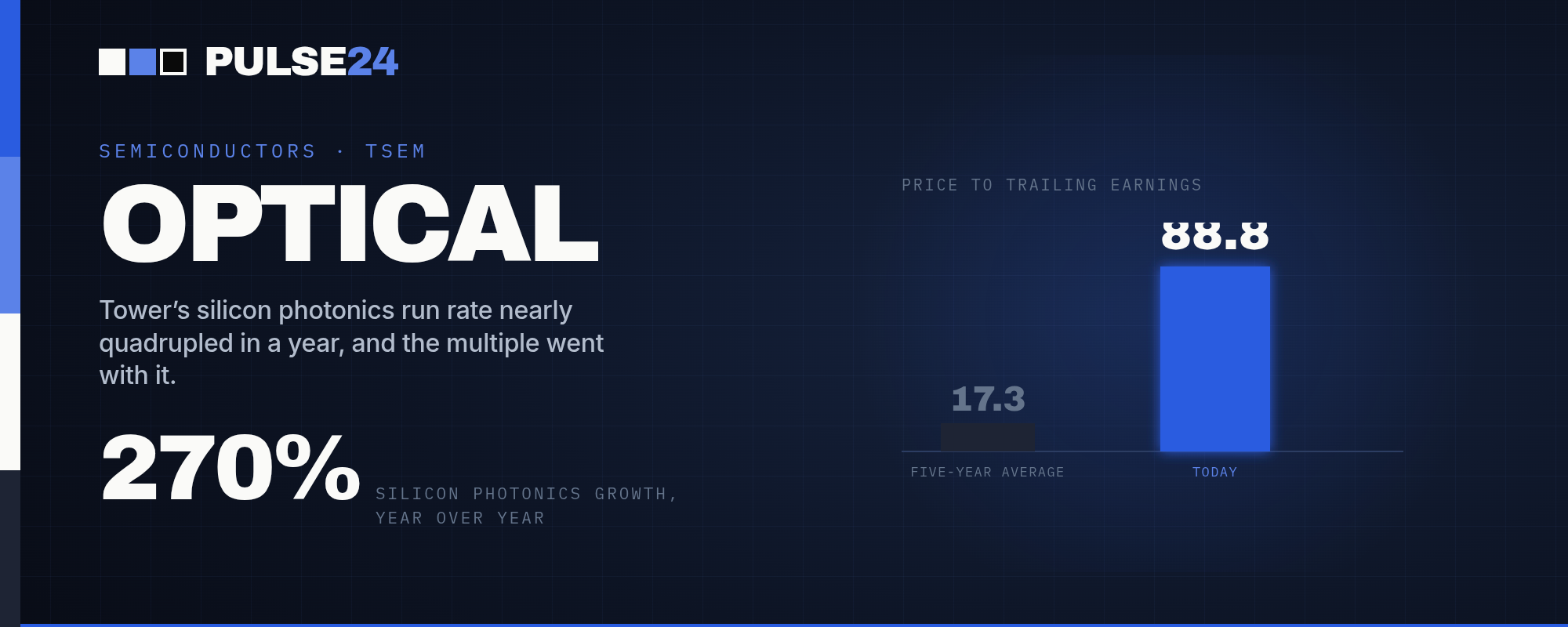
Tower Semiconductor's silicon photonics business grew 270% in a year, and Wall Street rewarded it with a 12% single-day stock jump on record guidance. The catch is that the stock now trades at nearly five times its own historical valuation multiple.
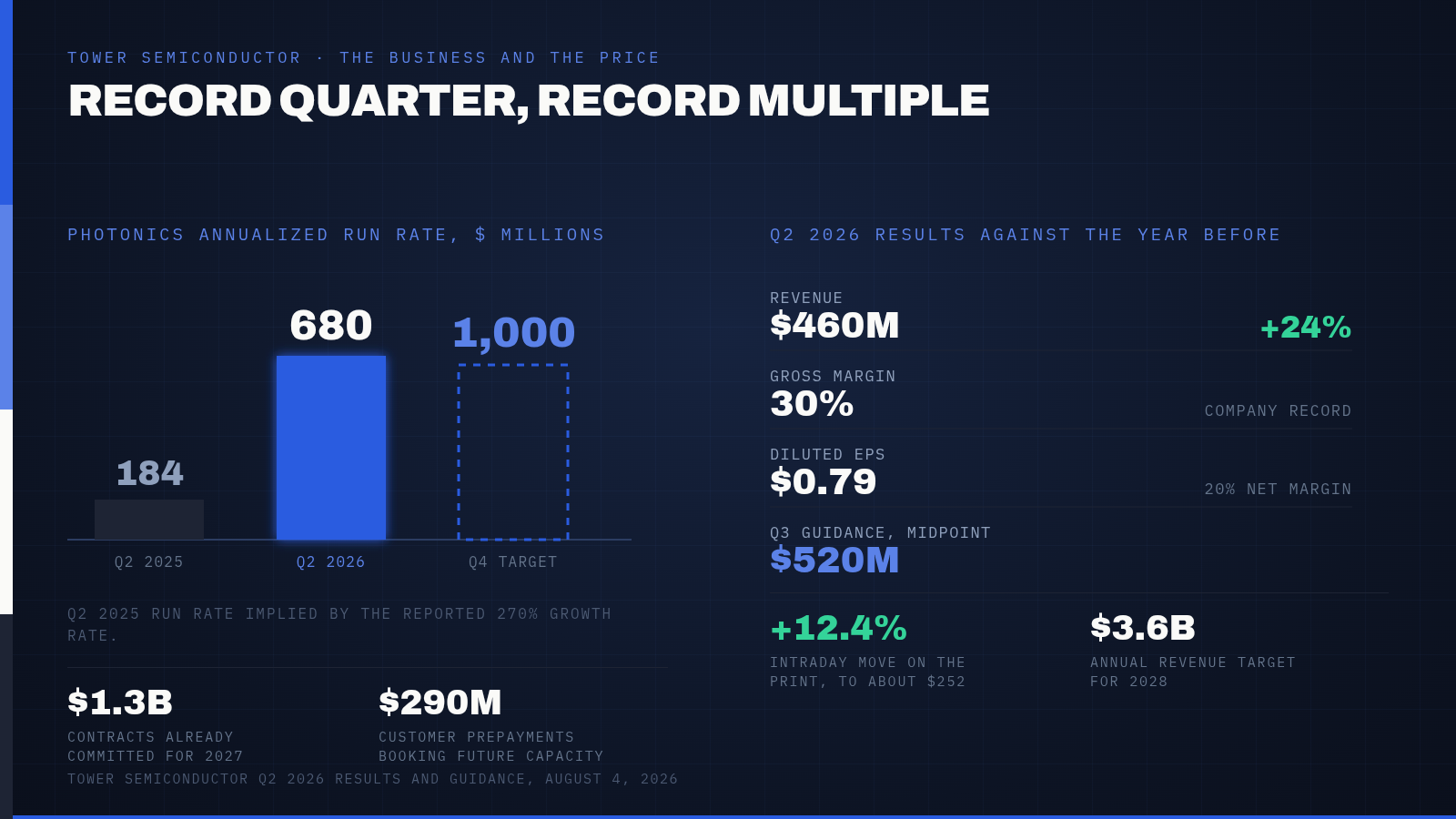
Tower Semiconductor's silicon photonics unit grew 270% year over year in the second quarter, and that single number did more to move the stock on August 4 than the company's headline earnings beat. Shares climbed as much as 12.37% intraday, touching roughly $252, after the Israeli chipmaker posted record quarterly revenue of $460 million and guided to $520 million for the third quarter.
Tower isn't a household name like Nvidia or TSMC. It's a specialty foundry, the kind of company that makes analog, RF and mixed-signal chips other manufacturers don't want to bother with. But that specialty now puts it in the middle of the AI buildout, because the industry's newest bottleneck isn't compute. It's how you move data between chips fast enough to keep hundreds of thousands of accelerators talking to each other without blowing through the power budget.
What Changed
Tower's Q2 numbers were strong on their own. Revenue rose 24% year over year and 11% from the prior quarter, diluted earnings per share came in at $0.79, and the company posted record gross, operating and net margins of 30%, 20% and 20% respectively. None of that alone explains a 12% single-day pop for a stock that had already doubled in 2026.
The real trigger was the silicon photonics disclosure. That segment's annualized run rate hit $680 million in the second quarter, and management said it's targeting a $1 billion run rate by the fourth quarter. Customers have already signed $1.3 billion in committed contracts for 2027, and Tower disclosed $290 million in customer prepayments, a signal that buyers are locking in capacity years in advance rather than shopping around.
CEO Russell Ellwanger tied the demand directly to the physics of scaling AI clusters, telling investors that clusters growing from thousands to hundreds of thousands of accelerators are pushing electrical interconnects to their practical limits. Optical connectivity, in Tower's telling, is the fix, and it's a fix only a handful of foundries can currently manufacture at volume.
Bank of America agreed with the framing. The firm initiated coverage the same week with a buy rating and a $367 price target, implying 63% upside from where the stock closed before the call, and projected the silicon photonics segment could double its revenue again in 2026.
Why It Matters
This is the same story that's been playing out across the chip sector all year: the AI buildout keeps finding new bottlenecks, and whichever company controls the current one gets re-rated overnight. High-bandwidth memory saw it first, when SK Hynix's profit jumped 557% on HBM demand, even though that stock still trades at just 5 times next year's earnings because investors aren't convinced the cycle lasts. Advanced logic capacity saw it too, when TSMC priced its 2nm wafers at $30,000 and booked its order book through 2028. Optical interconnects are just the newest link in that chain.
The difference with Tower is valuation. SK Hynix, for all its growth, still trades like a cyclical memory name. Tower now trades at roughly 88.8 times trailing earnings, more than five times its own five-year average of 17.3. That's a bet that silicon photonics revenue keeps compounding at triple-digit rates for years, not quarters. If growth slows even to a still-healthy 50% or 60% a year, a lot of that multiple has nowhere to go but down.
There's a structural reason to take the demand seriously, though. Tower is funding a dual-track fab expansion in Japan worth roughly $3 billion, net of $1 billion in Japanese government grants, backed by METI, entirely from internal cash generation without diluting shareholders. That's a company betting its own balance sheet on the demand holding, not just marketing a story to investors.
What to Watch Next
Tower's fourth-quarter silicon photonics run-rate target of $1 billion is the number to track first. It's a near-term checkpoint that will either validate the current multiple or expose it. Beyond that, watch whether other specialty foundries and packaging players start disclosing similar prepayment and multi-year contract terms, which would suggest the optical interconnect bottleneck is an industry-wide phenomenon rather than a Tower-specific one. And keep an eye on hyperscaler capex commentary in upcoming earnings, since continued references to interconnect and packaging capacity as constraints are the demand signal underwriting all of this.
The Pulse24 Take
Tower's rally is a reminder that the AI trade keeps rotating through the supply chain, rewarding whoever solves this quarter's bottleneck. That's real, and it's backed by actual contracted revenue, not just guidance. But a stock trading at five times its own historical multiple has already priced in years of flawless execution, and specialty foundries have a long history of demand cycles that looked permanent until they weren't. The theme is worth owning, but the valuation is worth watching closely.
How we read the data
Curious how we get from raw data to a take like this? Our Trader's Toolkit walks through the tools we lean on.
Explore the Toolkit