Pulse24 Original
Amazon Had to Sweeten a $25 Billion Bond Sale This Month. Wall Street's Appetite for AI Debt Is Cooling Fast.
July 28, 2026
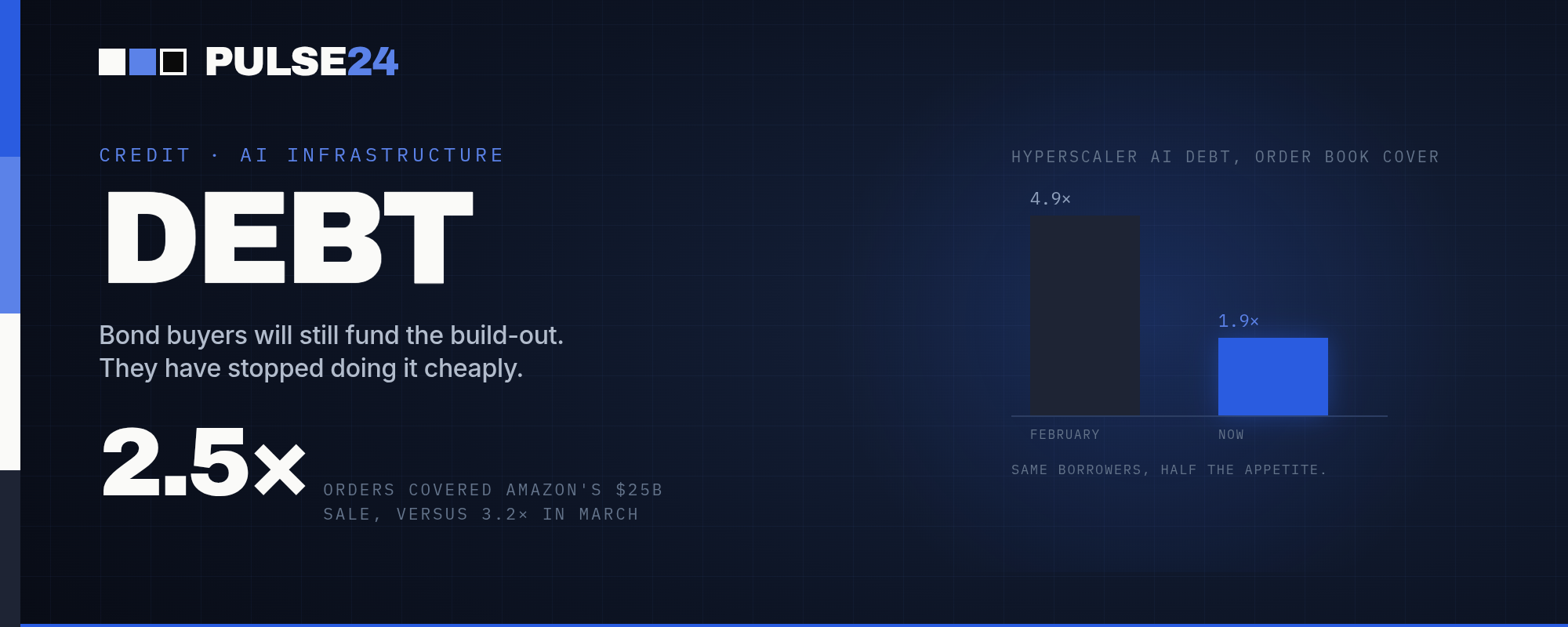
Amazon paid extra yield to get its $25 billion bond sale done this month, and across the broader hyperscaler market, order books that covered new AI debt nearly five times in February now cover less than two. That shift in the credit market is exposing a risk in the AI buildout that equities haven't fully priced in yet.
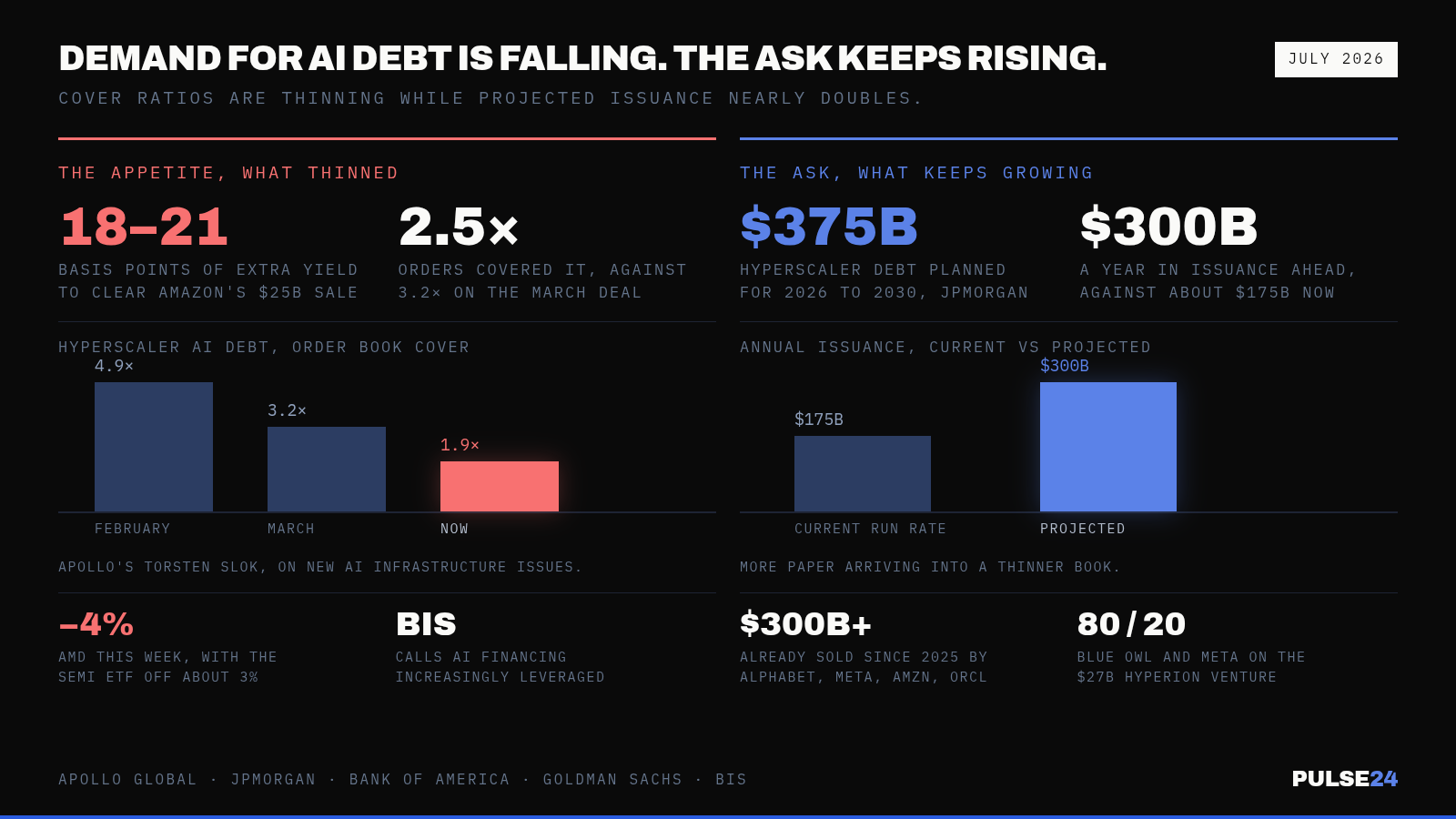
Amazon raised $25 billion in bonds this month, and it had to offer investors 18 to 21 basis points of extra yield just to get the deal done. Orders covered that sale only 2.5 times, down from 3.2 times when Amazon last sold debt in March. Look at the broader hyperscaler bond market and the shift is sharper still: order books that covered new AI infrastructure debt nearly five times in February now cover it less than two times, according to Apollo Global's chief economist Torsten Slok. Bond investors aren't refusing to lend to the companies building AI's data centers. They're getting pickier about the price, right as those companies are asking for more money than ever.
What Changed
Alphabet, Meta, Amazon and Oracle have sold a combined $300 billion or more in bonds since the start of 2025, financing the data centers, chips and power contracts behind the AI build-out. Nvidia joined them this year with its first bond sale in five years, a $25 billion offering. JPMorgan now estimates the top hyperscalers could raise roughly $375 billion in debt between 2026 and 2030, with issuance projected to run near $300 billion a year going forward, up from about $175 billion currently. Bank of America put it bluntly after Amazon's sale: investors are pushing back, and the deal itself injects more uncertainty into the AI supply outlook.
Some of this financing has moved off the traditional bond market entirely. Meta's $27 billion Hyperion data center joint venture with Blue Owl Capital is structured so Blue Owl holds 80% of the equity and Meta holds 20%, a setup that keeps most of the debt off Meta's own balance sheet while still funding the buildout Meta needs. JPMorgan's credit strategists have flagged a related risk: as AI debt issuance expands, broader bond portfolios are becoming more correlated with the fortunes of a handful of large technology companies.
Why It Matters
This isn't just a story about hyperscalers being reckless with debt for its own sake. Goldman Sachs has warned that hyperscaler capital spending is now outrunning operating cash flow, comparing the current financing structure to a rubber band stretched close to its limit, the same dynamic behind Alphabet's capex guidance triggering a one-day, 4.8% drop in the Magnificent Seven index earlier this week. Data center and power investment tied to AI is projected to run toward $3 trillion in the coming years, and possibly more than $5 trillion once new power generation is included, according to estimates from Morgan Stanley, Moody's and JPMorgan. Even companies with enormous cash flow can't fund that kind of buildout from their checking accounts alone, which is exactly why the financing mix has shifted toward corporate bonds, private credit and joint ventures like Hyperion.
That shift is showing up in equities too. Semiconductor stocks sold off again this week, with AMD down more than 4% and the VanEck Semiconductor ETF down roughly 3%, in a selloff Bloomberg linked partly to AI debt jitters alongside renewed China competition concerns, the same week Korea's Kospi sank 10% on fears about circular financing in Nvidia's OpenAI deal. The Bank for International Settlements used its own annual report this summer to warn that AI financing has become "increasingly leveraged," with complex interactions across the supply chain, and that a repricing in credit markets could tighten financial conditions quickly. When an institution whose job is watching for systemic risk starts describing an industry's financing structure that way, the equity story and the credit story stop being separate conversations.
What to Watch Next
Microsoft and Meta report earnings on July 29, with Apple and Amazon following on July 30. Listen for how each company frames its financing mix on those calls, not just its capex total. A pivot toward more off-balance-sheet joint ventures like Hyperion, rather than straight corporate bonds, would suggest management teams are already responding to the same investor pushback showing up in cover ratios. Watch investment-grade credit spreads for hyperscaler names specifically too. Bank of America and JPMorgan have both flagged early widening, and a further move would confirm the bond market is repricing AI risk rather than simply digesting a heavy issuance calendar.
It's also worth tracking whether regulators pick up the BIS's thread. The report's core message, from general manager Pablo Hernandez de Cos, was that policymakers need to act before the necessary adjustments become more costly. Whether that turns into concrete scrutiny of private credit exposure to data centers, or stays a warning nobody acts on, will shape how much this credit story matters beyond bond traders.
The Pulse24 Take
The AI trade has mostly been judged on demand: how fast revenue is growing, how much compute customers want, whether the return shows up eventually. The bond market is asking a different question, which is who actually holds the risk if that return arrives late or smaller than expected. A joint venture like Hyperion looks appealing precisely because it moves debt away from Meta's own credit rating, but the risk doesn't disappear. It just lands on Blue Owl's balance sheet and, eventually, on whoever holds the securitized pieces of that deal.
Declining cover ratios don't mean the AI buildout is ending. Plenty of hyperscaler bonds are still getting sold, just at wider spreads and with more sweeteners attached. What they do mean is that the easiest phase of financing this boom, when investors would take almost any AI-adjacent bond at almost any price, is over. The companies spending hundreds of billions of dollars a year now have to earn their financing the way ordinary borrowers do, one basis point at a time, and that's a healthier dynamic than the alternative even if it makes for less exciting headlines.
How we read the data
Curious how we get from raw data to a take like this? Our Trader's Toolkit walks through the tools we lean on.
Explore the Toolkit