Pulse24 Original
China's Manufacturing PMI Fell to 49.2, Snapping a Four-Month Growth Streak. Copper and Iron Ore Already Felt It.
August 1, 2026
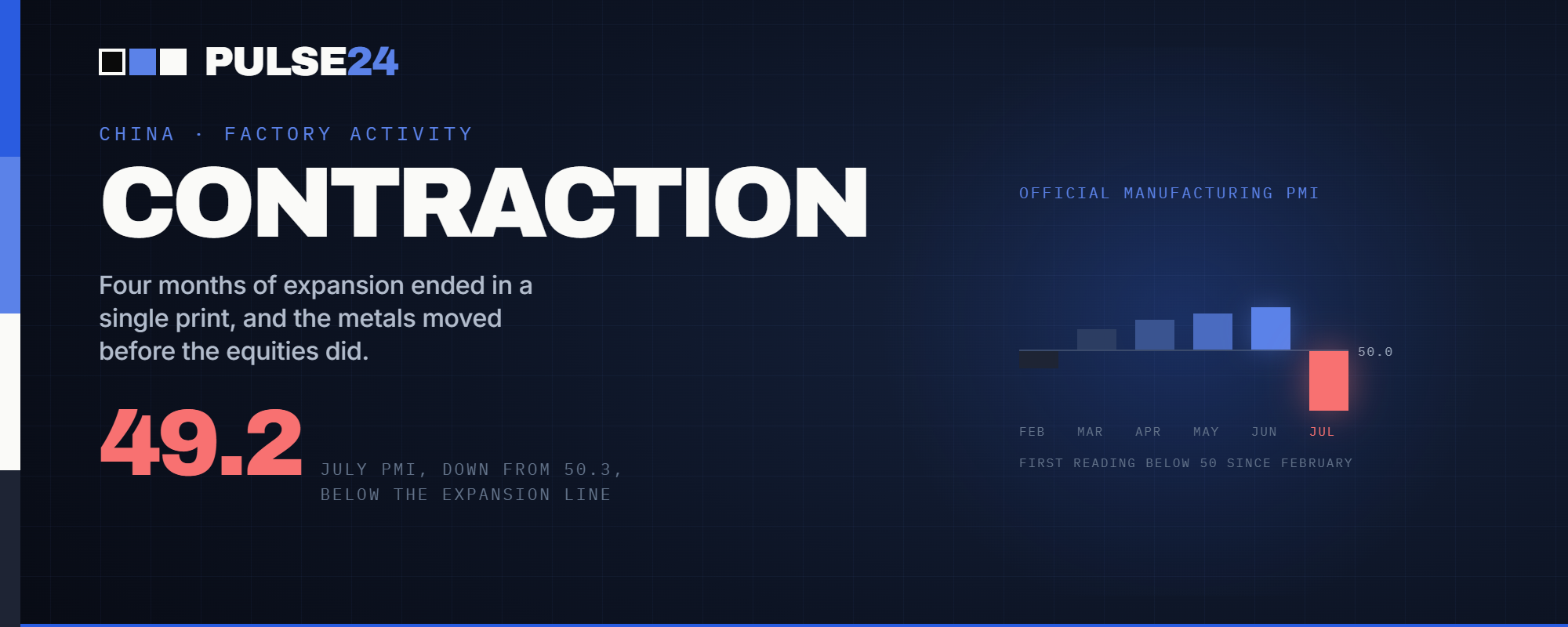
China's factory activity fell back into contraction in July, with the official PMI slipping to 49.2 from 50.3 in June. Copper and iron ore prices are already sliding on the renewed demand worries, even as Beijing's Politburo pledged fresh stimulus to keep the world's second-largest economy on track.
What Changed
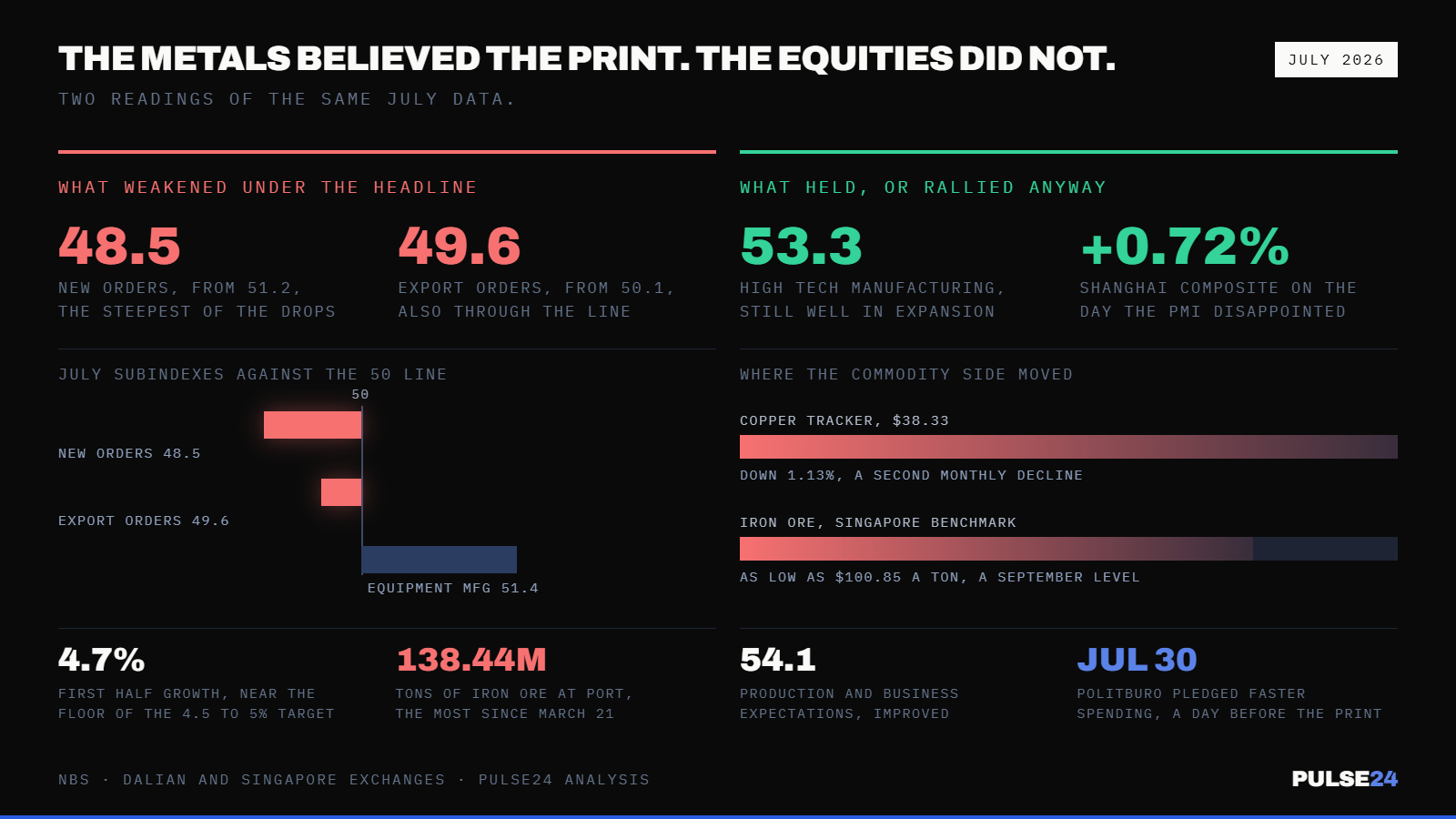
China's National Bureau of Statistics put the country's official manufacturing PMI at 49.2 for July, down from 50.3 in June and below the 50 line that separates expansion from contraction. It's the first contraction reading since February, and it ends a four-month run of expansion that had just started to look like durable momentum. New orders fell to 48.5 from 51.2. Export orders slipped to 49.6 from 50.1. Both moved the wrong way at the same time, which is usually the tell that a soft month isn't just noise from one subsector.
NBS chief statistician Huo Lihui attributed the drop to a high comparison base after a stretch of rapid manufacturing growth and the industry's traditional off-season for some producers. Independent economists weren't as quick to wave it off. Capital Economics pointed to genuine weakness in domestic demand, including construction activity, and analysts also flagged a string of typhoons that hit China in July as a likely disruption to factory output. Equipment manufacturing held at 51.4. High-tech manufacturing came in at 53.3. Production and business expectations actually improved to 54.1. The picture underneath the headline number is less uniformly weak than 49.2 alone suggests, which is exactly why the next month or two of data will matter more than this one.
The timing put pressure on Beijing to respond, and it did. The Communist Party's Politburo met on July 30, one day before the PMI release, and pledged to accelerate fiscal spending and roll out incremental measures in a timely manner to support growth. First-half GDP growth came in at 4.7% for the year, near the low end of the government's 4.5% to 5% annual target, itself weighed down by a second quarter that grew just 4.3% year over year, the weakest quarterly reading since late 2022 that pushed the PBOC into its own $139 billion liquidity injection weeks earlier. A weak PMI landing the day after a Politburo meeting that had already promised more support reads less like coincidence and more like confirmation that policymakers saw this coming.
Why It Matters
Commodity markets took the PMI at face value in a way equities didn't. Copper, often treated as a proxy for global industrial demand because it shows up in everything from wiring to construction, fell alongside the data. Its CPER tracker dropped 1.13% in the sessions leading into the print, closing at $38.33, and copper miners felt it directly: Southern Copper slipped to $178.96, Freeport-McMoRan fell to $61.64, both down on the day. Copper was already on pace for its second straight monthly decline, with traders citing uneven Chinese construction data and cautious infrastructure spending as reasons near-term demand looks capped.
Iron ore told a similar story from a different angle. Dalian futures touched their lowest level since July 10, and Singapore's benchmark contract dipped as low as $100.85 a ton, a level not seen since September 1. What's notable isn't just the price, it's the inventory sitting behind it: Chinese port stockpiles rose to 138.44 million tons, the highest since March 21, as steel mills facing squeezed margins cut back on buying and some idled equipment for maintenance rather than keep running at a loss. That's a demand problem showing up as a supply glut, and gluts tend to take longer to clear than a simple price dip.
Equities read the same day's news almost the opposite way. The Shanghai Composite still rose 0.72% on July 31, adding to a year that's up 7.69% even after a rough July, and the gain came almost entirely from semiconductor names: Cambricon jumped 10.2%, Semiconductor Manufacturing International Corp added 8.1%, and smaller optical component makers like Zhongji Innolight and Eoptolink rallied even harder. Investors chasing China's chip self-sufficiency push aren't pricing the same thing copper traders are. One group is betting on how much China invests in building its own technology stack. The other is watching how much its factories and construction sites are actually buying and building with right now. Both can be true, and both are informative, just about different parts of the same economy.
What to Watch Next
The next real test is whether the Politburo's language turns into something with teeth. Incremental measures is vague enough to mean anything from a modest reserve requirement ratio cut to a much larger fiscal push, and markets have learned to wait for specifics rather than trade the rhetoric. August's PMI print will matter more than usual too: if 49.2 was genuinely a one-month blip from a high base effect, as the NBS suggested, a bounce back above 50 would confirm it, while a second straight contraction month would say something different. Copper and iron ore prices into mid-August are worth tracking as well, since both are more sensitive to real-time demand signals than backward-looking GDP data, and a continued slide would argue the PMI wasn't a fluke.
The Pulse24 Take
The easy read on a 49.2 print is that China is slowing and the exposure should go. A harder, more useful read is that this economy is currently running two different stories at once. The physical, construction-and-manufacturing side is genuinely soft, soft enough that commodity markets that live and die on actual tonnage moved priced it in immediately. The technology and equipment side, particularly anything tied to semiconductors and AI infrastructure, is still finding buyers even on a day the broader data disappointed.
That split matters for how to think about China exposure generally, not just this print. A single PMI number rarely tells you which of those two economies will win out over the next few quarters, and Beijing's own sub-indices suggest even policymakers see it that way, choosing to frame July as a base-effect blip rather than a trend. What we'd watch closest isn't the headline 49.2 itself, it's whether the Politburo's incremental language becomes an actual RRR cut in the coming weeks. That's the difference between officials talking about support and officials actually providing it, and commodity markets in particular are unlikely to stabilize until they see the latter.
How we read the data
Curious how we get from raw data to a take like this? Our Trader's Toolkit walks through the tools we lean on.
Explore the Toolkit