Pulse24 Original
China Grew at Its Slowest Pace Since 2022. The PBOC Just Answered With $139 Billion.
July 24, 2026
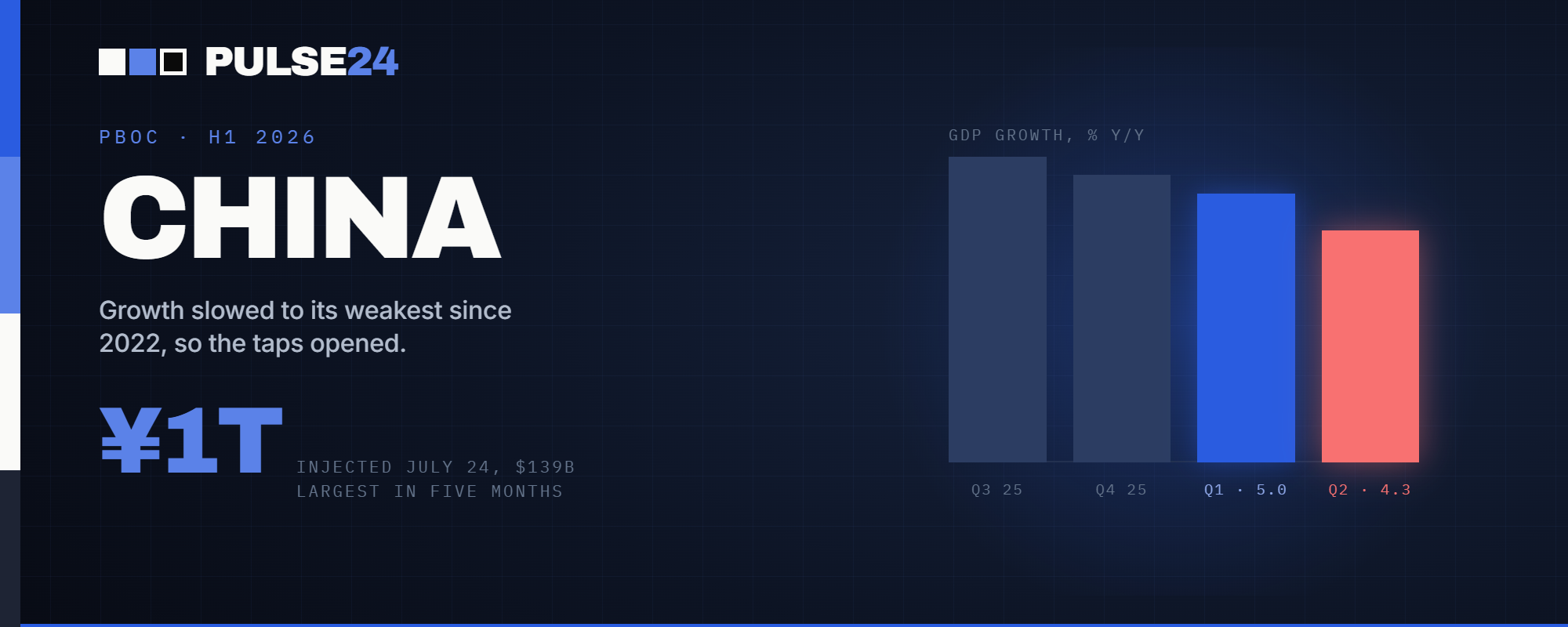
China's economy grew just 4.3% in the second quarter, its weakest reading since late 2022, and the PBOC responded Friday with roughly 1 trillion yuan ($139 billion) in fresh liquidity, its biggest injection in five months. It's landing in the same week the Fed is leaning hawkish on oil-driven inflation, putting the world's two largest central banks on opposite paths at the same time.
What Changed
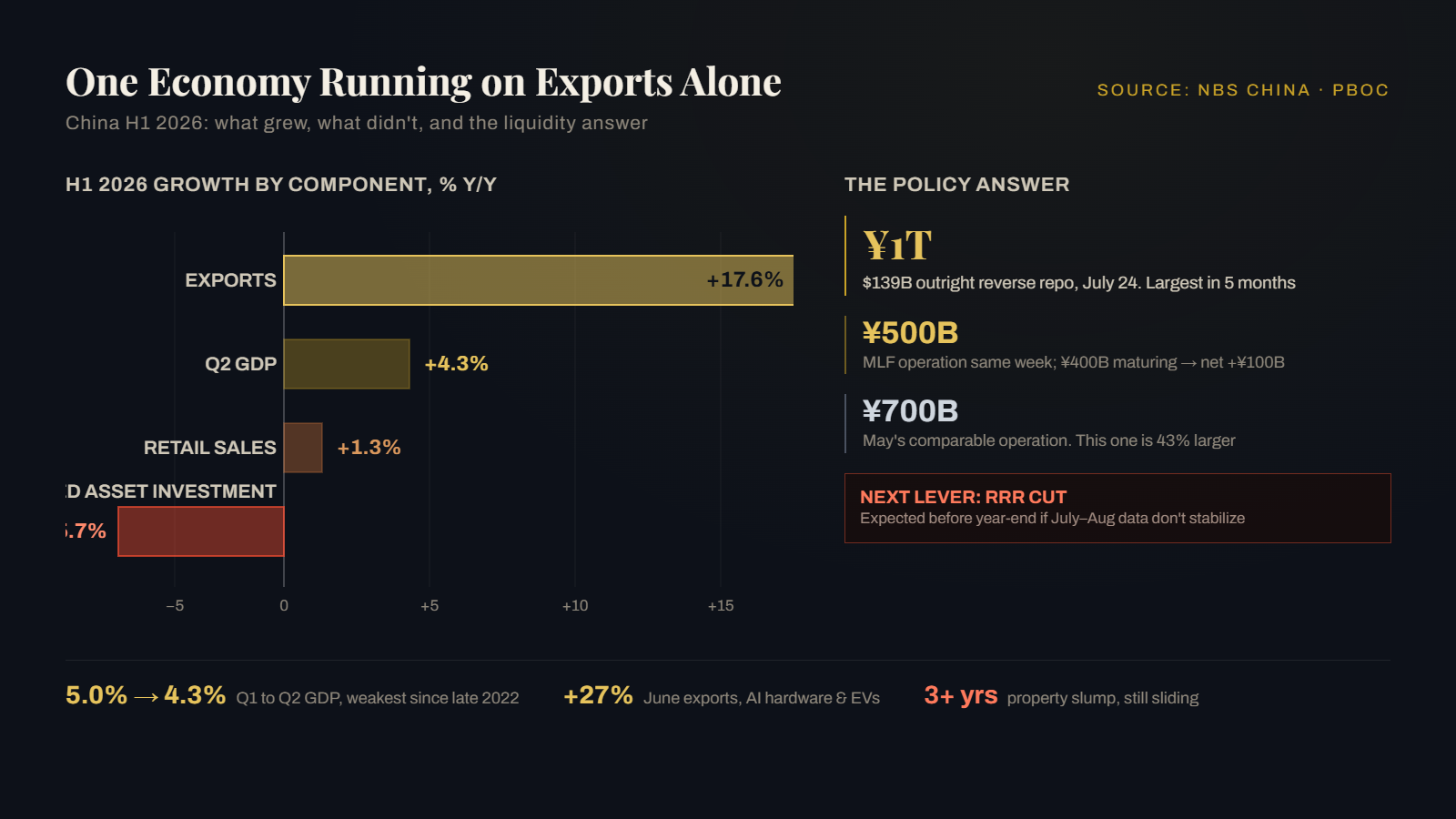
On Friday, the People's Bank of China pushed roughly 1 trillion yuan, about $139 billion, into the banking system through an outright reverse repo operation. It's the largest liquidity injection China has made in five months, and it didn't come alone. A separate 500 billion yuan medium-term lending facility operation landed the same week, and with 400 billion yuan of old MLF debt maturing, that nets out to another 100 billion yuan of fresh money. Two operations, one intent: keep cash cheap and keep it flowing.
The timing tells the real story. Nine days earlier, China reported second-quarter GDP growth of 4.3% year-over-year, down from 5.0% in the first quarter and the weakest quarterly print since late 2022. Retail sales crept forward just 1.3% in the first half. Fixed asset investment fell 5.7%. Housing prices kept sliding, extending a slump that's now stretched past three years. The one line of the report that looked strong was exports, up 17.6% in the first half and 27% in June alone, carried largely by AI hardware and electric vehicles shipped abroad, the same export strength sitting behind China's growing challenge to Western AI labs' pricing power. China's own deputy statistician, Mao Shengyong, described what's underneath those numbers without much spin: the imbalance between strong supply and weak demand remains acute.
China's central bank has injected cash before, but the size and framing of this operation stand out. The 1 trillion yuan reverse repo compares to a 700 billion yuan operation in May, and the PBOC was explicit about why: to ensure ample liquidity in the banking system and help commercial banks bring down their funding costs. Officials also pointed to global economic uncertainty and friction in the broader Sino-US economic relationship as part of the backdrop, without spelling out specifics.
What makes this easing cycle different from prior ones is where China sits on rates and inflation. Its real interest rates are relatively high right now, not because policy is tight in any absolute sense, but because inflation is so low that even modest nominal rates translate into real borrowing costs well above what the US or Japan are running. That gives the PBOC room the Fed doesn't have. Analysts covering the space expect additional reserve requirement ratio cuts before the end of the year if the growth data doesn't turn, freeing up more capital for banks to lend without touching the benchmark rate directly. The bond market read it as dovish: 30-year Chinese treasury futures rose on the news, a sign investors expect this easing bias to persist rather than reverse.
Why It Matters
Central bank divergence isn't new, but this particular pairing is worth sitting with. The Fed's hawkish lean this month has nothing to do with US growth outrunning its potential. It's an oil shock, tied to an escalating Middle East conflict, pushing Brent crude toward $100 and inflation expectations higher along with it. The PBOC's easing has nothing to do with inflation either. It's a direct response to a domestic economy where consumers aren't spending, developers aren't building, and growth increasingly depends on how much the rest of the world buys from Chinese factories. Two central banks, two entirely different problems, arriving at opposite policy signals in the same week.
That divergence flows through to currency and capital markets whether or not either central bank intends it to. A Fed that holds rates higher for longer normally pulls capital toward dollar assets, and a PBOC that's easing normally puts pressure on the yuan. But the mechanism this time is unusual: the Fed's hawkishness is coming from a supply shock rather than domestic strength, which is a shakier kind of dollar support than a genuinely overheating US economy would provide. Meanwhile, China's push to buy gold has picked up as its own currency and growth outlook wobble, evidence that Chinese savers and institutions are treating hard assets as ballast while policymakers work the liquidity taps. None of this happens in isolation. A weaker yuan against a Fed-driven strong dollar makes China's exports even more competitive at the exact moment exports are the only part of its economy actually working, which in turn keeps downward pressure on global goods prices even as oil pushes energy inflation the other way.
What to Watch Next
The reserve requirement ratio is the next lever to watch. If China's July and August data don't show retail sales and investment stabilizing, a cut becomes more likely than not, and it would be the clearest signal yet that Beijing sees this as more than a seasonal liquidity squeeze. The yuan's daily reference rate is worth checking day to day too. A PBOC actively defending a level would say something different than one letting the currency drift weaker alongside the stimulus. On the US side, the Fed's July 29 decision and the language Chair Warsh uses regardless of the outcome will shape how wide this policy gap gets. And it's worth tracking whether China's credit growth actually responds to this liquidity, since previous injections have sometimes sat in the banking system rather than reaching households and small businesses, which is precisely the demand-side gap officials admit is still there.
The Pulse24 Take
It's tempting to read this as a simple contrast: America fighting inflation, China fighting stagnation. That's directionally true, but the more useful frame is that both central banks are managing problems that trace back to the same global backdrop of supply chains, energy, and trade relationships in flux, just from opposite ends. The Fed's problem showed up through an oil chokepoint. China's problem showed up through three years of a property slump and a consumer that never fully came back after it. Neither is purely domestic anymore.
What we'd watch closest from here isn't the injection amount itself, it's whether it's a one-off or the start of a sustained easing campaign. A single reverse repo operation is plumbing. A reserve requirement ratio cut, paired with more of these liquidity operations through year-end, is a policy stance. If that materializes while the Fed is simultaneously debating a hike, the resulting rate gap between the world's two largest economies would be among the widest of this cycle, and that's the kind of divergence that eventually shows up in currency markets, commodity flows, and capital allocation decisions well beyond either country's borders.
How we read the data
Curious how we get from raw data to a take like this? Our Trader's Toolkit walks through the tools we lean on.
Explore the Toolkit