Pulse24 Original
ASML Sank 10% in Two Days. China's First Homegrown Lithography Machine Is Why.
July 29, 2026
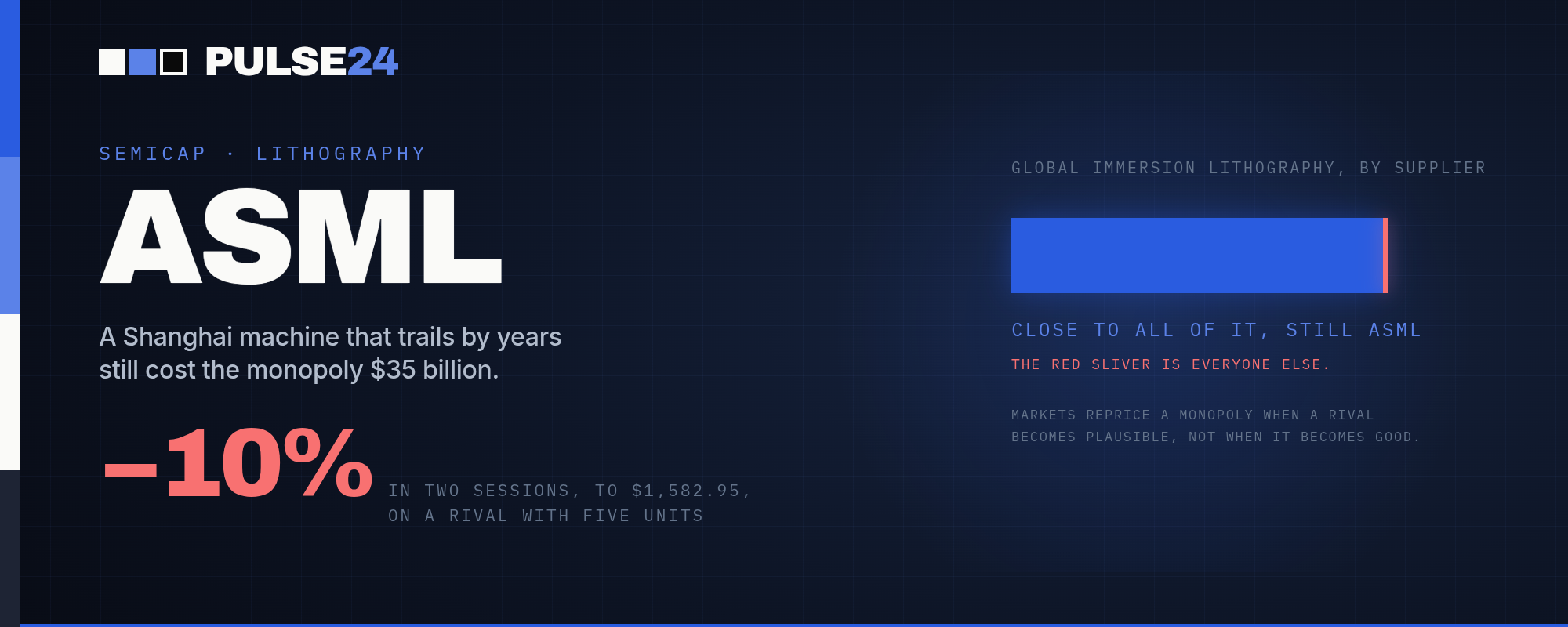
ASML lost more than $35 billion of market value in a single trading session after a state-backed Shanghai manufacturer confirmed it has started shipping China's first domestic immersion DUV lithography machines. The technology still trails Dutch equipment by years, but it chips away at the export control leverage the whole industry has relied on.
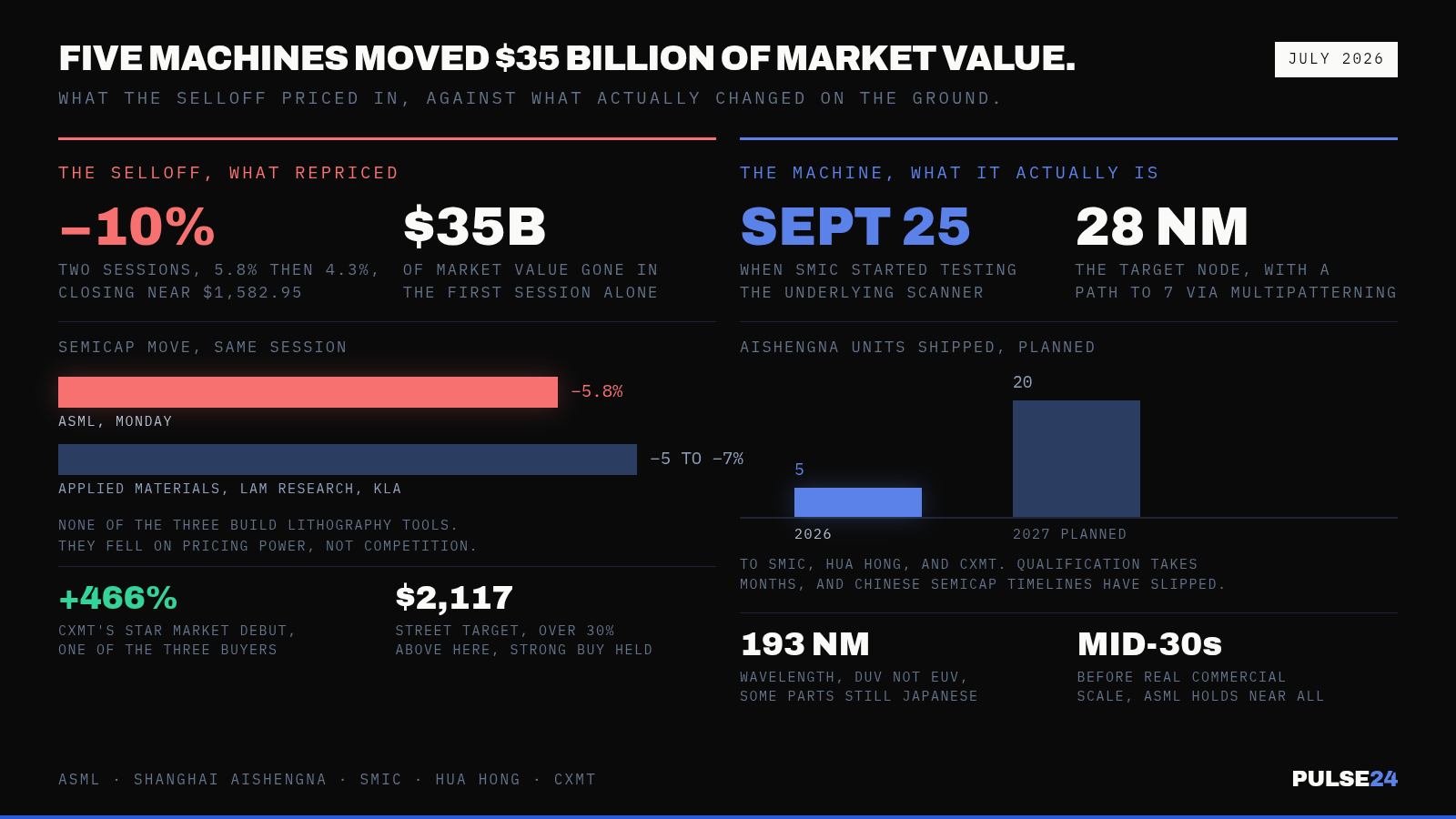
ASML lost more than $35 billion of market value in a single trading session this week, and the company that triggered it barely had a name investors recognized a month ago. Shanghai Aishengna Electronic Technology Group, a state-backed manufacturer that absorbed the team behind an earlier scanner from Shanghai Yuliangsheng Technology, confirmed it has begun shipping China's first domestically-built immersion deep ultraviolet lithography machine. ASML shares fell 5.8% on Monday and another 4.3% on Tuesday, a two-day decline of nearly 10% that pulled the stock down to $1,582.95.
The selloff didn't stay contained to ASML. Applied Materials, Lam Research, and KLA Corp, three big US-based suppliers of chipmaking equipment, all fell alongside it even though none of them build lithography tools themselves. Investors were pricing in a question bigger than one company's quarter: whether the near-monopoly a handful of firms hold over the tools that make advanced chips is more fragile than the last two decades suggested.
What Changed
Lithography is the process of printing circuit patterns onto silicon wafers, and for nearly two decades ASML has held something close to a monopoly on the machines that do it at commercial scale. Immersion deep ultraviolet isn't the cutting-edge extreme ultraviolet gear reserved for the most advanced chips. It's the older workhorse used for a huge share of mid-range production, and until this week, every unit of it running in serious commercial use came out of ASML's factory in Veldhoven, Netherlands.
That changed this week. SMIC has been testing a scanner built by Yuliangsheng's team since September 2025, and now, under the Aishengna banner, initial shipments are going out to SMIC, Hua Hong Semiconductor, and ChangXin Memory Technologies. The machines run at a 193-nanometer wavelength, target 28-nanometer chip production today, and could theoretically reach 7-nanometer nodes through multipatterning, a technique that exposes a single layer multiple times to squeeze extra resolution out of older hardware. Roughly five units are expected to ship this year, with output scaling to around 20 in 2027. Most of the components are domestically sourced, though the machines still rely on some parts imported from Japan.
Why It Matters
US export controls on advanced lithography equipment rest on a straightforward premise. Cut China off from ASML's machines, and its most advanced chipmakers eventually hit a wall they can't engineer around. That premise doesn't collapse because of one Shanghai firm's early shipment numbers. ASML still controls close to the entire global immersion lithography market, and independent industry analysis puts commercial-scale Chinese immersion DUV capability more realistically in the mid-2030s than anywhere close to now. What changed isn't the balance of power today. It's the existence of an alternative at all, however early and however limited.
That distinction is what markets actually reacted to. None of Applied Materials, Lam Research, or KLA face any near-term competitive threat from a company most investors had never heard of a month ago, since none of them build lithography tools directly. What moved was sentiment about how durable Western equipment makers' pricing power really is, an assumption that rests on the same AI infrastructure spending investors have recently started to question and that has supported premium valuations across the whole group for years, the same pricing power TSMC and Broadcom demonstrated just days earlier with a record June and a $100 billion AI chip guide.
There's a second layer to this. CXMT, one of the three companies now receiving Aishengna's tools, went public on Shanghai's STAR Market last week and closed its debut up 466%, instantly becoming one of mainland China's most valuable listed companies. A domestic lithography supplier, even an early and imperfect one, removes one more constraint standing between CXMT's ambitions and the memory chip capacity Samsung and SK Hynix have spent years building, the same supply crunch that has pushed DRAM prices up more than 270% over the past year.
What to Watch Next
Qualification is the real gate here, not shipment counts. A lithography tool has to pass rigorous customer testing before it can run in a real production line, and that process alone can take many months even when a machine performs well. Watch whether SMIC's unit actually enters production on anything close to its 2027 target, since Chinese semiconductor equipment timelines have slipped before.
Also watch ASML's own response. The company has downplayed domestic Chinese lithography threats on past earnings calls, and its next one will be the first real opportunity for management to address a stock move this sharp directly. And keep an eye on Washington. A working, if limited, Chinese DUV machine adds fresh urgency to a debate policymakers have been having quietly for a while: whether tightening export controls further mostly slows China down, or mostly accelerates the domestic buildout those controls were meant to prevent.
The Pulse24 Take
A nearly 10% two-day drop in one of the most important companies in the semiconductor supply chain looks dramatic on a chart, and most of Wall Street still isn't convinced it's justified. ASML's price target near $2,117 implies more than 30% upside from current levels, and the Strong Buy consensus hasn't moved. Machines that still lag on performance, built by a company that didn't exist as a household name a year ago, don't erase two decades of dominance in a single week, and near-total market share doesn't turn into genuine competition overnight either.
What the selloff actually priced in is optionality, not present-day substitution. Export controls work by keeping a ceiling in place indefinitely. The moment a domestic alternative exists, even a crude one running years behind the leader, that ceiling stops looking permanent and starts looking like a target. Markets tend to reprice monopolies the instant a credible competitor becomes plausible, well before that competitor becomes good. This week, plausible was apparently enough.
How we read the data
Curious how we get from raw data to a take like this? Our Trader's Toolkit walks through the tools we lean on.
Explore the Toolkit