Pulse24 Original
The Treasury's Cash Reserve at the Fed Has Swelled to $950 Billion, Nearly Double What Janet Yellen Kept on Hand. Officials Say That Money Could Now Fund the Bond Buyback Program.
August 26, 2026
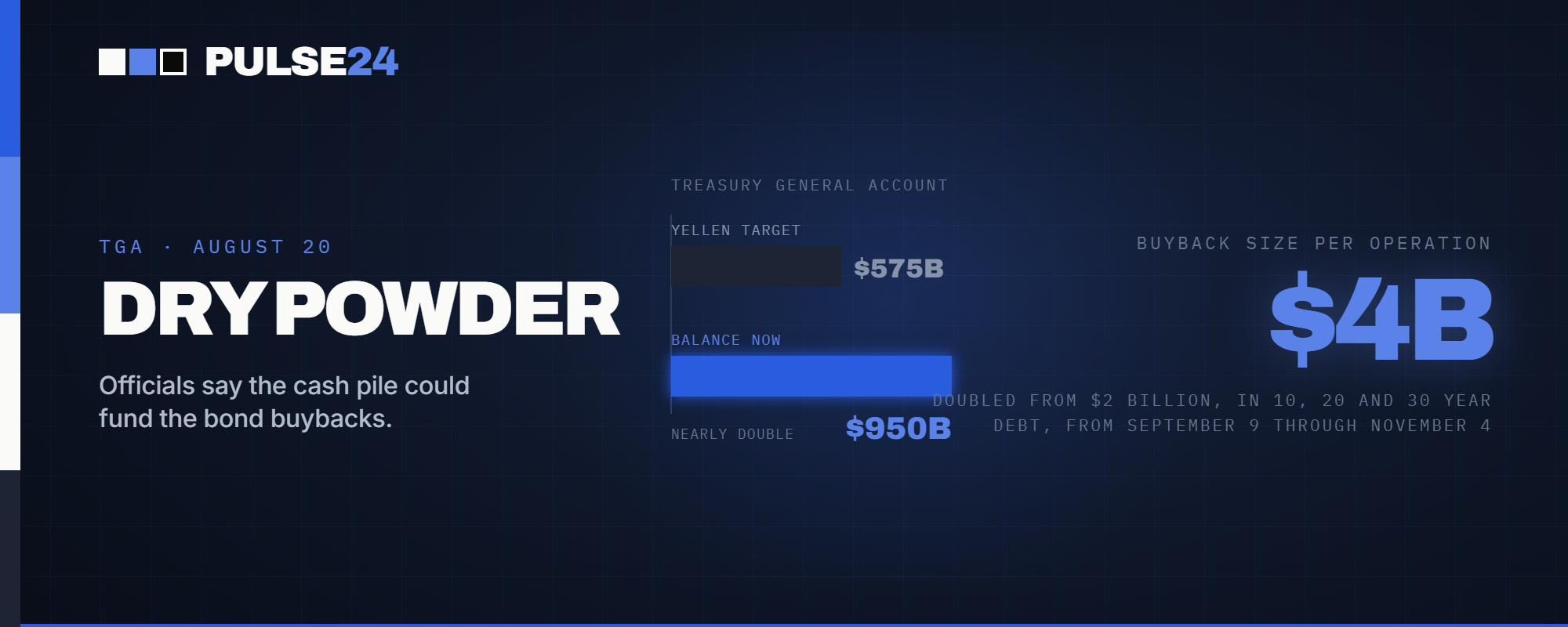
Treasury Secretary Scott Bessent has built a $950 billion cash reserve at the Federal Reserve, nearly double the balance Janet Yellen kept on hand, and officials now say that money could fund an expanded bond buyback program instead of sitting idle. Gold and Bitcoin have already rallied on the signal that Washington will step in when yields climb too far.
$950 billion is sitting in an account most people have never heard of. It's called the Treasury General Account, essentially the federal government's checking account at the Federal Reserve, and under Treasury Secretary Scott Bessent it has grown to nearly double the size Janet Yellen's Treasury kept on hand. Senior officials told CNBC on August 24 that Bessent could tap that reserve to help pay for an expanding bond buyback program, a tool the market has been watching closely for two weeks now.
What Changed
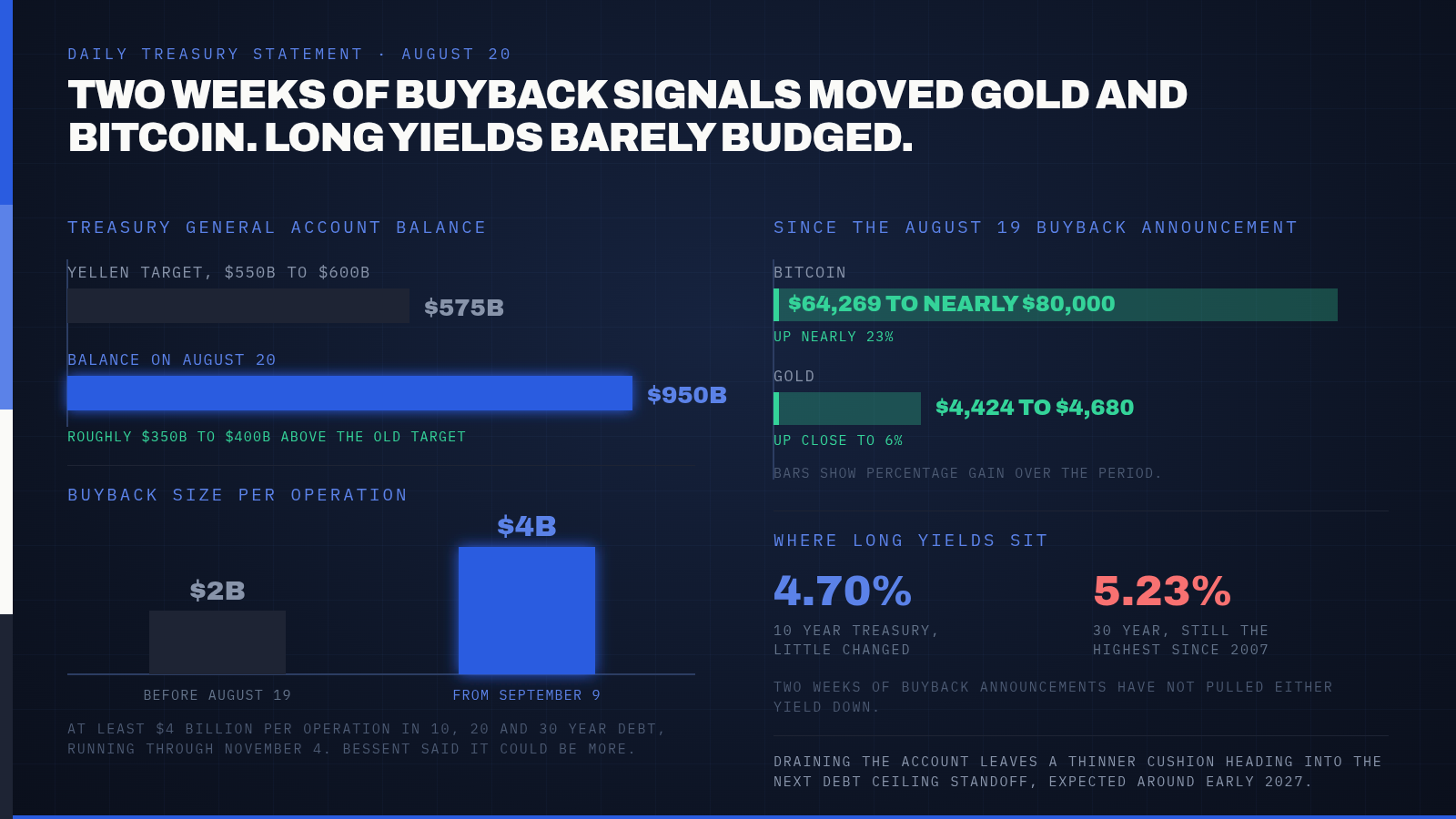
The Daily Treasury Statement showed the TGA balance near $950 billion as of August 20. Yellen's Treasury had operated with a much smaller cushion, publicly targeting $550 billion to $600 billion, enough to cover roughly a week of government outlays without needing fresh borrowing. Bessent's Treasury built a reserve worth close to double that, and until this week, the reasoning behind the extra size wasn't entirely clear.
Now it is. According to CNBC's reporting, two senior Treasury officials said the TGA balance is considered available to finance the department's buyback operations, which target older, less frequently traded Treasury bonds. That would let Bessent expand purchases without issuing new short-term debt to pay for them, a meaningfully different approach from simply announcing bigger buyback sizes.
The buyback program itself has been building for weeks. The Treasury doubled its buyback size from $2 billion to $4 billion per operation on Wednesday, August 19, and Bessent said publicly the number "could be more than $4 billion per issue." The expanded operations begin September 9 and run through November 4, concentrated in 10-, 20-, and 30-year bonds. Officials haven't said how much of the $950 billion might actually get deployed or when a formal announcement might come.
Why It Matters
Bond buybacks and TGA drawdowns sound like plumbing, and mostly they are, but the plumbing has been leaking into every other market this month. When the Treasury signals it will step in to support long bonds, investors read that as a promise that yields won't be allowed to rise indefinitely no matter what the deficit or the debt load implies. That promise makes assets with no yield and limited supply, gold and Bitcoin chief among them, more attractive relative to bonds whose real return keeps getting managed lower.
The numbers back that up. Gold traded near $4,000 an ounce for much of July. It's since climbed above $4,600 and now sits around $4,680, a move of nearly 6% just since the August 19 buyback announcement. Bitcoin's run has been sharper still, from $64,269 before the announcement to nearly $80,000 today, a gain near 23% in roughly two weeks. Traders have taken to calling this pattern the debasement trade: when policymakers act to keep borrowing costs artificially low, investors rotate toward assets that can't be printed.
What's notable is how little the buybacks have actually done for yields so far. The 10-year dipped to about 4.64% right after the initial announcement before climbing back above 4.7% within a day. The 30-year has held near 5.23%, a level not seen since 2007. The national debt crossed $40 trillion earlier this month, and a few billion dollars a month in bond purchases, even backed by a $950 billion reserve, is a small tool against a deficit and issuance schedule that large. The market appears to be pricing the intent behind the move as much as the mechanics of it.
There's also a cost to tapping the TGA that doesn't show up in tomorrow's yield print. A dollar index that already fell to a three-month low after the initial buyback news has kept sliding, down roughly 2.4% for the month. Every dollar pulled from the TGA to buy bonds today is a dollar Treasury will eventually need to replace through new issuance, deferring the cost rather than eliminating it. And a smaller cash buffer heading into the next debt ceiling fight, expected in winter or early spring 2027, is a tighter margin for error if that fight runs long.
What to Watch Next
The first concrete signal will be whether Treasury formally confirms how much of the $950 billion it plans to use, and whether that announcement comes before or after the September 9 start of the expanded buyback operations. A specific dollar figure would tell markets far more than the current vague framing of funds being "considered available."
Yields are the second thing worth tracking closely. If the 10-year and 30-year stay anchored near current levels through September despite the larger buybacks, it will suggest the program's ceiling on rates is lower than the headlines imply, and that structural pressures from debt issuance and inflation are simply stronger than a few billion dollars in monthly purchases can offset. A meaningful, sustained drop in yields would tell the opposite story.
Also worth watching: how the TGA balance itself moves in coming weeks. A sharp drawdown would confirm officials are actually deploying the reserve rather than just floating the idea to calm markets, and would be the clearest sign yet of how far Bessent is willing to go before the debt ceiling fight forces his hand.
The Pulse24 Take
Treasury officials built an unusually large cash reserve, then let it leak into headlines just as bond buybacks were struggling to hold down yields. That timing might be coincidental. It might also be a deliberate signal, since a $950 billion number sounds far more credible as a backstop than "we might buy a bit more debt" ever did, whether or not most of it ever actually gets spent.
Either way, gold and Bitcoin investors have already made their read. They're treating this as confirmation that Washington will keep leaning on managed liquidity rather than let markets set long-term borrowing costs on their own terms. History offers reasons for both confidence and caution here. Central banks and treasuries have used balance sheet tools to cap yields before, and it has worked for a while, until fiscal pressure eventually overwhelmed the tool. Whether this is the start of a durable regime or a short-term bridge to calmer conditions is the real question, and it won't be answered by anything happening in September. It will be answered by what the deficit looks like in 2027, and by how much of that $950 billion cushion is left when the next debt ceiling deadline actually arrives.
How we read the data
Curious how we get from raw data to a take like this? Our Trader's Toolkit walks through the tools we lean on.
Explore the Toolkit