Pulse24 Original
Bitcoin Cleared $80,000 for the First Time Since May on a $1.92 Billion Weekly ETF Inflow, the Strongest in Ten Months. Traders Are Calling It the 'Debasement Trade,' the Same Force Lifting Gold.
August 25, 2026
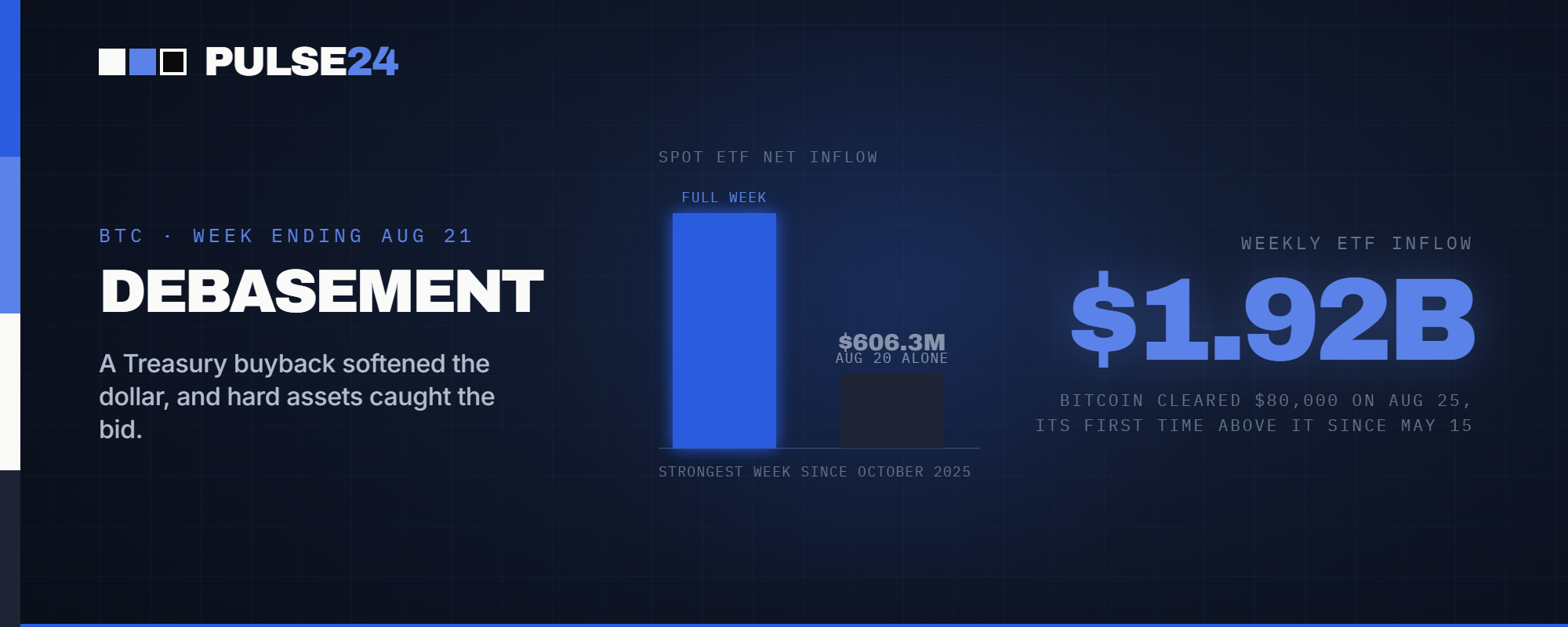
Bitcoin cleared $80,000 for the first time since May, powered by the strongest weekly ETF inflow in ten months and the same Treasury bond buyback that's been weakening the dollar. Traders are calling it the debasement trade, and gold is riding the same wave.
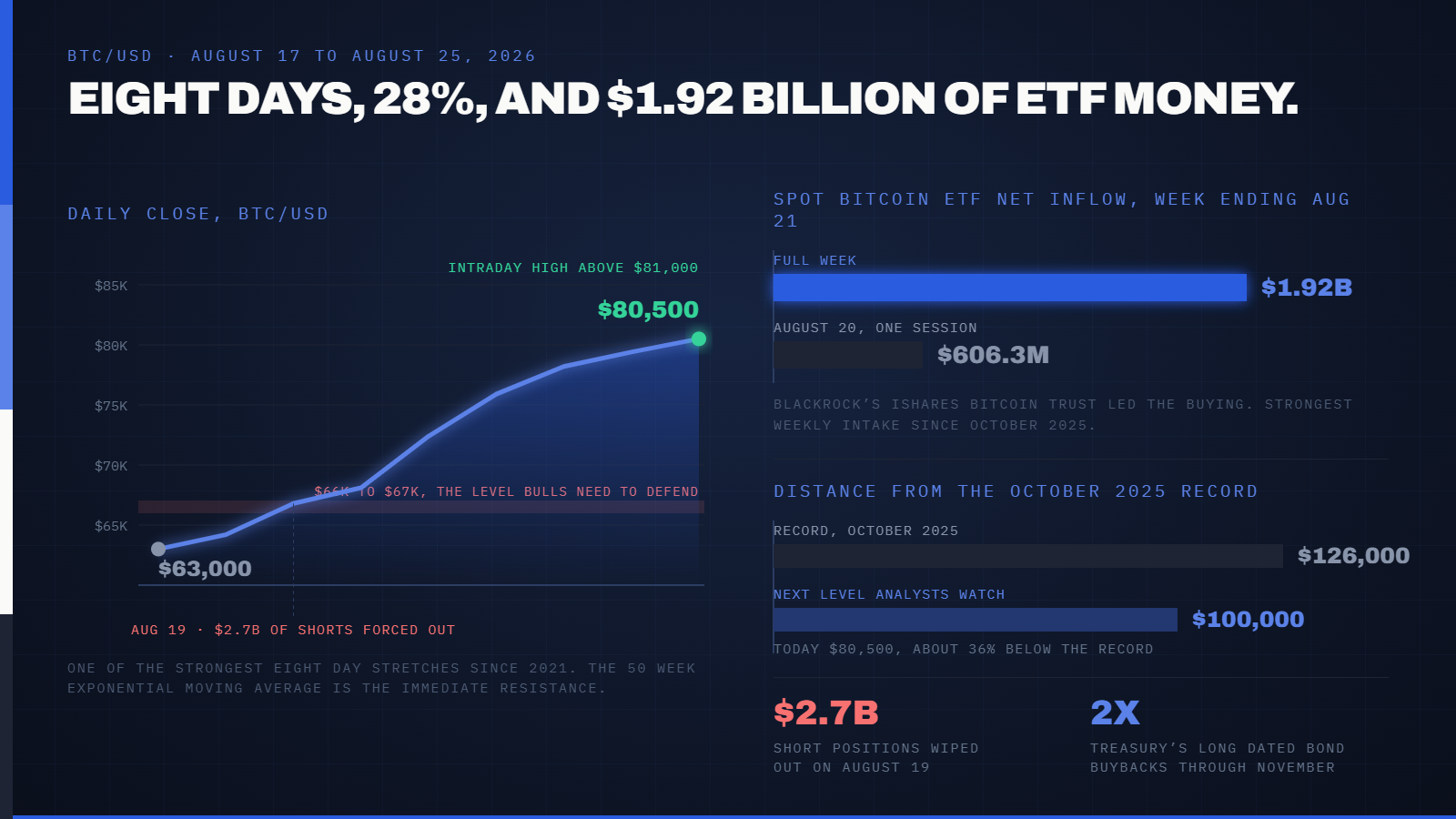
Bitcoin traded above $80,000 on August 25 for the first time since May 15. The intraday high pushed past $81,000 before the coin settled back near $80,500, according to pricing from CoinDesk and Bloomberg. Eight days earlier it was trading near $63,000, meaning the coin has gained roughly 28% in just over a week, one of its strongest eight-day stretches since 2021.
What Changed
Real money moved into bitcoin at a pace the market hasn't seen in nearly a year. Spot bitcoin ETFs absorbed $1.92 billion over the week ending August 21, the strongest weekly intake since October 2025. A single day, August 20, accounted for $606.3 million of that total on its own. BlackRock's iShares Bitcoin Trust led the buying, according to CoinDesk reporting.
Leveraged short sellers took the other side of the trade and lost. On August 19, the rally's single largest liquidation event forced out $2.7 billion in short bets within hours, a Bloomberg-reported figure that ranks among the largest one-day liquidation totals of the year. Traders who had bet against a recovery got squeezed out just as the ETF buying accelerated, and the combination turned a steady grind higher into an eight-day sprint through $80,000.
None of this started with bitcoin itself. The move traces back to the US Treasury's decision to roughly double its long-dated bond repurchases through early November. Treasury Secretary Scott Bessent has also signaled the department could tap close to $1 trillion sitting in its General Account to help fund those buybacks. Lower long-term yields were the stated goal. A softer dollar came along with it, and traders have piled into what Bitget Wallet research analyst Lacie Zhang called a revived debasement trade spanning bitcoin and gold.
Gold made a similar move on the same trigger, clearing $4,600 an ounce days before bitcoin's own breakout. Both assets are being bought for a version of the same reason: if the government is going to keep leaning on the bond market to manage its own borrowing costs, hard assets with a fixed or algorithmically limited supply look more attractive by comparison.
Why It Matters
For a fiscal-policy decision to visibly move an asset most institutions still treat as speculative says something about how thin the line has become between government debt management and everything downstream of it. Bitcoin's last comparable breakout came less than two weeks ago on a short squeeze tied to stalled crypto legislation. This one has a cleaner throughline: a specific Treasury action, a specific currency reaction, and a specific asset-class response that shows up the same week.
The scale of the ETF inflow matters as much as the price level. $1.92 billion in a single week is institutional money, not retail momentum chasing a headline. Vehicles like BlackRock's IBIT exist specifically so pension funds, endowments, and advisors can take a position without touching a crypto exchange, and when that channel absorbs nearly $2 billion in five trading days, it tends to reflect a genuine shift in allocation rather than a short-term trade.
What To Watch Next
The PCE inflation report, due Wednesday, is the next scheduled catalyst, followed two days later by Fed Chair Kevin Warsh's first Jackson Hole keynote as chair. A soft inflation print would strengthen the case for holding rates where they are, extending the same liquidity backdrop that's been lifting both bitcoin and gold, and give Warsh room to sound patient on Friday. A hot print would do the opposite, and the debasement trade would have to prove it can hold up against a Fed that isn't done fighting inflation.
Technically, $100,000 is the level that matters if this rally keeps its legs, since bitcoin hasn't traded there since October 2025. Rekt Capital, a chart analyst, flagged bitcoin's 50-week exponential moving average as the immediate resistance level to watch, noting the rally has pushed into that line but hasn't cleared it. A failed retest could send the price back toward the $66,000 to $67,000 zone that analysts have flagged as the level bulls need to defend.
The Pulse24 Take
$80,000 is a round number and round numbers make headlines, but the more useful figure in this story is $1.92 billion. That's institutional ETF money, and it moved because a Treasury decision about bond buybacks made the dollar look less attractive, not because retail traders got excited about a chart pattern. Bitcoin's relationship to fiscal policy has changed shape over the past year. It used to trade mostly on its own internal cycles, halving events, exchange scandals, regulatory headlines. Now it's reacting to the same debt-management decisions moving gold and the dollar, on the same days, for the same stated reasons.
On its own, that's neither bullish nor bearish. It does mean bitcoin has become a more direct read on how markets feel about US fiscal policy than it was a year ago, and that relationship cuts both ways. Should Treasury's buyback program keep yields contained and the dollar keep drifting lower, the debasement trade has room to run toward $100,000. A PCE report hot enough to put a September hike back on the table could send the same channel that pushed bitcoin higher this week into reverse just as fast.
How we read the data
Curious how we get from raw data to a take like this? Our Trader's Toolkit walks through the tools we lean on.
Explore the Toolkit