Pulse24 Original
Estee Lauder Stock Jumped 16% on a Beat and Raise. In May, the Company Announced Plans to Cut Up to 10,000 Jobs, Nearly a Fifth of Its Workforce.
August 20, 2026
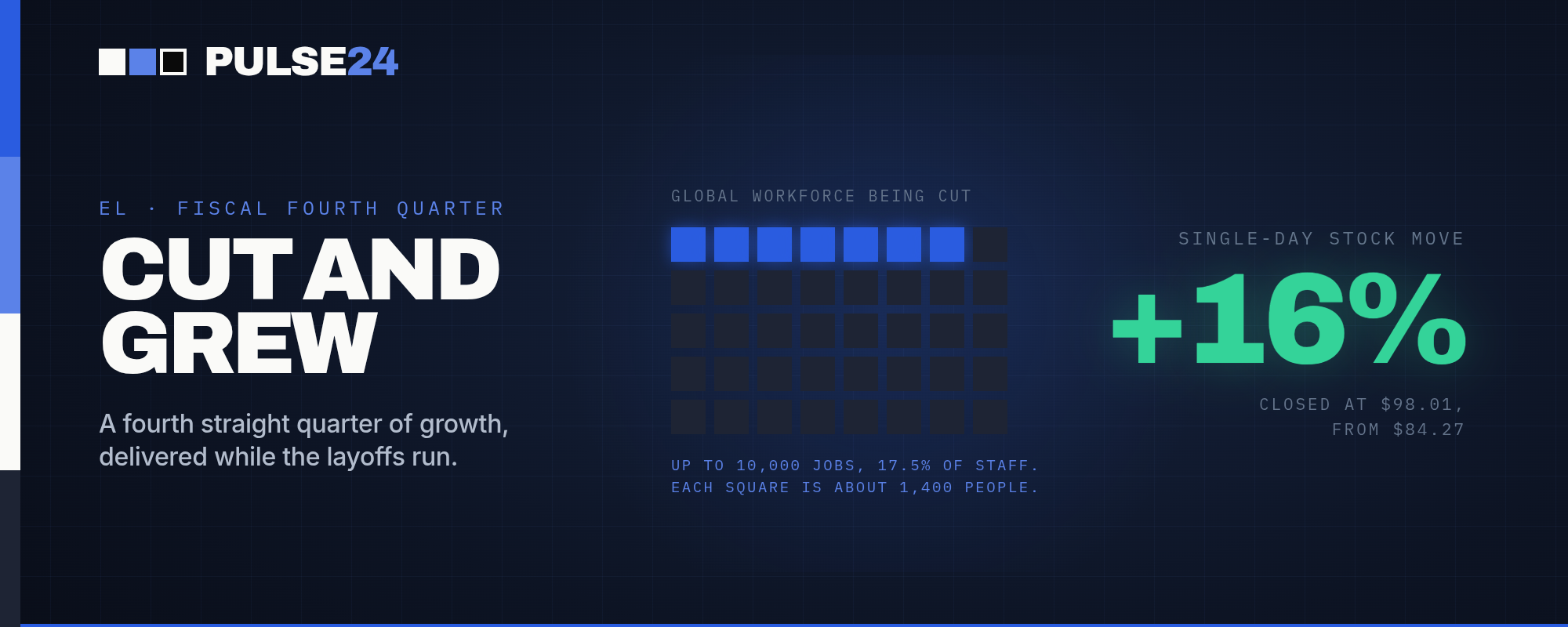
Estee Lauder shares jumped 16% after a China-led turnaround quarter, even as the company works through cuts to nearly a fifth of its global workforce. The report is a real test case for whether cost cutting and revenue growth can move together, and whether Chinese luxury spending is actually coming back.
Estee Lauder shares closed at $98.01 on Wednesday, up 16.3% from the previous day's $84.27 close, after the beauty giant reported its fourth straight quarter of organic sales growth and issued a fiscal 2027 profit outlook that topped Wall Street's revenue expectations even as the midpoint of its earnings guidance landed just under consensus. The rally came from a company that spent the past year cutting jobs, not adding them.
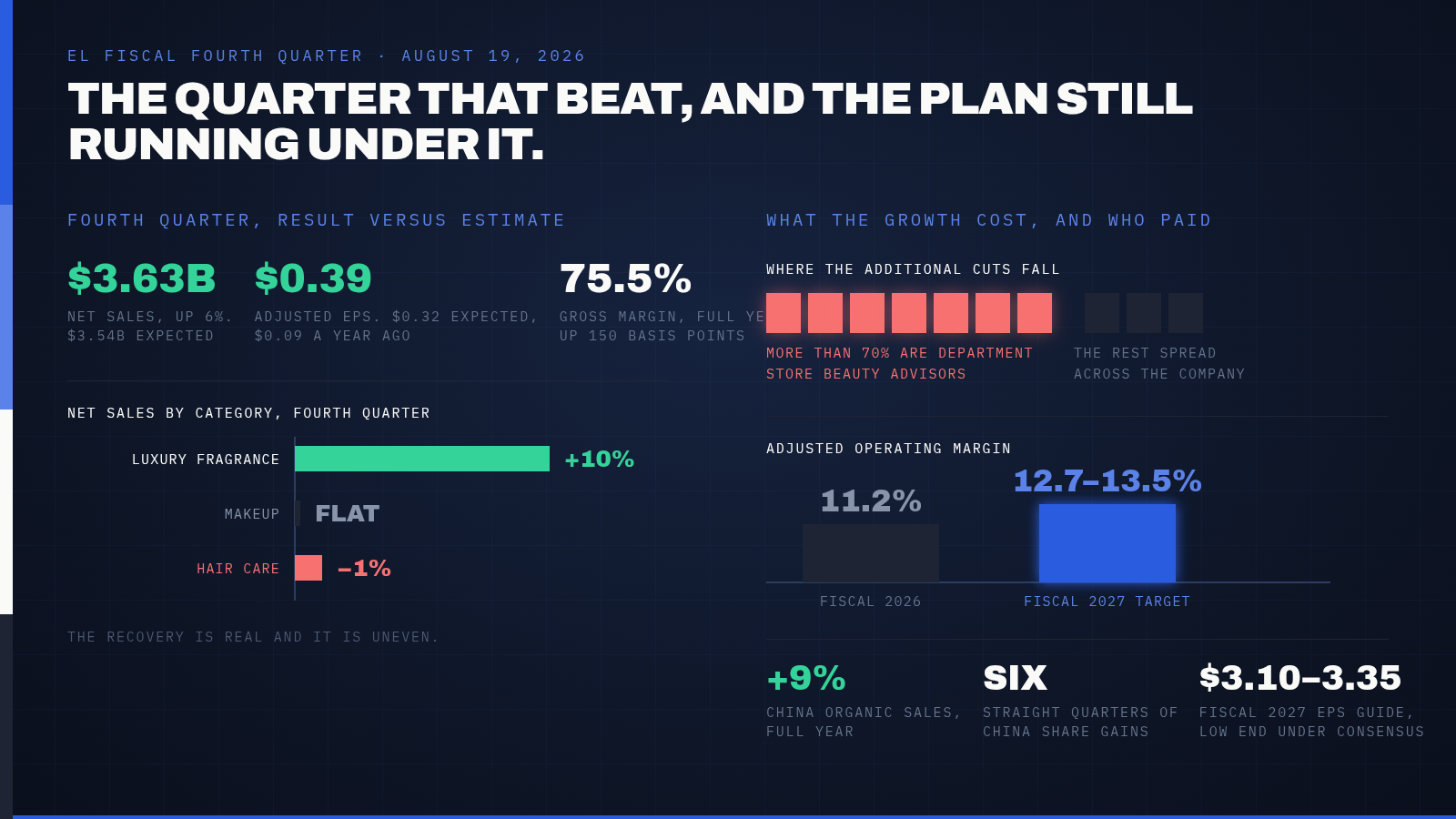
The fourth quarter numbers were the clearest evidence yet that chief executive Stephane de La Faverie's Beauty Reimagined turnaround is gaining traction. Net sales rose 6% to $3.63 billion, beating the $3.54 billion analysts expected, and adjusted earnings of 39 cents a share came in well above the 32 cent estimate and more than four times the 9 cents Estee Lauder posted in the same quarter last year. De La Faverie said the company has "reignited growth," a claim the numbers mostly back up: full year organic sales rose 3%, the first full year of growth in two years, while the fourth quarter alone accelerated to 5%.
What Changed
China did the heavy lifting. Mainland China organic sales grew a broad based 9% for the full year, and Estee Lauder said it has now gained prestige beauty market share in the country for six consecutive quarters, helped by a less promotional pricing strategy and heavier investment in local product development. Roughly 30% of the company's global innovation pipeline now originates from its Shanghai research center, tailored specifically to Chinese consumer preferences. Travel retail also stabilized, particularly in Hainan, though South Korea's duty free channel and airport retail transitions remain a drag.
Luxury fragrance was the standout category, with net sales up 10% in the quarter. Makeup net sales were flat and hair care slipped 1%, a reminder that the recovery is uneven across the portfolio even as the headline numbers improved.
None of this happened without cost. Estee Lauder is still working through a restructuring plan announced in May that will eliminate between 9,000 and 10,000 positions, as much as 17.5% of its global workforce. More than 70% of the additional cuts fall on department store beauty advisors, as the company shifts spending toward digital channels like Amazon and TikTok Shop. The trade off shows up directly in the margins: full year gross margin expanded 150 basis points to 75.5%, and adjusted operating margin improved 3.2 percentage points, giving the company room to raise its fiscal 2027 operating margin target to a range of 12.7% to 13.5% from 11.2% in fiscal 2026.
There was also a smaller, one time boost. Estee Lauder booked a $38 million tariff refund in the quarter, set against a $102 million gross tariff cost for the full year, tied to the same category of IEEPA duty refunds that padded Target's own profit forecast raise this week. It is a minor line item next to the China and margin story, but it is one more data point suggesting these refunds are showing up broadly across retailers' results this earnings season.
Why It Matters
Estee Lauder's turnaround is a useful read on two separate questions investors have been asking all year: whether Chinese consumers are actually spending again, and whether corporate cost cutting can coexist with real revenue growth rather than just propping up margins on a shrinking base.
On the first question, Estee Lauder's 9% China growth lines up with a broader pattern showing up across the luxury sector this year, as LVMH and Hermes have both reported improving or stabilizing China trends in their own results. A single quarter from one beauty company is not proof of a durable Chinese consumer recovery, but it adds to a growing pile of evidence that the worst of the pullback in luxury spending may be behind the sector, not still ahead of it.
On the second question, the answer so far looks like both things can be true at once. Estee Lauder cut deeply into its workforce while its underlying sales grew, which is a different story than a company cutting costs to offset declining revenue. Whether that combination holds up through a fiscal year that still includes thousands more layoffs to work through is the real test.
What to Watch Next
The company's next quarter will be the first to reflect a full period without last year's steepest declines as a comparison point, so growth rates should look more normal, for better or worse. Investors will also be watching whether the remaining round of job cuts announced in May disrupts the in-store experience enough to hurt sales in the channels Estee Lauder is deprioritizing, particularly during the holiday season when department store counters still matter. And with fiscal 2027 earnings guidance sitting just below where analysts had modeled, the market will want to see whether that reflects genuine conservatism from a management team that has repeatedly beaten its own targets this year, or an early sign the recovery's pace is leveling off.
The Pulse24 Take
A 16% single day rally on an earnings report is the kind of move that invites a simple headline: turnaround complete. The details underneath are more interesting than that. Estee Lauder grew sales while cutting close to a fifth of its workforce, which is not how most retail turnarounds work, and it did so on the back of a Chinese consumer that most strategists spent the first half of this year writing off. Neither pattern is guaranteed to continue. Layoffs at this scale eventually show up in customer experience if a company is not careful, and a single strong quarter out of China does not undo two years of luxury spending caution there. What the quarter does confirm is that the market had priced Estee Lauder for a slower recovery than the one now underway, which is why the stock moved as much as it did on largely incremental news. The next two quarters, not this one, will show whether that repricing was earned or premature.
How we read the data
Curious how we get from raw data to a take like this? Our Trader's Toolkit walks through the tools we lean on.
Explore the Toolkit