Pulse24 Original
$150 Billion More in Buybacks Pushed Nvidia's Total to $235 Billion. Its Stock Hit a Record High the Same Week.
October 2, 2026
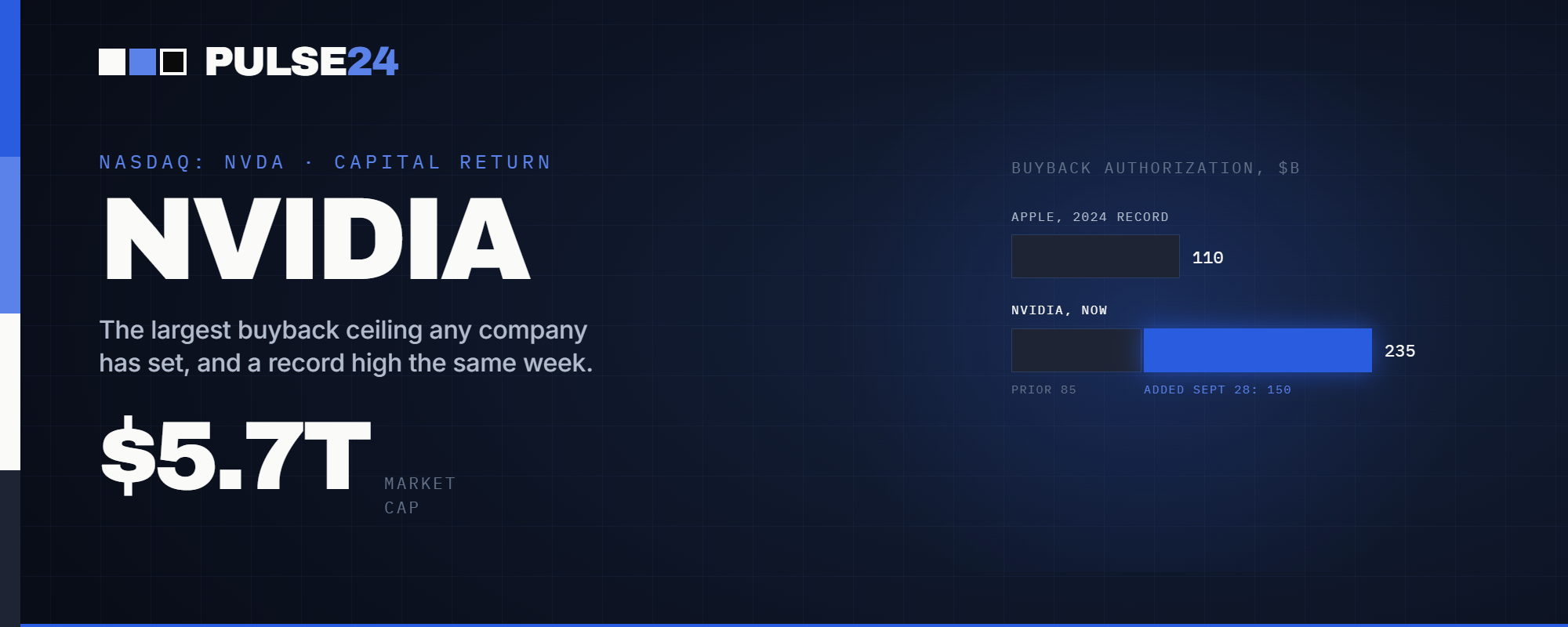
Nvidia's board added $150 billion to its buyback authorization last week, pushing total capacity to $235 billion, the largest such ceiling any public company has set. The stock answered Friday with a record intraday high near $237.55 and a market cap of roughly $5.7 trillion.
Nvidia's board approved $150 billion in additional share buyback capacity on September 28. Five days later, on Friday, the stock climbed to its highest price ever, touching an intraday record of $237.55 a share and pushing the company's market cap to roughly $5.7 trillion.
What Changed
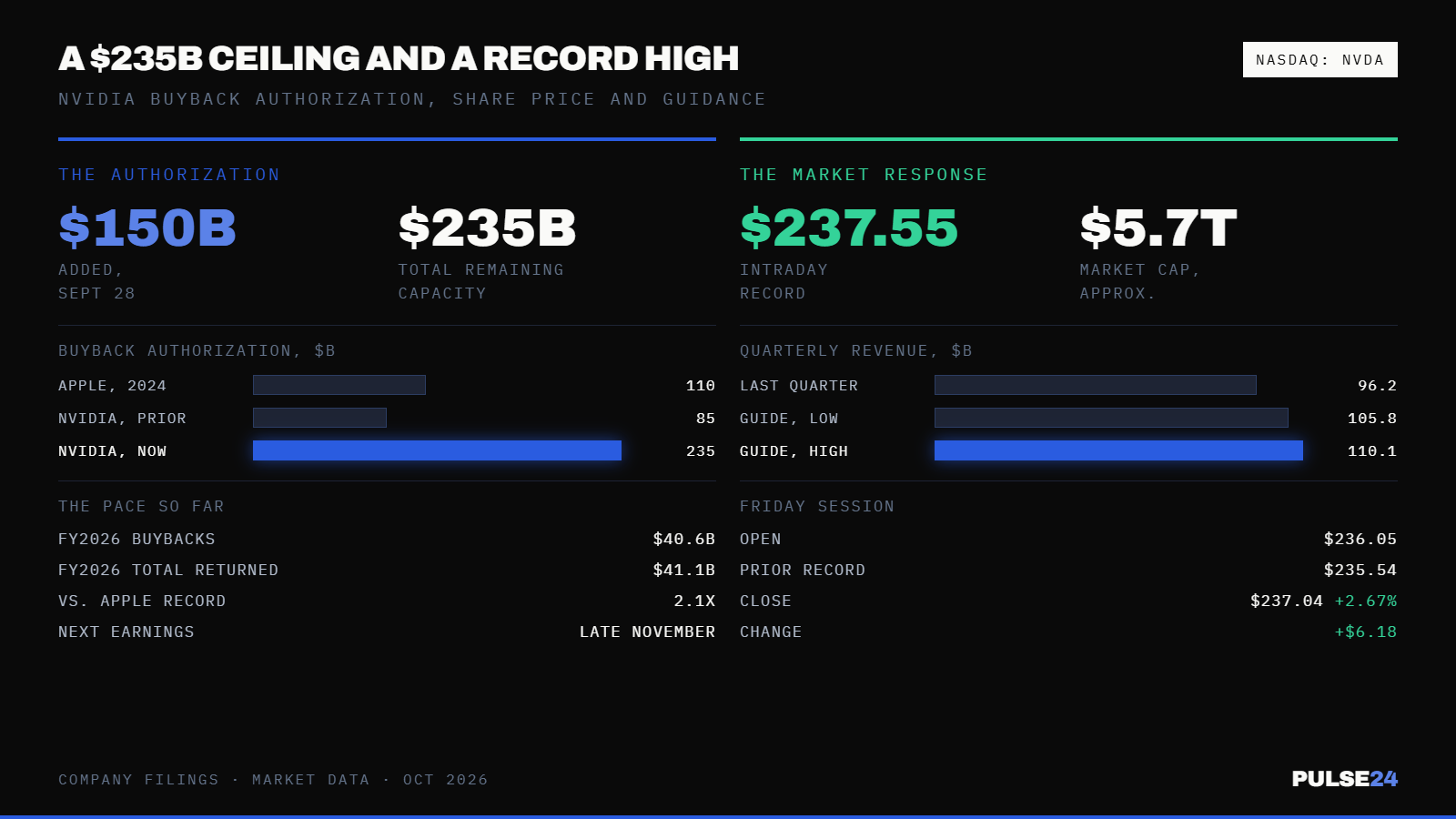
The $150 billion increase brings Nvidia's total remaining buyback authorization to $235 billion, by most accounts the largest such ceiling any public company has ever set. Apple held the previous record, a $110 billion authorization from 2024, and Nvidia has now more than doubled it in a single move. CEO Jensen Huang framed the decision in similarly confident terms: "Our cash generation gives us the capacity to invest in the technologies that advance this transformation and return capital to shareholders."
Nvidia isn't starting from zero. The company spent $40.6 billion buying back its own shares in fiscal 2026 and returned $41.1 billion to shareholders in total once dividends are included. Scaling that pace up against a $235 billion ceiling implies years of sustained repurchases, not a one-quarter sugar rush.
The market's response arrived almost immediately. Shares opened Friday at $236.05, touched an intraday high of $237.55, eclipsing the previous record of $235.54, and finished the session up 2.67%, or $6.18, at $237.04. At that valuation, Nvidia's market cap sits around $5.7 trillion, a level no company had reached before Nvidia got there earlier this year and has now pushed further past.
Why It Matters
A buyback this size is as much a signal as a mechanical reduction in share count. Nvidia posted $96.2 billion in revenue last quarter and guided to $105.8 billion to $110.1 billion for the current one, and a board willing to commit nine figures to repurchases is a board that doesn't see that growth slowing anytime soon. Companies rarely promise to spend $235 billion buying their own stock unless they expect the cash to keep arriving.
It also puts Nvidia in a different financial position than much of the AI buildout around it. SoftBank is paying record bond yields to keep funding its share of the OpenAI buildout, and plenty of the infrastructure names riding the same boom are leaning on debt rather than free cash flow. Nvidia's buyback is only possible because its margins let it fund expansion and shareholder returns at the same time, a luxury not every company chasing the same trend can claim.
The rally also extends a reshuffling that's been under way across the market for months. Four AI infrastructure stocks recently took Nike's place in the S&P 100 after the sneaker maker lost $207 billion in market value, and Nvidia's latest record high is the clearest sign yet that investors still haven't found a ceiling for how much of the market AI infrastructure spending can justify.
What to Watch Next
Nvidia's next earnings report, expected in late November, will be the first real test of whether the buyback math holds up. A revenue number that falls short of the $105.8 billion to $110.1 billion guidance would make the $235 billion authorization look more aggressive in hindsight than it does today.
Watch execution, too. An authorization is a ceiling, not a commitment, and companies routinely approve buyback room they never fully use. How quickly Nvidia actually deploys the new $150 billion, visible each quarter in its cash flow statement, will say more about management's real confidence than the headline number did on announcement day.
The Pulse24 Take
The size of the number tends to overshadow the more interesting question, which is why Nvidia can make this move at all. Most companies funding an AI buildout this large are borrowing to do it. Nvidia is instead sitting on so much cash from selling the chips everyone else needs that it can expand capacity, pay a dividend, and still commit a quarter-trillion dollars to buying back its own stock. That's less a statement about Nvidia's confidence in artificial intelligence than it is a statement about how little resistance the company is meeting on its way there. A $5.7 trillion market cap and a record high are the easy headlines. The buyback authorization is the number that tells you how long Nvidia's board thinks the good times last.
How we read the data
Curious how we get from raw data to a take like this? Our Trader's Toolkit walks through the tools we lean on.
Explore the Toolkit