Pulse24 Original
Services Prices Climbed to 72.6% in August, the Fifth Time Above 70% in Six Months. New Orders Jumped 3.7 Points to 60.9% While Hiring Stayed Negative for a 13th Time in 18 Months.
September 5, 2026
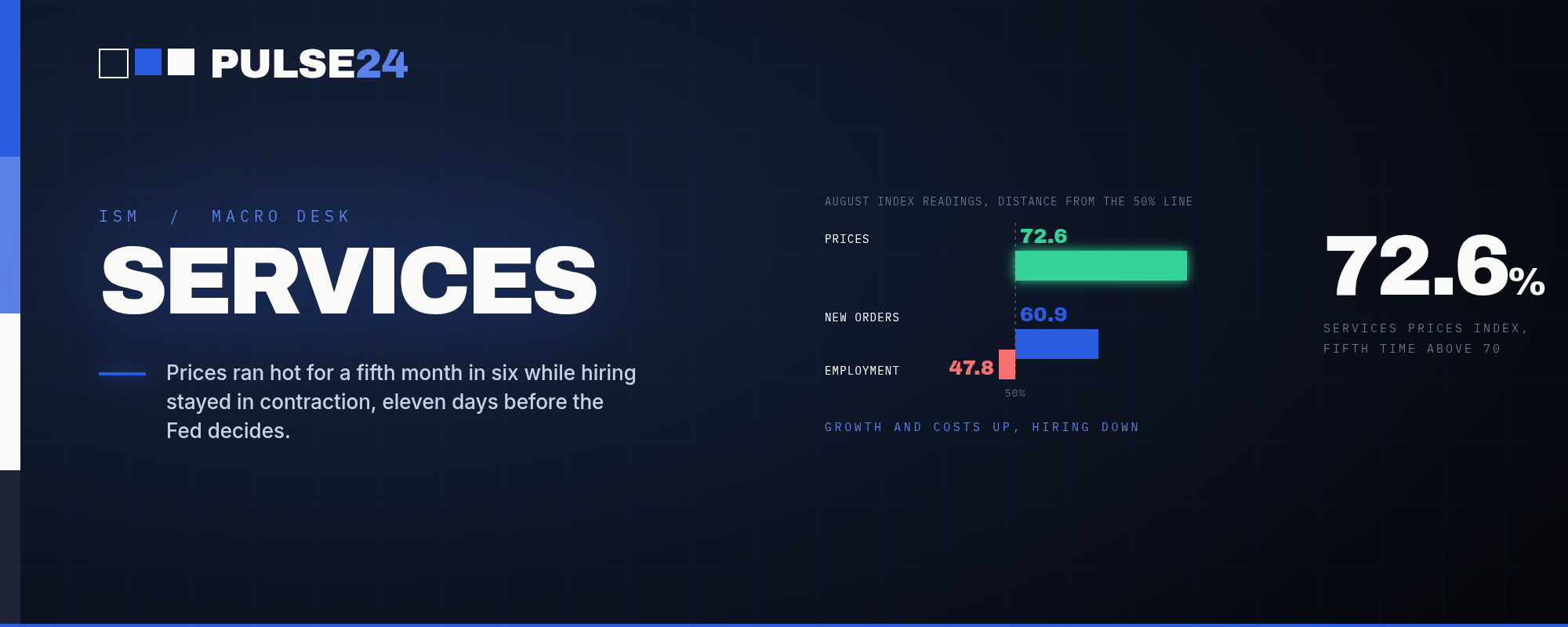
The ISM's Services Prices Index jumped to 72.6% in August, its fifth reading above 70% in six months, while new orders and business activity both accelerated sharply. Hiring inside the same report stayed negative for a 13th time in 18 months, and GPUs officially joined the list of commodities running short, all of it landing eleven days before the Fed's September 16 rate decision.
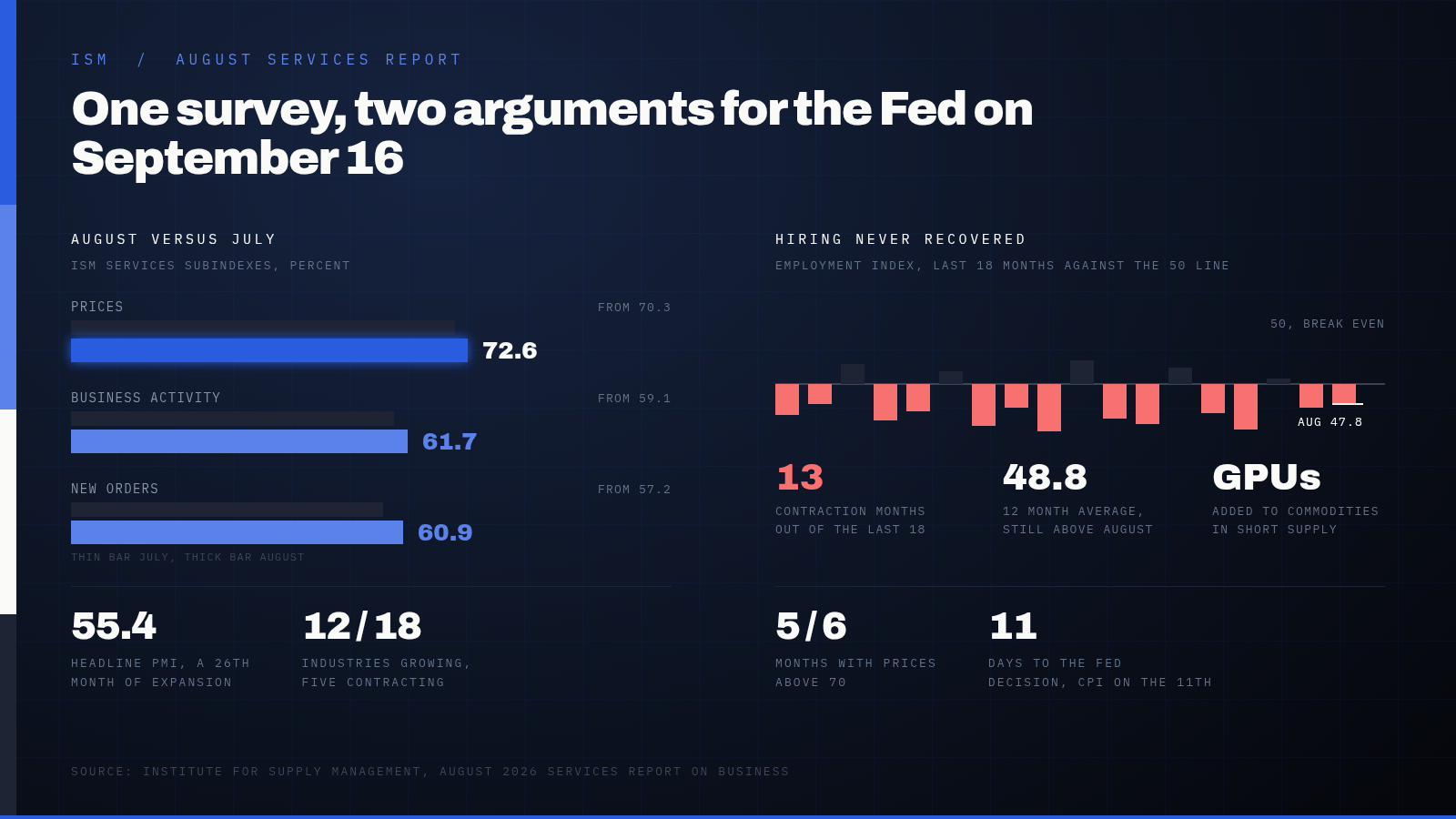
ISM chair Steve Miller had two numbers to reconcile in the same report this week. One showed the services sector accelerating hard: New Orders jumped 3.7 points to 60.9%, Business Activity rose 2.6 points to 61.7%, and the headline PMI climbed to 55.4% from 54.1%, the 26th straight month of growth. The other showed prices paid climbing to 72.6%, the fifth reading above 70% in six months, a threshold ISM's committee treats as evidence of broad, stubborn cost pressure. Both numbers came out of the same survey, covering the same month, and they hand the Federal Reserve two different arguments eleven days before it has to decide on rates.
What Changed
Demand accelerated almost everywhere in the report. New Orders beat the 56.0% consensus estimate by nearly four points, and Business Activity, the services-sector proxy for output, posted its sharpest one-month jump of the year. Miller's own summary called it the sector's "26th consecutive month" of expansion, a streak that has now outlasted most predictions of a services-led slowdown made earlier this year. Twelve of the eighteen tracked industries reported growth in August, one fewer than in July, while five reported contraction, up one from the month before. Retail trade, information, and professional and technical services were among those still expanding, while finance and insurance and construction were among the industries that shrank.
The Prices Index is the number that should worry the Fed more than any other in the release. At 72.6%, it sits well above the 50% line separating rising from falling costs, and this is the fifth time in six months that gauge has cleared 70%. Miller flagged the specific inputs driving it: petroleum-related products, diesel, and gasoline all rose, alongside a detail that says as much about where the economy's stress is concentrated as any macro chart could. "Graphics processing units (GPUs) and steel were added as commodities in short supply," Miller said, putting a services-sector inflation report in direct conversation with the AI buildout. It is the same GPU scarcity Pulse24 has tracked through record DRAM pricing out of South Korea and chipmakers racing to redesign how AI hardware gets wired together, now showing up in a survey of hotel chains, law firms, and insurance brokers rather than a semiconductor earnings call.
Employment told a quieter, worse story. The index rose slightly to 47.8% from 47.4%, but that is still a contraction reading, the 13th time in 18 months the services sector has reported net job losses on this measure. It also sits below the index's own 12-month average of 48.8%. The combination of rising output and rising prices alongside falling headcount is harder to explain away than either trend by itself. A services sector that can grow output and orders while shedding jobs is either getting more efficient or getting more cautious, and this report doesn't settle which.
Why It Matters
This report did not arrive in isolation. Three days earlier, the ISM's Manufacturing PMI showed the same split: a Prices Index stuck at a severe 71.1% for a second straight month while new orders, backlog, and imports all fell. That report flagged services as the next place to check whether the same pattern held. It does, and in the bigger of the two sectors. Services make up roughly three-quarters of the US economy, so a prices gauge running hot there carries more weight for the Fed's mandate than a factory-sector reading ever could on its own.
Kevin Warsh's first Jackson Hole speech argued the central bank still has work to do on inflation, and traders pushed September rate-hike odds above 50% within hours of it. By the following week, CME futures had those odds sitting closer to 64%, even with some retail platforms quoting figures as high as 90%. This services prices reading does nothing to narrow that gap. If anything, it gives the hawks on the committee a second data set to point to, on top of core PCE holding at 3.3% in July and an August payrolls report that beat expectations by roughly triple.
The counterargument is buried in the same report. An Employment Index stuck in contraction for 13 of the last 18 months is not the profile of an overheating labor market, and Fed officials who favor patience can point to it as evidence that demand strength is not translating into hiring, let alone wage pressure broad enough to sustain 70-plus prices readings indefinitely. The committee's July minutes already showed a split, with three members dissenting toward an immediate hike while most others wanted more data first. This report gives both camps something to cite, which is exactly the kind of print that tends to keep a committee divided rather than resolve it.
What to Watch Next
The August CPI report lands September 11, five days before the Fed meets, and will likely carry more weight for the rate decision than either PMI release. A hot core CPI print would echo the services Prices Index and could push hike odds well past the current range. A softer number would give the committee's patience camp new ammunition just as it needs it most.
From there, the Fed's September 15-16 meeting will land with a full run of September's most-watched data behind it: two PMI reports, a jobs number, and a fresh CPI reading, all pointing in a similar direction on prices and a murkier one on demand and hiring. Markets are still pricing something close to a coin flip on a hike. Whether that number moves meaningfully before the meeting probably depends more on what CPI shows next Friday than on anything in this week's services report.
The Pulse24 Take
The GPU line is the detail worth sitting with longer than the headline PMI number. ISM surveys purchasing managers across law firms, hospitals, and retailers, not chipmakers, and when that panel starts naming graphics processors as a commodity running short, it means the AI buildout's supply crunch has stopped being a story confined to semiconductor earnings calls. It is now visible in the same monthly survey that tracks the price of diesel and steel, which is a good proxy for how broadly that scarcity has spread through the rest of the economy.
None of this settles the Fed's argument on its own. A services sector that grows output and orders while raising prices and cutting headcount is an uncomfortable combination to build a rate decision around, and Chair Warsh has eleven days and one more inflation report to figure out which piece of that picture matters most. Betting heavily on the outcome before then, with the manufacturing report pointing one way on demand and the services report pointing another, still looks more like conviction borrowed from certainty the data hasn't earned yet.
How we read the data
Curious how we get from raw data to a take like this? Our Trader's Toolkit walks through the tools we lean on.
Explore the Toolkit