Pulse24 Original
August Payrolls Beat Forecasts by 109,000, Nearly Triple What Economists Expected. The Information Sector Cut Jobs at the Fastest Pace in Years Anyway.
September 5, 2026
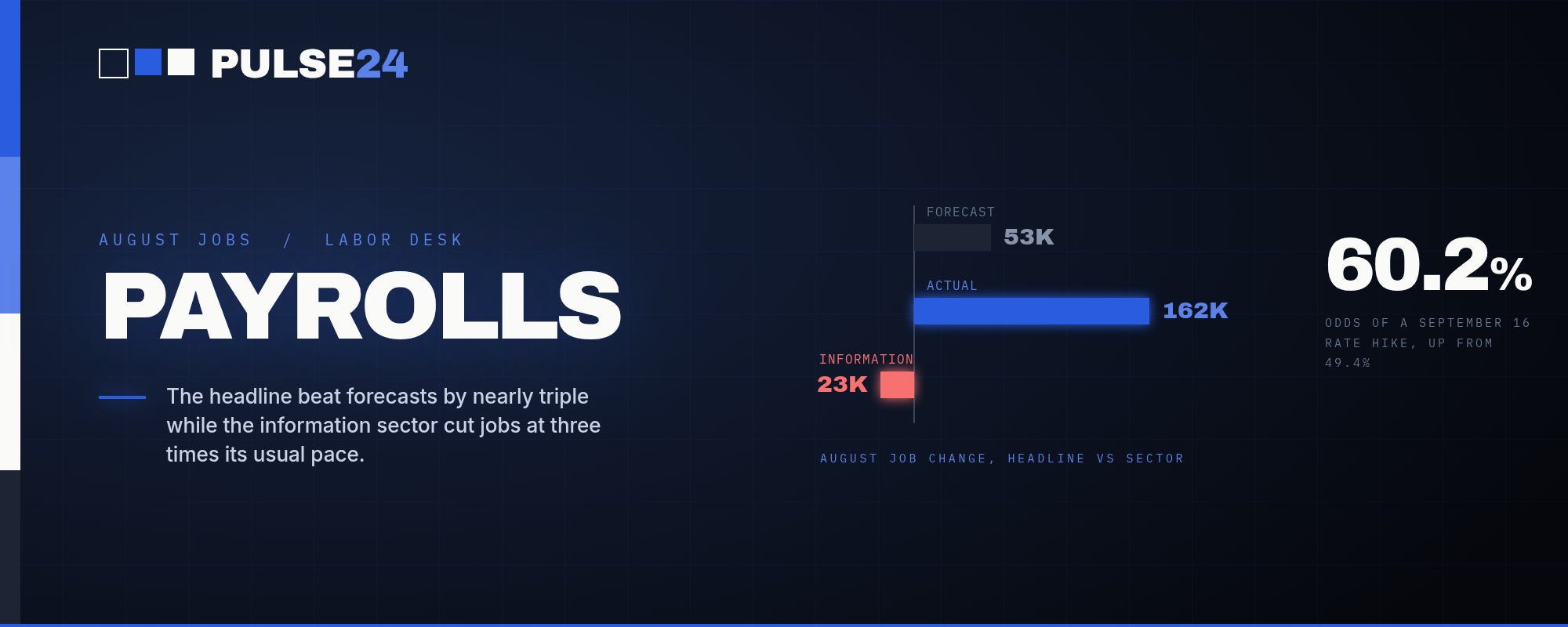
The US economy added 162,000 jobs in August, blowing past the 53,000 forecast and pushing CME FedWatch odds of a September 16 rate hike to 60.2%. Underneath that headline number, the information sector, the most AI-exposed corner of the labor market, shed jobs at nearly three times its usual pace.
The Bureau of Labor Statistics counted 162,000 new jobs in August. Economists surveyed ahead of the report had penciled in roughly 53,000.
That gap, nearly 110,000 jobs wider than expected, landed twelve days before the Federal Reserve's September 16 rate decision, and it arrives right on top of a summer where officials had been debating whether the labor market was cooling enough to justify a pause. Friday's number argues the other way.
What Changed
Unemployment held steady at 4.1%. Average hourly earnings rose 10 cents to $37.75, a 0.3% monthly gain that puts the year-over-year rate at 3.1%. Wages are still growing, just not fast enough to alarm anyone on their own.
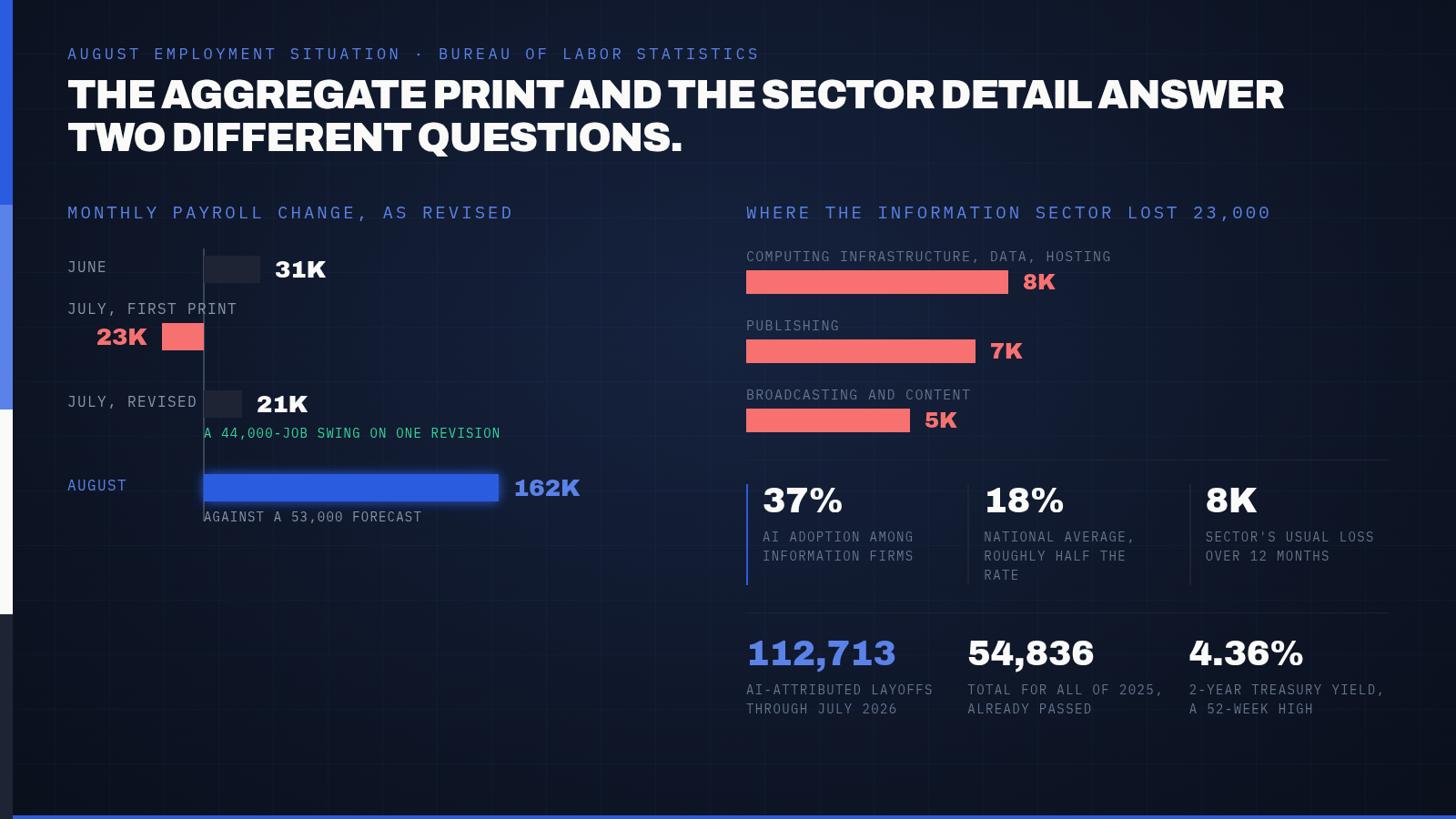
The bigger surprise sat in the revisions. June's initial print was upgraded to 31,000 from 20,000. July, which the BLS had originally reported as a decline of 23,000 jobs, a print that fed weeks of recession chatter, was revised all the way to a gain of 21,000. A 44,000-job swing on a single revision is unusual even by the standards of a data series that gets rewritten twice after first release.
Put together, the three months now read as a labor market adding jobs at a steadier clip than almost anyone believed in early August.
Why It Matters
Markets read the headline number as hawkish, and CME FedWatch pricing moved accordingly. The odds of a quarter-point hike at the Fed's September 16 meeting jumped to 60.2% from 49.4% a day earlier. Reuters' survey of traders put the shift at a similar magnitude, from roughly 55% to 65%.
Stocks wobbled on the news rather than rallying. The Dow fell 245 points, about 0.5%, the S&P 500 slipped 0.3%, and the Nasdaq eased slightly too. Bonds told a more interesting story: the 2-year Treasury yield, the part of the curve most sensitive to Fed policy, jumped to a fresh 52-week high near 4.37%, while the 10-year moved only a touch higher, to about 4.77%. The front end of the curve moving more than the long end usually means traders are pricing in a near-term hike without losing confidence in the longer-run growth and inflation outlook, a more measured reaction than the headline jobs number alone would suggest.
Underneath the aggregate strength, the information sector told a different story. It lost 23,000 jobs in August, about three times its trailing 12-month average monthly decline of roughly 8,000. Computing infrastructure, data processing, and web hosting firms cut 8,000 positions. Publishing lost 7,000. Broadcasting and content businesses shed another 5,000.
That sector also happens to be the one adopting AI fastest. The Federal Reserve's own Business Trends and Outlook Survey puts AI adoption among information-sector firms at 37%, roughly double the 18% national average. Researchers at the St. Louis Fed and Stanford's Digital Economy Lab have each found a correlation between AI adoption and job losses concentrated in roles where AI substitutes for tasks rather than augments them. Challenger, Gray & Christmas data show AI-attributed layoff announcements reached 112,713 through July, already well past the 54,836 recorded across all of 2025.
None of that shows up in the headline 162,000 figure. A single print that beats forecasts by triple can still mask a structural shift in which sectors are actually hiring.
The private-sector ADP print earlier that same week told a related but distinct story: large employers with 500 or more workers added 34,000 jobs in August while every smaller private employer combined added just 3,000. Scale, not just sector, is shaping who's hiring in this economy, and Friday's information-sector losses fit that same uneven pattern.
What to Watch Next
September 16 is now the number to circle. If the Fed hikes, it will be leaning on a labor market that, on paper, looks stronger than it did a month ago. If it holds, the information-sector detail and the AI-adoption data give it cover to argue the headline number overstates underlying strength.
Watch whether September's jobs report, due in early October, shows the information sector's losses accelerating or stabilizing. A second month of losses running near triple the historical pace would be much harder to wave off as noise. Also worth tracking: whether wage growth, still at 3.1% year over year, decelerates further as labor supply loosens in AI-exposed white-collar roles even as blue-collar and services hiring stays firm.
Fed rate-hike odds have swung sharply on single data points before this year, and not every headline pricing shift has held up once the actual dot plot or press conference arrived. The 60.2% figure from CME FedWatch is a snapshot, not a certainty, and it will keep moving as more data lands before September 16.
The Pulse24 Take
A jobs report that beats by triple and still shrinks a sector by three times its normal pace makes sense once you stop reading it as one number. Aggregate payrolls and sector composition are answering two different questions, and this month they disagree.
The aggregate number is what moves Fed odds and stock futures in the first ten minutes after 8:30am. Sector-level detail is what actually tells you where the economy is headed. Information-sector employment falling at nearly triple its usual pace, in the industry with double the national AI adoption rate, is a more useful signal for anyone pricing AI-exposed equities than the topline payroll beat.
Investors chasing the headline risk missing the story underneath it. The Fed's September 16 decision will hinge on how officials weigh a strong aggregate print against a labor market that is clearly not strengthening evenly. That tension, not the 162,000 number itself, is worth watching over the next two weeks.
How we read the data
Curious how we get from raw data to a take like this? Our Trader's Toolkit walks through the tools we lean on.
Explore the Toolkit