Pulse24 Original
Cisco Grew Revenue 18% to a Record $17.25 Billion and Booked $9.3 Billion in AI Orders This Year. The Stock Still Fell 4% After Hours.
August 13, 2026
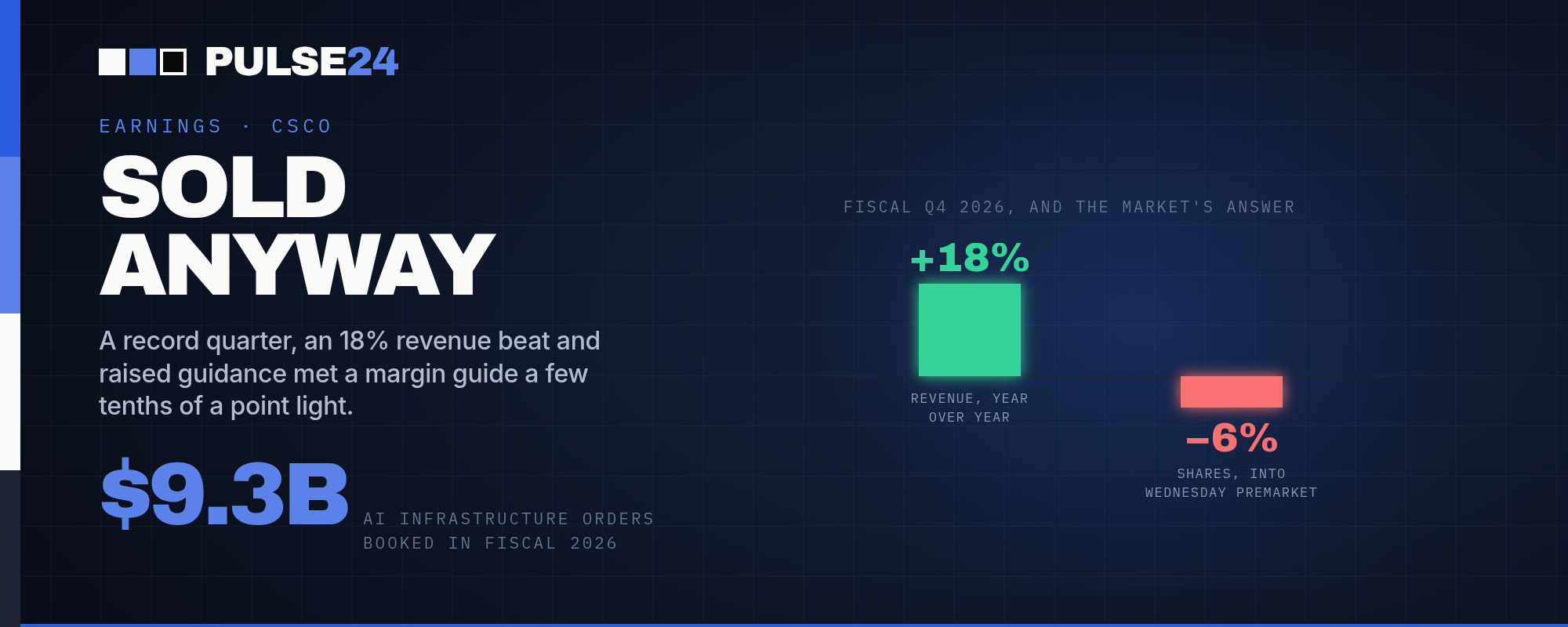
Cisco beat on revenue, profit and next year's revenue guidance in the same report, and grew its AI infrastructure order book to $9.3 billion for the year. Wall Street sold the stock anyway, because a softer first quarter margin guide overshadowed the beat.
Cisco posted $17.25 billion in revenue for its fiscal fourth quarter, its best quarter on record, and the stock fell anyway. Shares dropped as much as 4.2% in Tuesday's after hours trading to around $118.69, then extended the slide into Wednesday, falling as much as 6% from the prior close of $123.88 to around $116.40 before the opening bell. Revenue grew 18% from a year earlier and beat the Street's $16.83 billion estimate. Adjusted profit came in at $1.22 a share against a $1.17 consensus. Net income jumped 51% to roughly $3.9 billion. By almost every conventional measure, this was a clean beat.
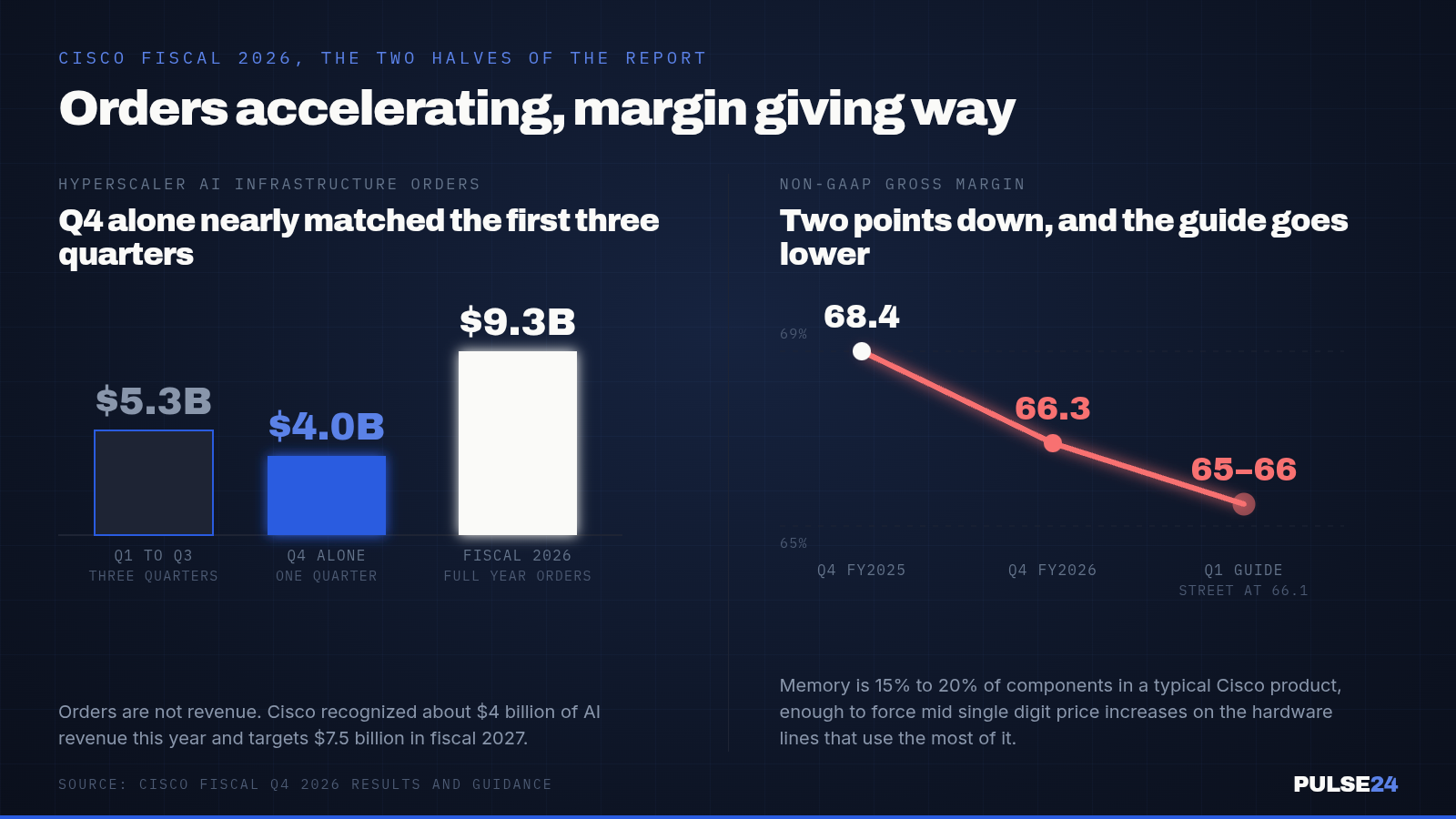
The number drawing the most attention was AI infrastructure orders. Hyperscalers, the cloud giants building out data centers for AI workloads, placed $4 billion in orders with Cisco during the quarter, pushing the fiscal year total to $9.3 billion. That figure stood at $5.3 billion just three months earlier, so hyperscalers placed nearly as much in new orders during the fourth quarter alone, $4 billion, as they had committed across the first three quarters combined, $5.3 billion. CEO Chuck Robbins called it the fastest moving technology transition Cisco has seen in more than three decades, with demand running across networking, security and compute all at once.
So why did a record quarter with raised guidance send the stock lower? Margin compression is part of it. Cisco's non-GAAP gross margin fell to 66.3%, down from 68.4% a year ago, and management pointed to a heavier hardware mix tied to the AI buildout along with rising memory costs. Memory only makes up 15% to 20% of the components in a typical Cisco product, smaller than the share for a pure server maker, but it was enough to push the company into mid single digit price increases on the hardware lines that use the most of it. CFO Mark Patterson described those increases as a last resort rather than a strategy, which is not the kind of language that reassures investors already worried about margins.
The second issue was forward margin guidance. Cisco guided first quarter gross margin to a range of 65% to 66%, just below the roughly 66.1% analysts had modeled, and pointed to a heavier mix of AI-related hardware and elevated component costs as the reason. Revenue guidance for fiscal 2027 was strong on its face, $72.2 billion to $73.4 billion against a roughly $69 billion consensus, and Cisco also said it expects AI infrastructure revenue from hyperscalers to reach $7.5 billion in fiscal 2027, up sharply from the roughly $4 billion in AI revenue it recognized this year, even as AI orders reached $9.3 billion. None of that stopped the sell-off. Investors walked in already pricing a stock that had gained close to 60% this year and traded near 40 times trailing earnings, well above its five year median in the high teens. Once a strong growth story met a slightly softer margin number, that combination was enough to trigger profit taking at that valuation.
Why It Matters
Cisco's results are a useful cross check on the AI infrastructure spending story that has driven much of this year's market, because the company sits in an unusually good position to see it from multiple angles. It sells switches and routers to the hyperscalers building AI data centers, and it also has to buy the same memory chips those data centers are competing for. The margin pressure Cisco described lines up with what Pulse24 covered when DRAM and NAND prices surged as much as 63% in a single quarter: the AI buildout is pulling memory away from ordinary hardware and pushing costs higher for anyone who needs it, including a networking equipment maker that isn't even in the memory business.
The stock reaction also fits a pattern that has shown up repeatedly this earnings season, where companies post genuinely strong AI-linked results and get sold anyway, either because the market wanted more or because the stock had already priced in near perfection. AMD and SanDisk both beat every estimate this month and still watched their shares fall 7% and 6%, and Nvidia's own stock fell the same day it lined up $500 billion in AI financing. The bar for AI infrastructure names has moved from beating estimates to beating a valuation that already assumes the beat.
What to Watch Next
Applied Materials and Walmart both report later today, and Applied Materials in particular will offer another read on whether the AI capital spending cycle is broadening or concentrating, since it sells the equipment used to make the chips going into all of this hardware. July's Producer Price Index, released this morning, came in flat on the month and up 4.7% year over year, cooler than June's 5.5% pace, even though core PPI jumped 0.4% for the month. That mixed print, a soft headline number but a firmer core reading, is another data point the Fed will weigh alongside the cooler July consumer inflation reading in deciding whether September brings a rate move.
Cisco's next quarter will show whether the softer margin guide was a one-time step tied to this specific product ramp or the start of a longer trend, and whether the $7.5 billion AI revenue target for fiscal 2027 proves conservative or aggressive once hyperscaler orders start converting into recognized sales. If other networking and hardware vendors report similar margin compression tied to memory costs over the next few weeks, that would suggest the pressure Cisco described is an industry wide phenomenon rather than something specific to its own supply chain.
The Pulse24 Take
Cisco's quarter is a reminder that in this market, beating Wall Street's numbers and satisfying Wall Street's expectations have become two different tests. The company grew revenue 18%, added $4 billion in new AI orders in a single quarter, roughly 75% more than the full order book carried just three months earlier, and guided next year well above consensus on both the top and bottom line. None of that was enough, because the stock had already priced in a flawless report and got a merely excellent one instead.
The more interesting signal sits underneath the headline numbers. Margin compression tied to memory costs is showing up in a company that isn't a memory buyer in any obvious sense, which says something about how far the AI infrastructure buildout's cost pressure has spread through the hardware supply chain. And a first quarter margin guide that landed just below Wall Street's model, even by a few tenths of a point, is the kind of detail that tends to get revisited if AI hardware costs keep rising faster than Cisco can offset them with pricing. For now it reads as one data point among many, not a trend, but it is worth tracking alongside the next round of hardware and hyperscaler earnings.
How we read the data
Curious how we get from raw data to a take like this? Our Trader's Toolkit walks through the tools we lean on.
Explore the Toolkit