Pulse24 Original
Oracle's Bonds Due in 2046 Trade at 85 Cents on the Dollar. Its Credit Rating Still Says Investment-Grade.
October 3, 2026
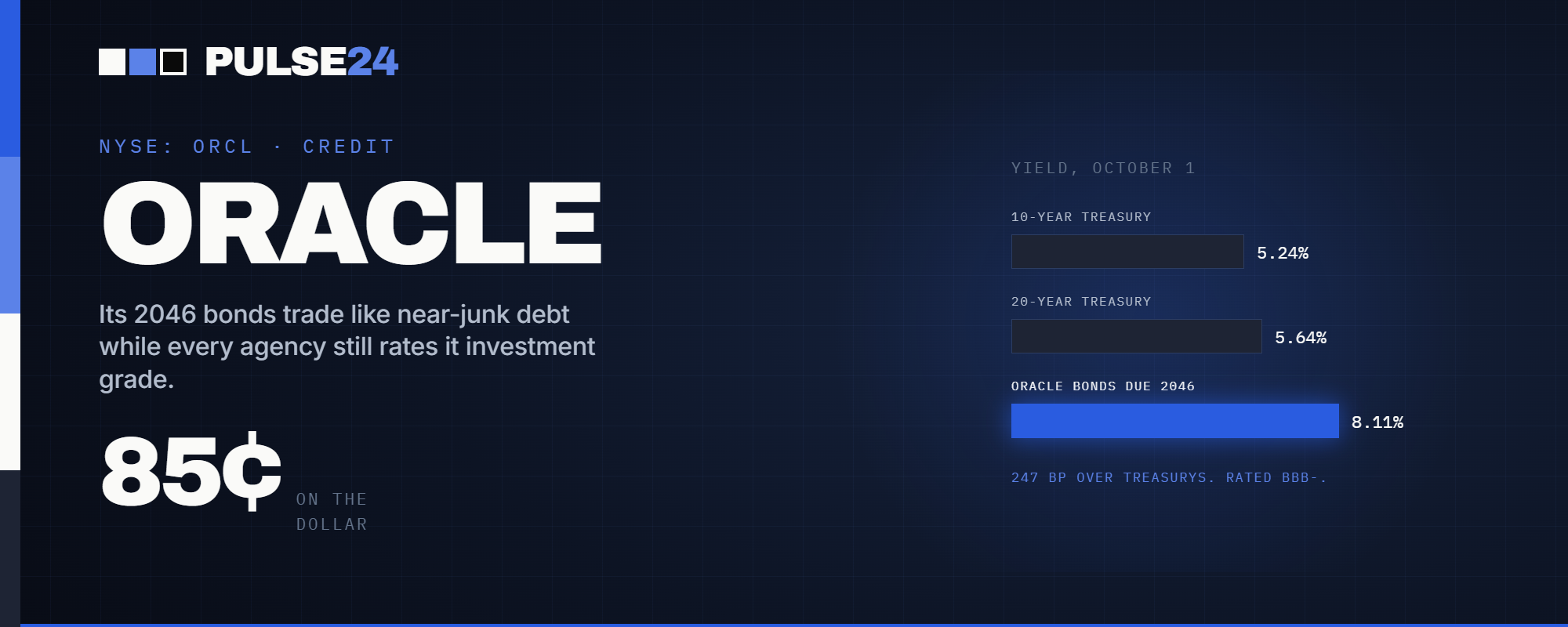
Oracle's bonds due in 2046 are trading like distressed debt, pricing an 8.11% yield to maturity even though every major rating agency still calls the company investment grade. The gap between what credit markets and equity markets believe about Oracle's AI buildout keeps widening.
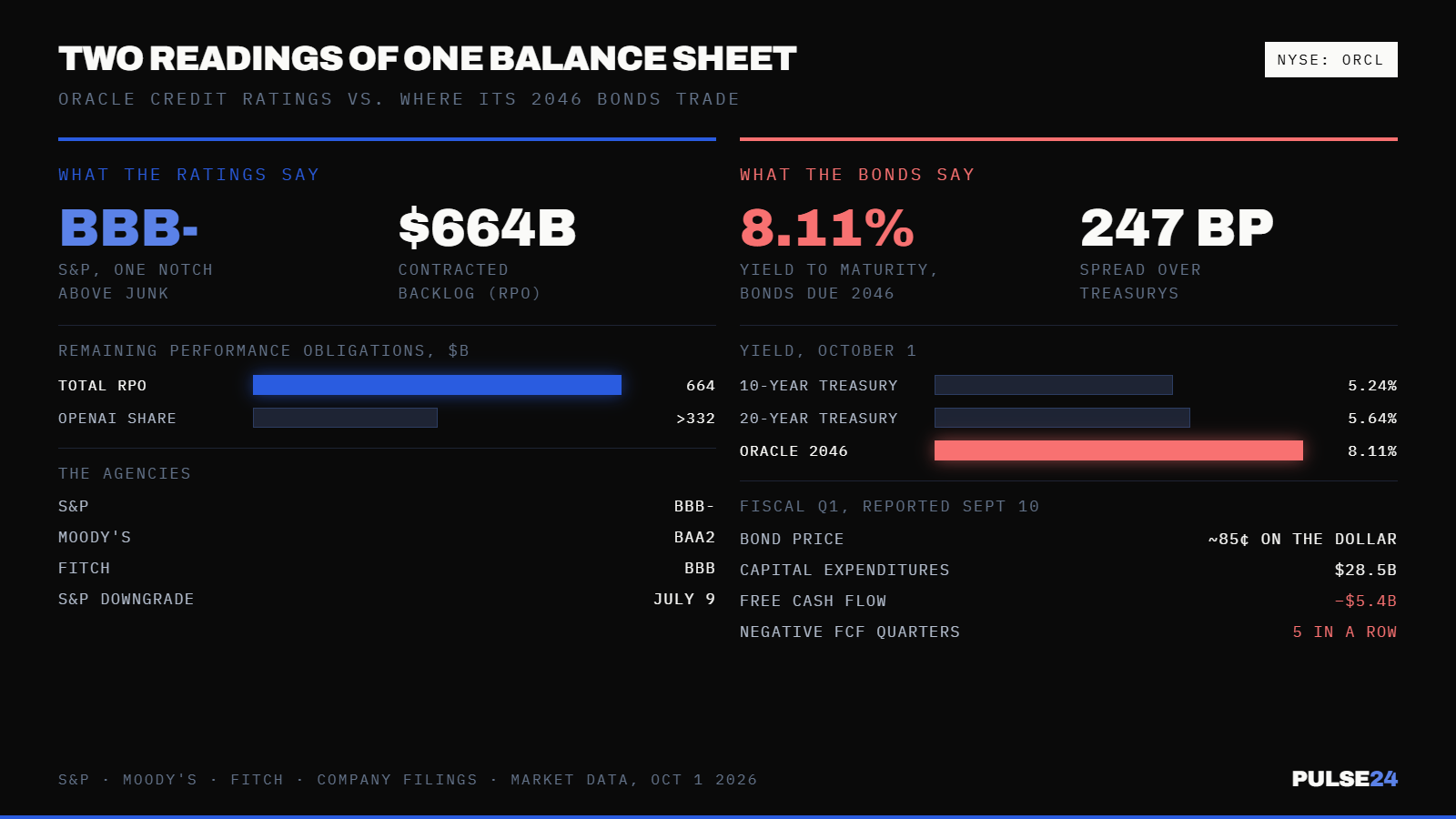
Oracle bonds maturing in February 2046 changed hands this week around 85 cents on the dollar. Buy one today and hold it to maturity, and the yield to maturity works out to 8.11%, a spread of 247 basis points over Treasurys. That's the kind of pricing bond traders usually reserve for companies teetering near junk status. Oracle's actual rating, from all three major agencies, says otherwise.
S&P has Oracle at BBB-, one notch above junk. Moody's calls it Baa2. Fitch has it at BBB. All investment grade, all comfortably so on paper. The bond market isn't buying the comfort.
What Changed
The gap between Oracle's credit rating and what its own debt actually trades for has been widening most of this year, and it's widened further as Treasury yields themselves have climbed to levels unseen in nearly two decades. The 10-year yield touched 5.24% on October 1. The 20-year reached 5.64% the same day, a level that puts long-dated Treasurys firmly above where they traded through most of the 2000s. Every company borrowing long-term money is paying more for it this year than last. Oracle is paying more than most.
Start with the numbers Oracle itself reported on September 10, when it posted fiscal first-quarter results. Capital expenditures came to $28.5 billion for the quarter alone, pouring into the data centers it's building to house AI chips for cloud customers. Free cash flow was negative $5.4 billion, the fifth consecutive quarter it's landed in the red. The company's remaining performance obligations, essentially contracted future revenue not yet booked, reached $664 billion. Bloom Energy's stock swung wildly late last month over a permitting dispute tied to Oracle's own Project Jupiter data center, a reminder that the buildout behind those numbers runs into real-world friction, not just spreadsheet assumptions.
Why It Matters
Credit investors and equity investors are reading the same balance sheet and reaching different conclusions, and that disagreement is the story. S&P downgraded Oracle to BBB- on July 9, citing rising business risk and weaker cash flow, a signal credit analysts were already uneasy well before this week's bond pricing. Since then, Oracle's five-year credit default swaps, the cost of insuring against an Oracle default, have climbed to levels unusual for an investment-grade name, more in line with how traders price risk in distressed corners of the market. SoftBank is paying its own highest-ever bond yields to fund its OpenAI commitments, and CoreWeave's interest bill has followed a similar trajectory. Oracle isn't alone in this, but it's by far the largest investment-grade borrower in the group, which is exactly why credit markets are watching it most closely.
The mechanism is straightforward once you see it laid out. Oracle is financing data center buildouts years ahead of the revenue those contracts are supposed to generate, borrowing now against promises collected later. More than half of that $664 billion backlog traces back to a single counterparty, OpenAI, a company that doesn't publish audited financials and is burning cash at a scale that dwarfs its current revenue. Equity analysts tend to treat a backlog like that as an asset: locked-in future business. Credit analysts tend to treat it as a liability: a claim on someone else's ability to keep raising money. Both framings can be correct at the same time, which is exactly what makes this hard to call.
What to Watch Next
Watch whether other investment-grade AI infrastructure names start trading the way Oracle's bonds already do. High-yield spreads widened to 294 basis points in late September, the broadest measure of credit stress tied to the AI buildout, but that move was concentrated in already-risky, lower-rated borrowers. Oracle's situation is different: it's an investment-grade company trading like it might not stay that way. If Moody's or Fitch follow S&P's lead and cut their own ratings, the pool of investors legally required to hold only investment-grade paper shrinks, forcing more selling into a market that's already nervous. Oracle's next debt sale, whenever it comes, and how the market receives it, will say a lot about whether this stays a company-specific story or becomes a template for the rest of the AI-financing complex.
The Pulse24 Take
None of this means the AI buildout is a mirage. Demand for compute is real, Oracle's cloud infrastructure revenue is genuinely growing at a pace few companies in any industry can match, and a $664 billion backlog doesn't appear out of thin air. What it means is that two different markets are pricing the same risk differently, and historically, when equity and credit disagree this sharply for this long, credit tends to be early rather than wrong. Rating agencies move slowly and in public. Bond traders move daily and anonymously, which is part of why their judgment often arrives first. Nobody needs to panic over an 8% yield on a single Oracle bond. But it's worth remembering that the price of money for the biggest investment-grade borrower in the AI buildout just told you something the stock price didn't.
How we read the data
Curious how we get from raw data to a take like this? Our Trader's Toolkit walks through the tools we lean on.
Explore the Toolkit