Pulse24 Original
China's Manufacturing PMI Beat Forecasts at 49.8 in August. New Orders Crossed Back Above 50, Reversing July's Slide.
August 31, 2026
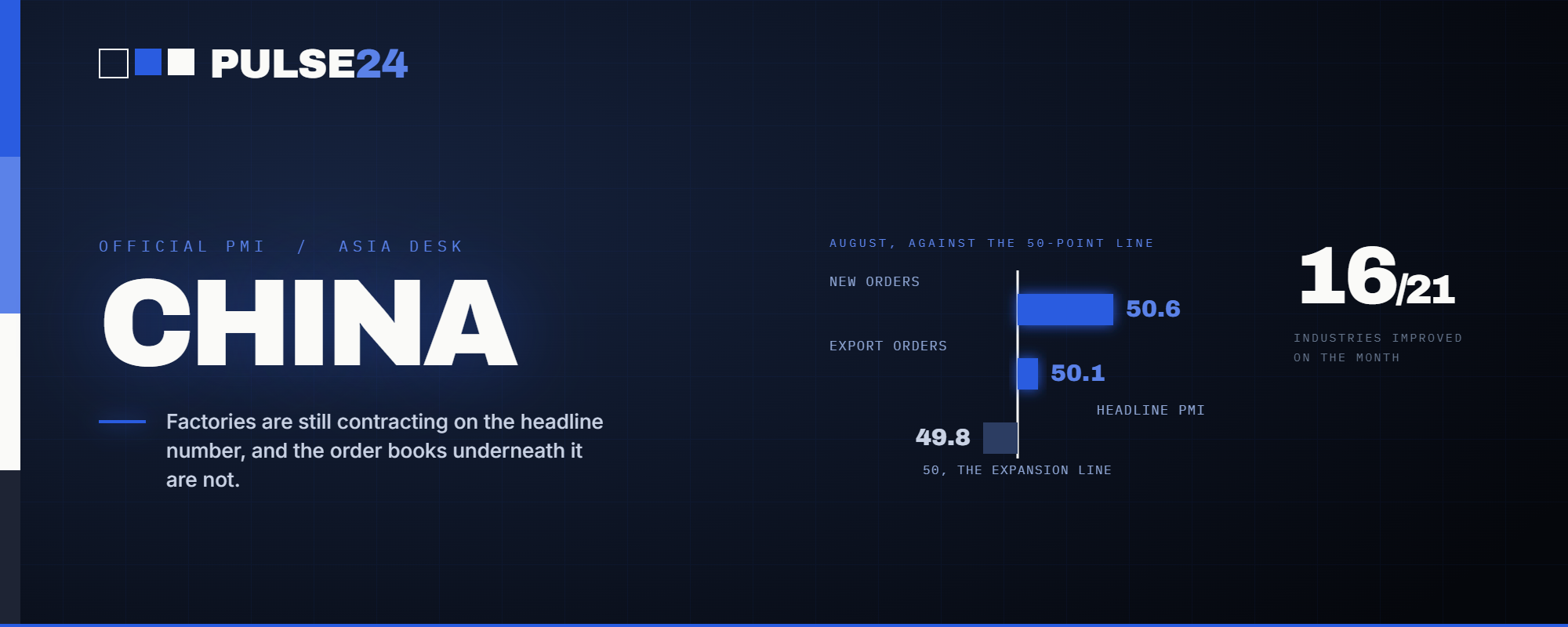
China's factory PMI improved to 49.8 in August, a second straight month of contraction but ahead of forecasts. The more telling number sits underneath the headline print, where new orders and export orders both swung back above 50, and Monday's new mortgage rules split bank and property-developer stocks into opposite camps within hours.
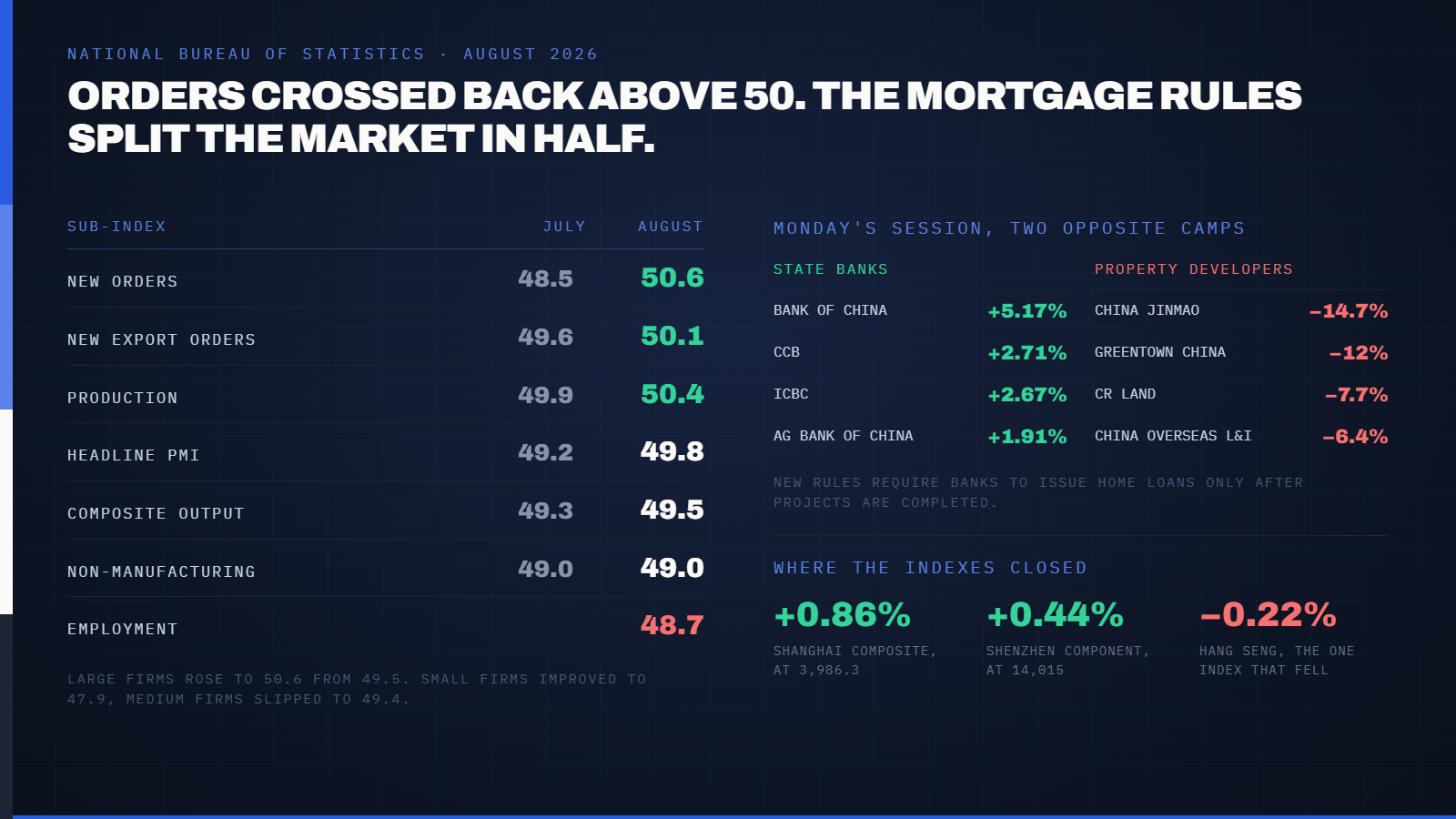
China's National Bureau of Statistics put the country's official manufacturing PMI at 49.8 in August, up from July's 49.2 and a touch better than the 49.7 economists had penciled in. That is still below the 50 mark separating growth from contraction, and it makes August the second straight month Chinese factories have reported shrinking output. The headline number is not the interesting part of this release. Buried in the same report, the new orders sub-index jumped from 48.5 to 50.6, moving from contraction into expansion in a single month, and new export orders climbed from 49.6 to 50.1 to do the same thing.
Composite output, which blends manufacturing with the services-heavy non-manufacturing PMI, ticked up to 49.5 from 49.3. Non-manufacturing itself held flat at 49.0, still weak but not deteriorating further. NBS statistician Huo Lihui described production and demand as expanding in tandem this month, with 16 of the 21 industries the bureau tracks showing improvement over July, concentrated in hi-tech manufacturing and larger firms. The production sub-index climbed to 50.4 from 49.9, while manufacturing employment slipped further to 48.7.
What Changed
Two forces have weighed on Chinese factories all year: soft domestic demand and a property sector still working through a multi-year correction. Second-quarter GDP grew 4.3%, below Beijing's own 4.5% to 5% target range for 2026, and July's PMI print had already confirmed a contraction. August did not reverse that contraction. It slowed it, and the internals suggest the slowdown in the slowdown has more behind it than a one-month blip.
New orders crossing back above 50 matters more than the headline index because orders lead production. A factory books an order this month and ships the product next month or the one after. When new orders sat at 48.5 in July, that pointed to weaker output ahead. At 50.6 in August, it points the other way. Export orders doing the same thing, moving from 49.6 to 50.1, is arguably the more interesting number given how much attention has gone to tariff risk and softer global trade this year. Large enterprises led the improvement, with their sub-index rising to 50.6 from 49.5, while small firms improved to 47.9 and medium-sized firms slipped slightly to 49.4.
ING's Greater China chief economist Lynn Song called the data "a little stronger than market expectations," language that fits a pattern this year of Chinese releases undershooting on the headline while beating on the details. Copper's rally to a record $6.78 a pound this month was mostly a story about a proposed US tariff and importers front-running a decision Washington still hasn't made, as Pulse24 covered in August, rather than a China demand story. If China's order books keep firming, that distinction gets harder to hold, and industrial commodities would be one of the first places to show it.
Why It Matters
Markets have spent this year pricing China largely off its weakest data point, and Monday's stock reaction is a case study in why that habit needs a second look. Shanghai's Composite Index rose 0.86% to 3,986.3 and the Shenzhen Component gained 0.44% to 14,015, with state-owned banks doing most of the lifting. Industrial and Commercial Bank of China rose 2.67%, Agricultural Bank of China gained 1.91%, China Construction Bank added 2.71%, and Bank of China jumped 5.17%. None of that was a direct reaction to the PMI. The People's Bank of China and the national financial regulator announced new mortgage rules the same day, requiring lenders to issue new-home mortgages only after a project is completed and extending the maximum loan term to 40 years from 30. Investors read it as good news for bank balance sheets.
Property developers read the same announcement the opposite way. China Resources Land fell 7.7%, China Jinmao dropped 14.7%, Greentown China declined more than 12%, and China Overseas Land and Investment lost 6.4%, all on worries that cutting off presale mortgage financing until a project is finished will squeeze developer cash flow harder in a sector still working through its correction. Same policy, same day, two opposite verdicts from two parts of the same market. That split is closer to how policy actually moves through an economy than either a blanket rally or a blanket selloff would suggest.
Hong Kong told yet another story. The Hang Seng fell 0.22%, recovering from a steeper early drop but still finishing lower even as mainland shares rose. Whatever pressure hit Hong Kong-listed names on Monday was not the same pressure lifting Shanghai, and anyone treating Chinese equities as a single trade had to pick a venue and live with the difference.
For markets outside China, the more durable read-through is what August's PMI internals say about global demand, not what Chinese bank stocks did on a Monday. A world where China's factories are still shrinking but taking in more new orders is a different setup than one where the whole print is deteriorating. Global growth forecasts, industrial commodity demand, and the case for a soft landing across major economies all lean partly on whether China stabilizes or keeps sliding. One month of stronger orders is evidence for stabilization, not proof of it.
What to Watch Next
The private Caixin manufacturing PMI, which skews toward smaller and export-oriented firms and can diverge sharply from the official survey, is due out within days and will be the next test of whether August's order strength shows up in a different sample of companies. A gap between the two surveys would say something about which part of the economy, state-linked heavy industry or private exporters, is actually driving the improvement.
September's data will matter more than August's. One month of stronger orders after a July contraction could reflect restocking ahead of a policy deadline, or it could be a genuine inflection. Watch whether new orders hold above 50 or slip back, and watch industrial metals and freight rates for early confirmation that Chinese demand is translating into actual purchases rather than survey optimism.
The Pulse24 Take
The headline number here says contraction, and it is technically correct. But stopping at 49.8 misses the part of the report that actually moves forward-looking odds: new orders and export orders both swung from below 50 to above it in a single month, the kind of shift that tends to show up in production data before it shows up in the headline PMI itself. That doesn't mean China's property overhang or its soft consumer demand have resolved themselves. Second-quarter growth still ran below Beijing's target, non-manufacturing activity stayed flat rather than improving, and Monday's mortgage rules split the market they were meant to stabilize into winners and losers within hours. What it does mean is that the easy short-China trade got a little harder to justify this week, and the assumption that Chinese demand for industrial commodities will keep sliding is now competing with a data point that argues the opposite. One PMI print is not a trend. It is, at minimum, a reason to read the internals of the next one instead of stopping at the headline.
How we read the data
Curious how we get from raw data to a take like this? Our Trader's Toolkit walks through the tools we lean on.
Explore the Toolkit