Pulse24 Original
China Has Already Imported More Gold This Year Than All of 2025. The Price Is Still 22% Off Its Record.
September 22, 2026
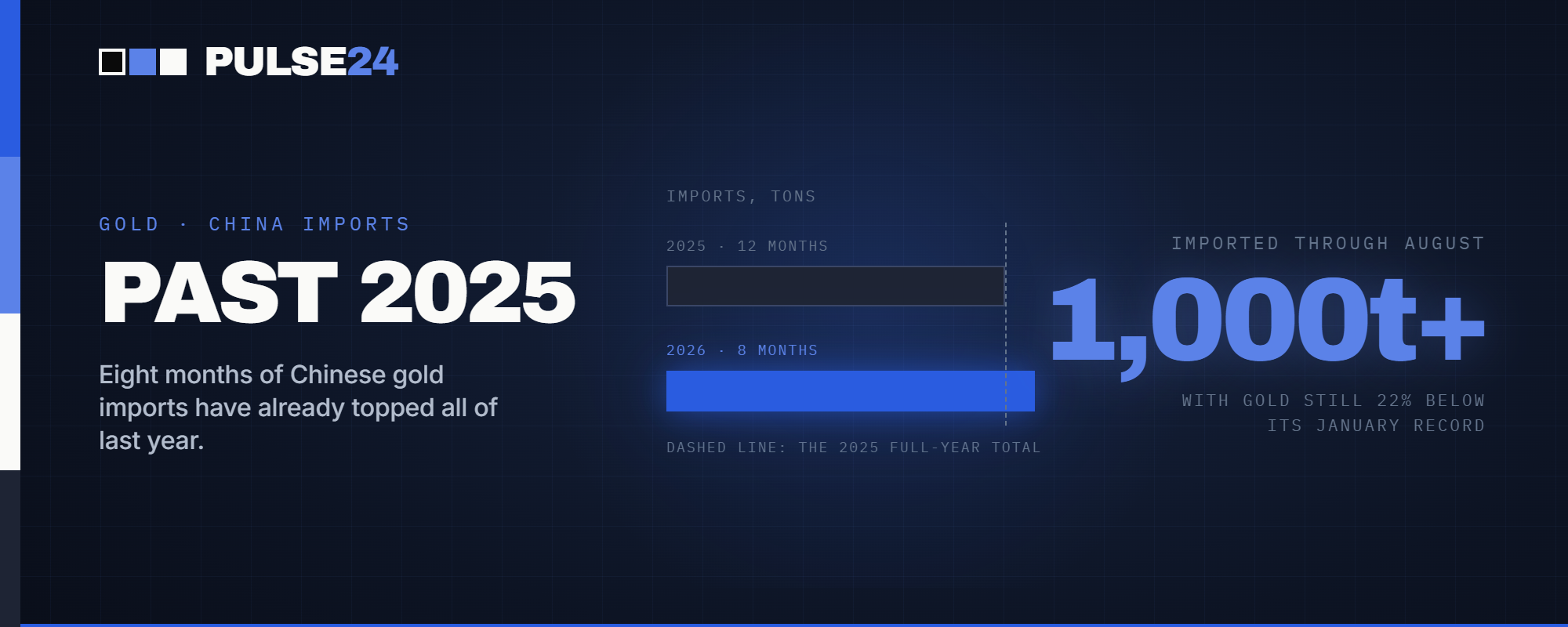
China's banks and its central bank have imported more than 1,000 tons of gold through August, already surpassing all of 2025, even as the metal trades about 22% below the record it set in January. The People's Bank of China posted its biggest single-month addition since 2023, and the timing, after the price pulled back rather than before, says something about who is setting the floor.
China imported more gold in the first eight months of 2026 than it did in the whole of 2025. Customs data released this week put the year-to-date total above 1,000 tons, a mark that all of last year's imports never reached.
The timing is what makes it interesting. Gold has spent most of this year sliding away from a record high, not climbing toward one.
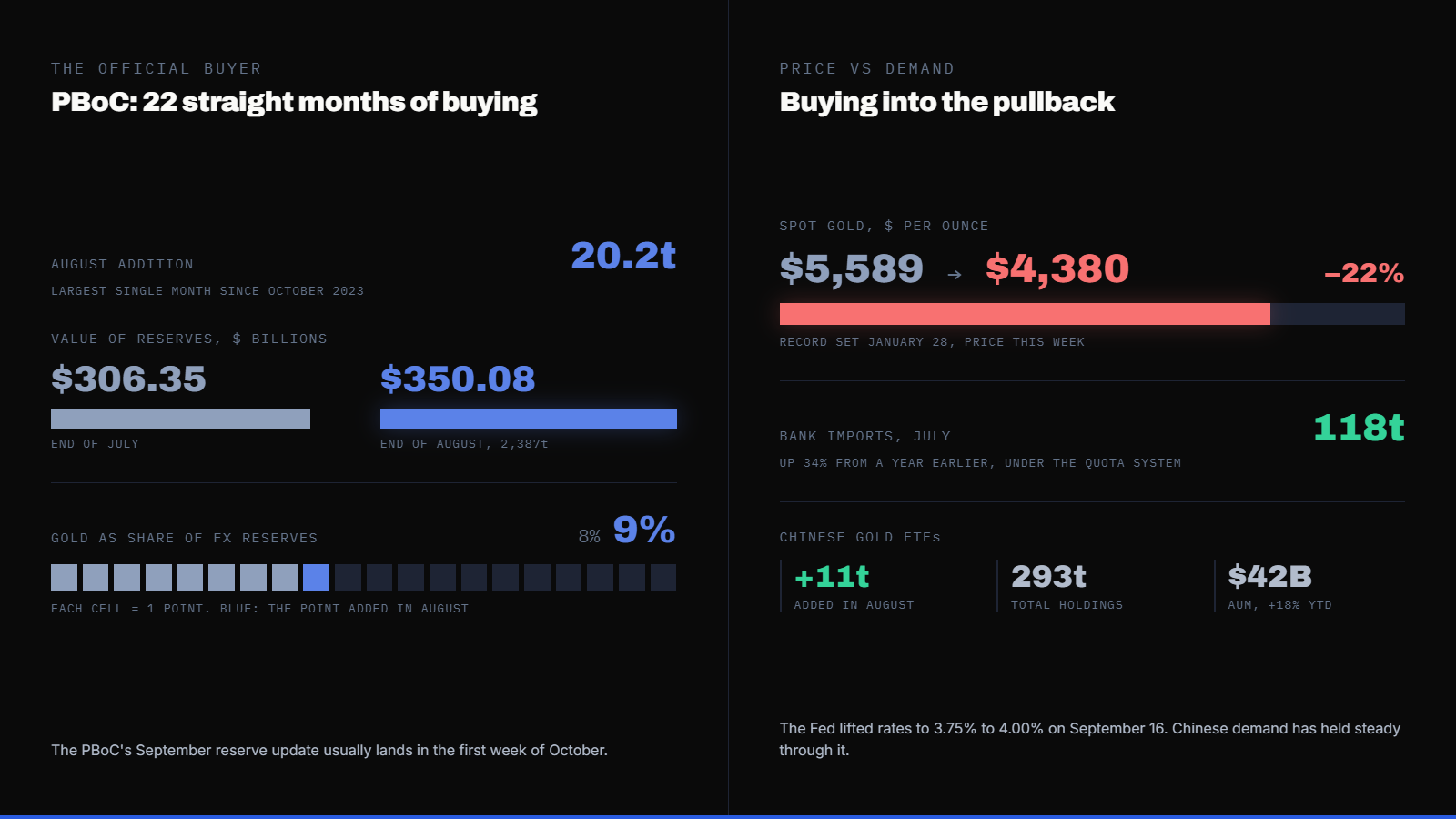
Since gold's all-time peak of $5,589.38 an ounce on January 28, the metal has fallen by roughly a fifth. It traded near $4,380 this week, a level that would have counted as disappointing a year ago and looks almost unremarkable now next to where it's been. China's buyers, both private and official, have used that decline as an entry point rather than a warning sign.
That split between price and demand runs through almost every data point coming out of China right now.
What Changed
The People's Bank of China added 20.2 tons of gold to its reserves in August, the largest single monthly increase since October 2023, according to World Gold Council figures. That marked the 22nd consecutive month the central bank has added to its holdings without a single month of net selling. Total PBoC reserves stood at 2,387 tons at the end of August, valued at $350.08 billion, up from $306.35 billion in July. Gold now accounts for 9% of China's foreign exchange reserves, up from 8% the month before.
Official buying is only part of the story. Commercial banks operating under China's import quota system brought in 118 tons of gold in July, the most recent month with a detailed customs breakdown, up 34% from a year earlier even though it slipped from June's pace. Add the months together and the year-to-date total clears 1,000 tons, more than China imported across the entirety of 2025, when the full-year figure came in just under that mark. Chinese gold-backed ETFs added another 11 tons in August, bringing their combined holdings to 293 tons and assets under management to roughly $42 billion, an 18% increase since the start of the year.
Zijie Wu, an analyst at Jinrui Futures Co., pointed to the yuan's strength as one reason banks have been able to bring in more gold. The yuan pushed through 6.70 to the dollar this week, and Wu said that strength has helped regulators grant more generous import quotas while keeping onshore gold prices at a slight premium to world benchmarks, a premium that itself entices banks to import more.
Why It Matters
Central bank gold buying isn't a new theme on its own. Central banks worldwide bought a record 289 tonnes last quarter, even as the metal's average price fell 8% over the same three months. What's notable now is that China's pace has picked up specifically as the price weakened, not despite it. The World Gold Council's Marissa Salim has said PBoC activity accelerated since gold's price pulled back earlier this year, with double-digit monthly purchases continuing every month since May.
Part of that pullback traces to policy in Washington. Fed Chair Kevin Warsh delivered the central bank's first rate hike since 2023 on September 16, lifting the target range to 3.75%-4.00% and signaling more increases could follow. Higher rates raise the opportunity cost of holding an asset that pays no yield, which is usually bearish for gold. China's reserve managers appear to be treating that as a buying opportunity rather than a reason to wait.
Gold's retreat from its January record has also been gradual compared with silver, which crashed 30% in a single session after Fed chair nominee Kevin Warsh's selection eased worries about political interference at the central bank. Gold never saw a break that sharp. It has instead drifted lower over eight months, with occasional rallies, while China's demand has only grown steadier.
What to Watch Next
The next data points worth tracking are September's numbers. China's customs bureau typically reports monthly import figures with about a six-week lag, and the PBoC's own reserve update for September usually lands in the first week of October. A fourth straight month of double-digit tonnage from the central bank would suggest this is closer to a structural reallocation than a one-off dip-buying trade.
Also worth watching is whether Beijing loosens or tightens the bank import quota system that governs how much gold commercial lenders can bring in. Wu's comment about more generous approval quotas suggests the door is currently open. A reversal there would be one of the clearer signals that policymakers think the pace of imports has gone far enough.
And there's the Fed side of the equation. Warsh has suggested at least one more hike is likely before year-end. If that materializes and gold keeps drawing steady Chinese demand anyway, it would be a meaningful test of how much higher rates still matter to gold's price when a large, price-insensitive buyer is active on the other side.
The Pulse24 Take
Gold's price and gold's demand are currently telling two different stories, and it's worth being precise about which one is more likely to be temporary. Prices are set at the margin, by whoever is trading in the moment, and right now that appears to be a market still digesting higher US rates and a stronger dollar. Demand from China's official and commercial buyers is a slower-moving force, built on reserve allocation decisions that don't reverse over a few weeks of price action.
History doesn't offer a clean rule for how long that gap can persist. It does suggest that when official buyers treat a price decline as an opportunity rather than a warning, the decline rarely turns out to be the whole story. Whether gold reclaims $5,589 anytime soon is a separate question. The buyer with the twenty-two month streak is worth watching more closely than the ticker.
How we read the data
Curious how we get from raw data to a take like this? Our Trader's Toolkit walks through the tools we lean on.
Explore the Toolkit