Pulse24 Original
IonQ's 15% Premarket Pop Vanished by the Closing Bell. After Hours, It Came Back.
September 23, 2026
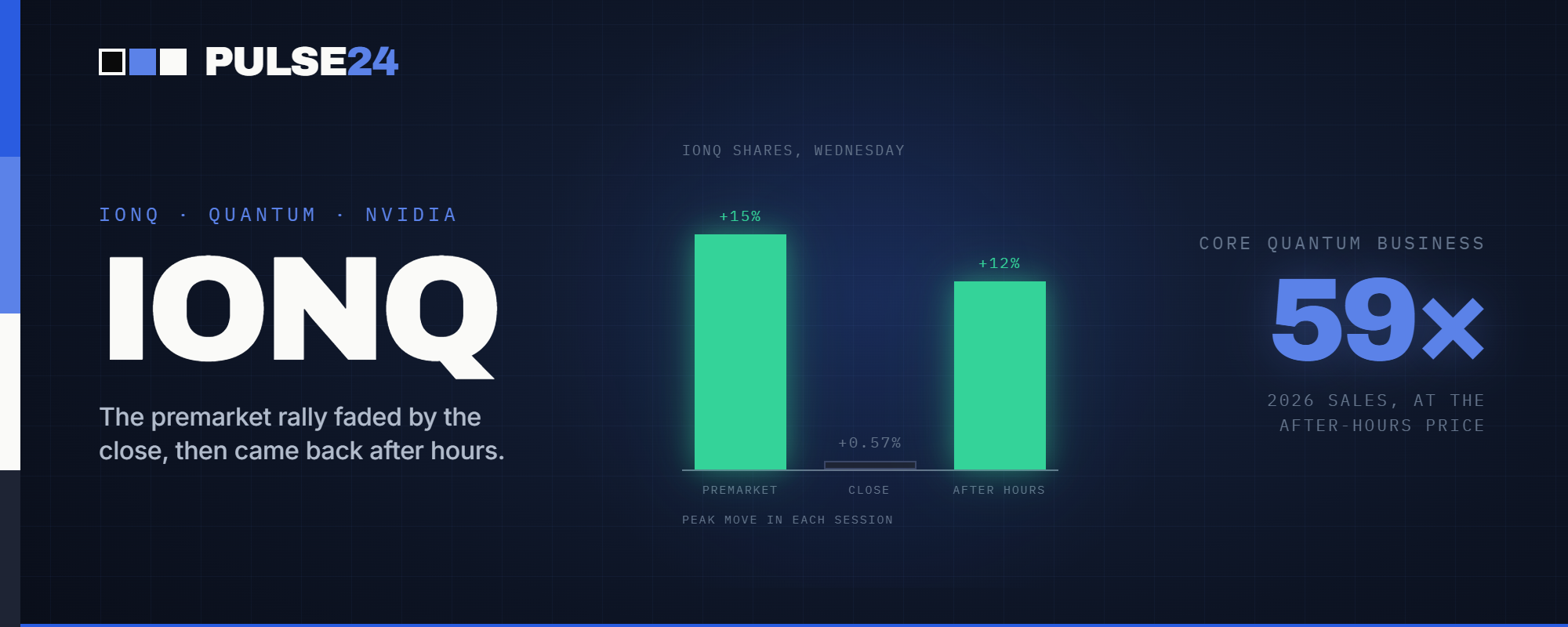
IonQ's stock surged as much as 15% before Wednesday's open on a quantum computing breakthrough and a new Nvidia deal, only to close nearly flat and then jump again after hours. The volatility says as much about the speculative quantum computing trade as the news itself does.
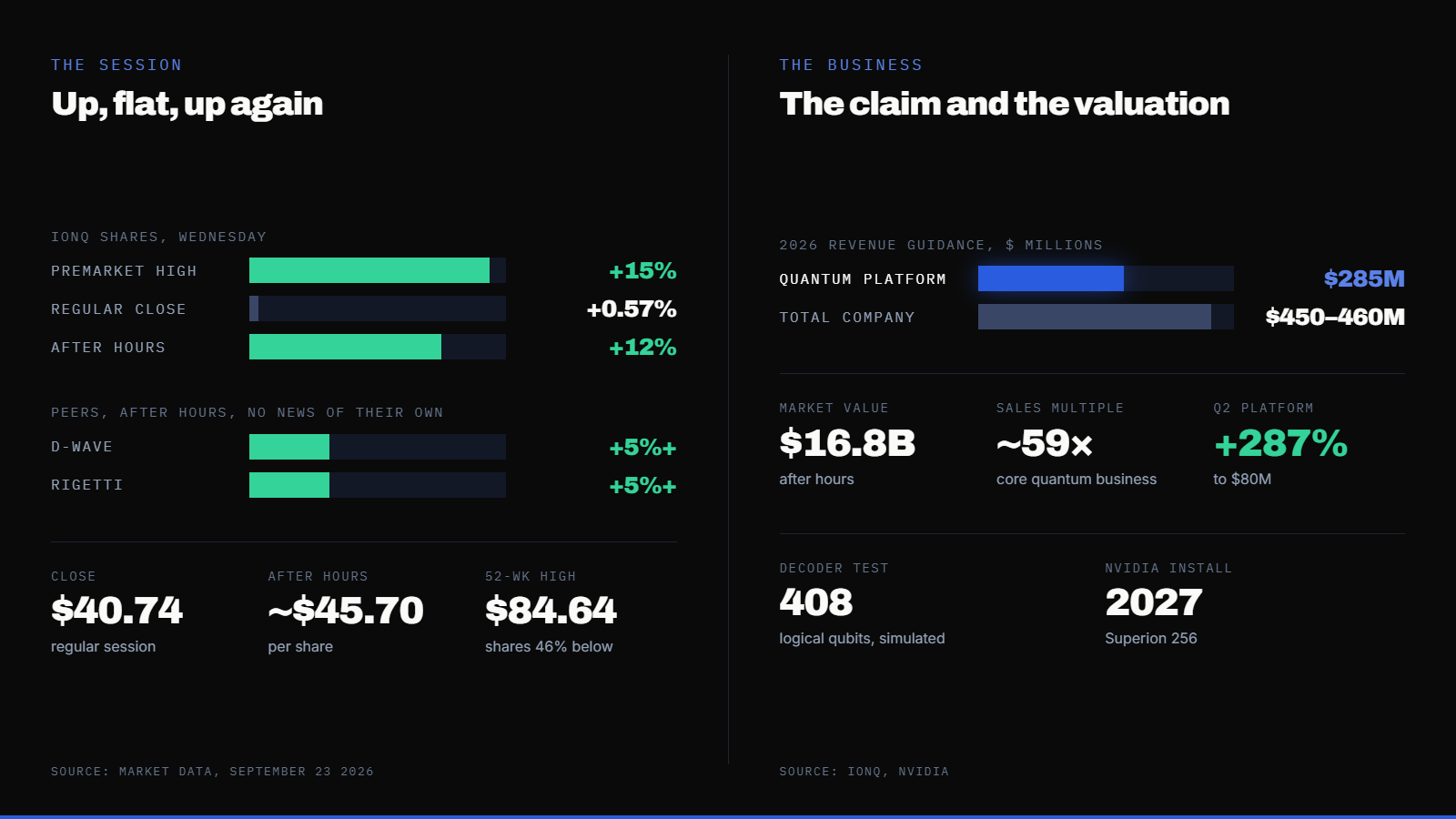
IonQ shares were indicated up as much as 15% before Wednesday's opening bell. By the closing bell, almost all of that gain was gone: the stock finished the regular session up just 0.57% at $40.74. Then, in after-hours trading, it jumped again, rising roughly 12% to around $45.70. The seesaw followed the quantum computing company's announcement that it had solved one of the field's most persistent scaling problems, getting classical computing hardware to keep up with a quantum processor's error rate in real time, using nothing more exotic than a standard CPU.
D-Wave Quantum and Rigetti Computing moved in the same pattern. Both were roughly flat during the regular session, then climbed more than 5% each after hours, even though neither company had an announcement of its own. That kind of delayed, correlated move says something about how small and sentiment-driven the quantum computing trade still is: one company's news, digested slowly over the course of a day, can end up moving an entire sector's market value together.
What Changed
IonQ's announcement centers on what the industry calls a real-time decoder, the software layer that has to continuously find and fix errors in a quantum computer's calculations as they happen. Quantum bits are notoriously unstable, and today's systems can generate errors faster than classical hardware can catch and correct them. That gap is one of the main reasons large-scale, genuinely useful quantum computers do not exist yet.
IonQ says it built the industry's first end-to-end version of that decoder running on a single, off-the-shelf CPU rather than specialized processors. In simulated tests, the system tracked and corrected errors across circuits as large as 408 logical qubits and more than 31 million quantum operations. Nicolas Delfosse, IonQ's quantum research lead, said the decoder added virtually no delay to the computation under standard operating noise.
That last detail matters more than it sounds like it should. A decoder that works but slows the whole system down defeats the purpose, and one that keeps pace on ordinary hardware would remove a cost barrier that has kept large-scale error correction mostly confined to research papers. The caveat is real, though: these are benchmark results on simulated circuits, not a demonstration on IonQ's actual quantum hardware running at that scale. IonQ has not yet shown the decoder working end to end on a physical machine handling 408 real logical qubits, a bar the industry as a whole has not cleared.
The second announcement came from Nvidia. IonQ's newest system, the Superion 256, will become the first quantum processor installed inside Nvidia's Accelerated Quantum Research Center, a facility built to pair quantum hardware directly with Nvidia's own supercomputers. When installation happens in 2027, the Superion 256 will connect to an Nvidia GB200 NVL72 system through NVQLink, Nvidia's interconnect for linking quantum and classical machines, with workloads coordinated by Nvidia's CUDA-Q software platform.
Nvidia vice president of quantum computing Timothy Costa framed the deal in sweeping terms: "Every supercomputer will become a quantum supercomputer." IonQ chief executive Niccolo de Masi described the deployment as validation of the company's approach, saying it would let "our partners... benefit from our scalable architecture and robust manufacturability."
Why It Matters
Quantum computing stocks trade almost entirely on narrative right now, because revenue does not yet justify the valuations on its own. IonQ's quantum platform is guided to roughly $285 million in 2026 revenue, essentially unchanged since August even as second-quarter platform revenue grew 287% year over year to $80 million. Using Wednesday's after-hours price, which pushed the company's market value to roughly $16.8 billion, that puts the core quantum business at somewhere around 59 times this year's expected sales. IonQ's total company-wide guidance is higher, $450 million to $460 million, but nearly all of that increase comes from SkyWater Technology, the chip foundry IonQ bought for about $1.8 billion in January to secure its own manufacturing supply, not from faster quantum computing growth. Growth at 59 times sales can support a rich multiple for a while. It cannot support one indefinitely, and it leaves little room for a disappointing quarter, on either side of the business.
That is why a day like Wednesday carries outsized weight for the sector. A specific, credible technical claim, paired with a real customer commitment from the most important company in AI infrastructure, gives investors a concrete reason to extend the growth story a little further into the future. Whether that reason survives contact with actual hardware results is a separate question, and it is the one likely to determine whether the after-hours strength holds or fades the way the premarket pop already did once. Even with Wednesday's gains, IonQ shares remain roughly 46% below their 52-week high of $84.64, a reminder of how far this stock has already swung in both directions this year.
What to Watch Next
The clearest test ahead is whether IonQ can reproduce the decoder's simulated performance on physical hardware at comparable scale, and whether it publishes those results with the same level of detail it gave for the simulation. Independent researchers will likely spend the coming weeks picking apart the benchmark methodology, and any gap between the simulated numbers and a live demonstration would matter more than Wednesday's headline did.
Thursday's regular session is the next test of whether the after-hours strength actually holds. The stock already round-tripped once on Wednesday, popping premarket and fading almost to flat by the closing bell before recovering after hours, and that kind of choppiness usually means the market has not settled on what the news is worth yet. The Nvidia installation itself is more than a year away, so watch instead for whether D-Wave, Rigetti, or other quantum names answer with technical announcements of their own, since sympathy rallies built on no news tend to give back their gains once the next earnings report or funding update resets expectations.
The Pulse24 Take
Separate the two things IonQ announced, because they carry different weight. The Nvidia deal is concrete: a signed commitment from the company that sits at the center of the AI buildout, wiring quantum hardware directly into its most advanced supercomputers. That is a genuine vote of confidence, even if the payoff is more than a year out.
The error-decoder claim is more provisional. It is a real technical result, validated by a named researcher with specific numbers attached, which puts it well above the vague breakthrough announcements this sector produces on a regular basis. But it was tested in simulation, not on IonQ's actual quantum processors running at that scale, and the company has not said when that harder demonstration is coming. Markets tend to round a promising simulated result up to a finished one, and that gap is usually where the disappointment comes from once reality catches up to the headline.
Wednesday's own trading made that point better than any analyst note could. A stock that opens up double digits, gives almost all of it back by the closing bell, and then jumps again after hours has not settled on what this news is worth. A near-60-times-sales multiple only makes sense if announcements like this keep arriving, each one narrowing the distance between what quantum computing promises and what it can currently do. The more useful question isn't whether this particular decoder works. It's how many more of these announcements the market will keep rewarding before it starts demanding the harder proof instead.
How we read the data
Curious how we get from raw data to a take like this? Our Trader's Toolkit walks through the tools we lean on.
Explore the Toolkit