Pulse24 Original
FICO Stock Cratered as Much as 21% in a Single Session. One Housing Regulator's Order Erased Its Mortgage Monopoly in a Sentence.
September 4, 2026
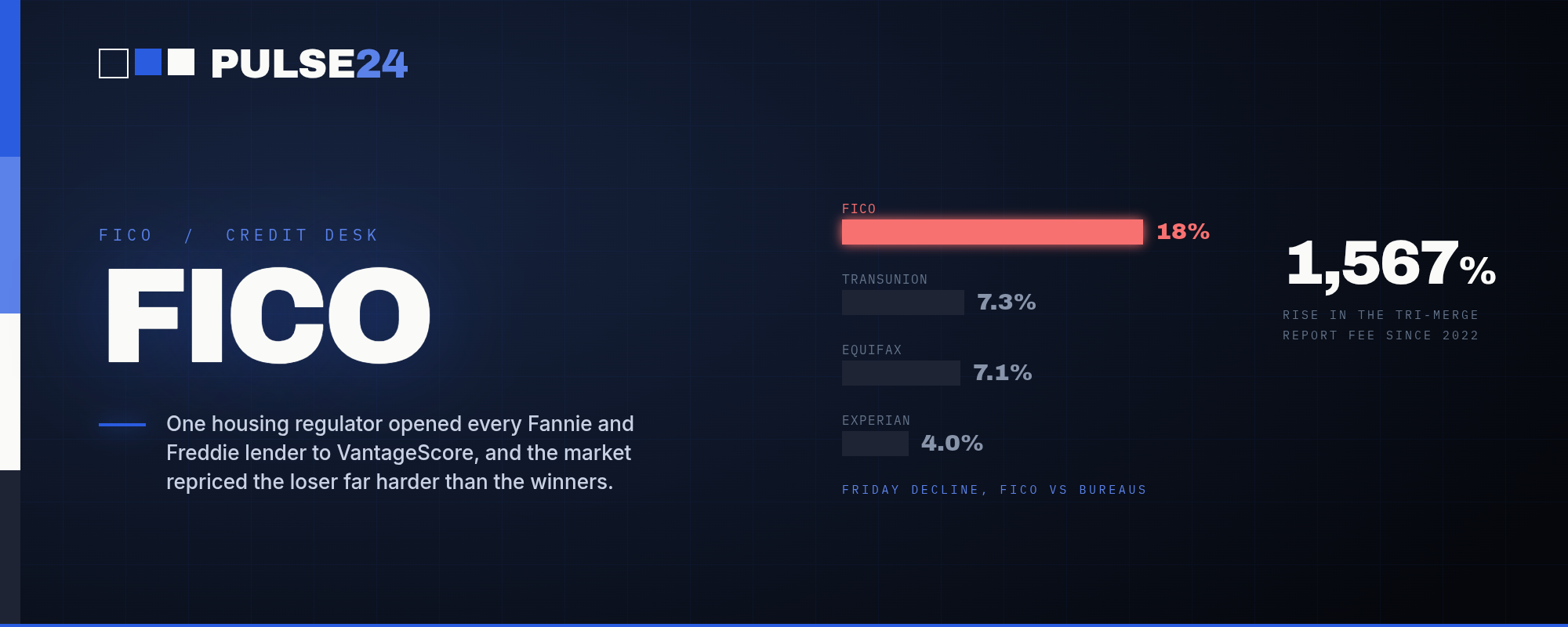
The Federal Housing Finance Agency ordered Fannie Mae and Freddie Mac to approve every mortgage lender for VantageScore on Thursday, ending FICO's decades-long grip on mortgage credit scoring. FICO shares cratered as much as 21% the next day, far outpacing the declines at the credit bureaus behind its replacement.
Bill Pulte posted nine words on X Thursday that undid three decades of pricing power: "FICO has enjoyed a monopoly. No more." As director of the Federal Housing Finance Agency, Pulte followed that post with an instruction to Fannie Mae and Freddie Mac, the two government-backed entities that buy or guarantee most U.S. mortgages: approve every lender, immediately, to use VantageScore instead of requiring FICO's model. It was a one-sentence order with the power to reshape a business FICO has effectively owned since the 1990s.
What Changed
The order didn't come out of nowhere. Pulte first signaled openness to an alternative credit-scoring model back in July 2025, then let a limited group of roughly 50 lenders start using VantageScore 4.0 on May 1 of this year as a test run. Thursday's directive tore down the guardrails around that pilot. Every lender selling loans to Fannie or Freddie can now choose VantageScore over FICO's Classic model, and Pulte made clear on social media that he sees the change as overdue rather than experimental.
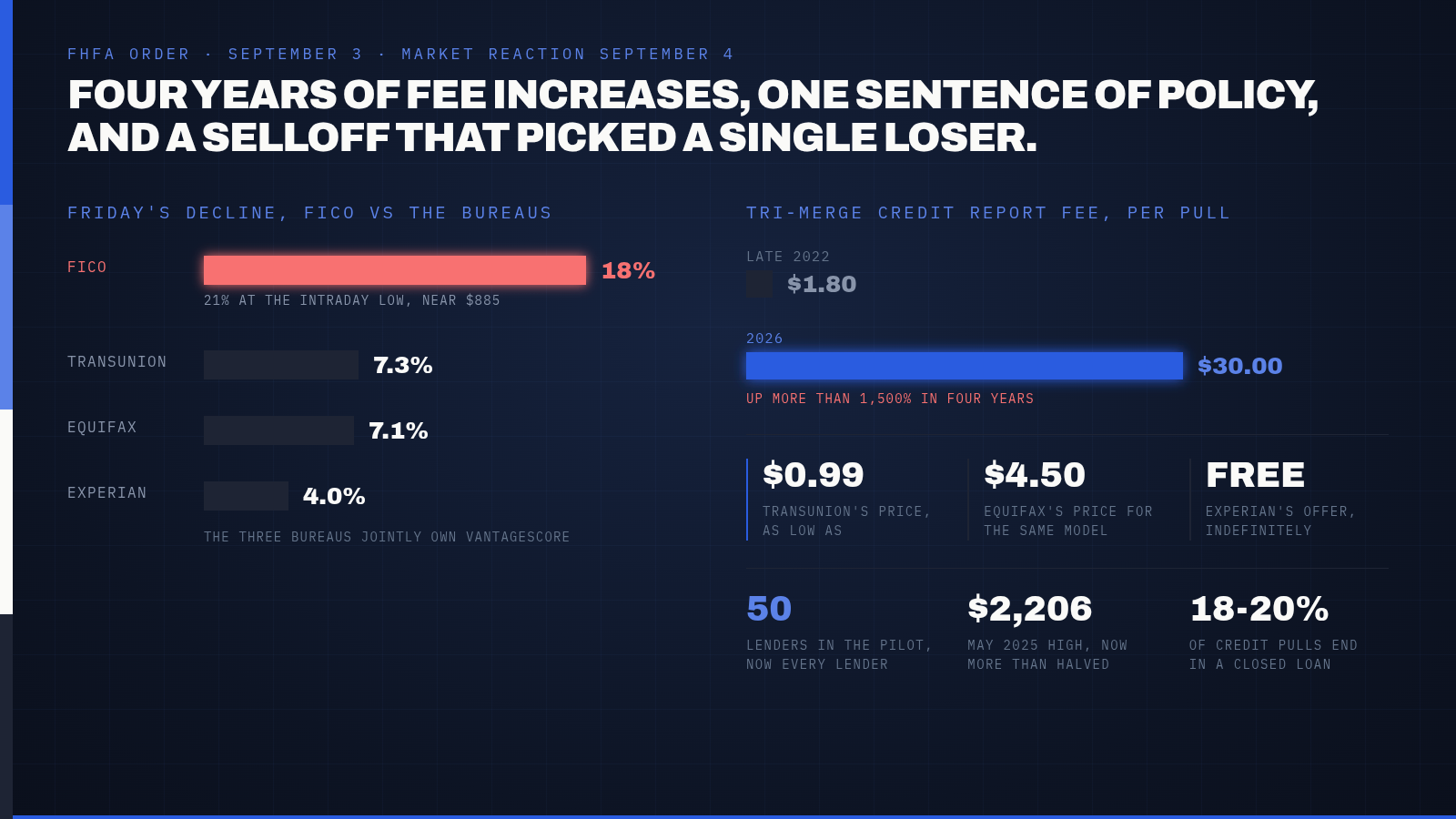
Wall Street's reaction wasn't close to proportional between the two sides of this trade. FICO shares cratered as much as 21% intraday Friday, tumbling from Thursday's $1,118.93 close to roughly $885 at the low before recovering some ground, a far steeper drop than anything the stock has logged since Pulte's initial public campaign against the company in 2025. The three credit bureaus that jointly own VantageScore and stand to gain volume from the shift got hit too, just nowhere near as hard. TransUnion and Equifax each fell more than 7% in premarket trading, and Experian slipped closer to 4%. Pulte had paired his FICO announcement with a separate jab at the bureaus themselves, accusing them of overcharging consumers and behaving like a cartel, which may explain why none of the three caught a bid despite standing to inherit FICO's lost mortgage volume.
The pricing numbers explain why regulators went looking for a fight in the first place. The Community Home Lenders of America has tracked FICO's base tri-merge credit report fee climbing from $1.80 in late 2022 to $30 by 2026, a jump north of 1,500% in four years. FICO's mortgage-specific score, priced separately, rose more than 40% in a single step in late 2024, from $3.50 to $4.95 per pull. VantageScore's backers are undercutting that on price: TransUnion has offered its version for as little as 99 cents to lenders, Equifax prices it near $4.50, and Experian has said it will provide VantageScore 4.0 for free indefinitely.
Why It Matters
A credit score is a small line item on a mortgage closing statement, but the market underneath it is enormous, and FICO's grip on it has been close to total. Every borrower applying for a conforming mortgage has effectively had to pay for a FICO score regardless of what it cost, because Fannie and Freddie wouldn't accept anything else. That's the definition of pricing power economists look for, and it shows up directly in FICO's margins: the mortgage segment has been the company's most profitable business even as it makes up a smaller share of overall revenue than its scores used for auto loans and credit cards.
Ending that requirement doesn't automatically mean lower costs land on borrowers. Lenders, not homebuyers, are the ones who choose which score to pull and pay the bureau fee, and there's no guarantee competitive pricing among bureaus gets passed through rather than absorbed as margin somewhere else in the origination chain. Still, the mechanics point toward more competition than the market has seen in years. Mortgage industry estimates suggest only 18% to 20% of the credit pulls lenders order during the application process ever result in a closed loan, meaning most of what borrowers indirectly pay for covers files that never become mortgages. Cheaper scoring, or more efficient matching between applicants and lenders, could chip away at that waste.
The timing matters too. Real home values, adjusted for inflation, have now fallen for 13 straight months even as nominal prices keep rising, and mortgage rates near 6.65% have already priced plenty of would-be buyers out of the market. A few dollars off a credit report fee isn't going to fix affordability on its own, but every regulator pushing on origination costs right now is responding to the same underlying pressure: a housing market where the mechanics of getting a loan feel as strained as the price of the home itself.
What to Watch Next
Lenders still don't have full clarity on execution. Housing industry trade groups have said they're waiting on final pricing commitments from the bureaus and a firm implementation timeline before shifting volume away from FICO in practice, and Pulte's Thursday order didn't spell out either. How quickly loan officers actually start pulling VantageScore instead of FICO will say more about the shift's real impact than the announcement itself.
There's also a bigger structural change waiting in the wings: a possible move from tri-merge credit reports, which pull data from all three bureaus, to bi-merge reports using only two. Pulte has floated reviving that idea after his predecessor shelved it. It would cut costs further, but only about 74% of consumer trade lines report to all three bureaus in the first place, so a bi-merge system risks producing thinner, less complete credit files for some borrowers. Watch for FHFA guidance on that question in the coming months, since it would matter more to loan approval odds than the FICO-versus-VantageScore fight does.
FICO management hasn't said how it plans to respond, whether through pricing concessions, a legal challenge, or a renewed lobbying push. The company's next earnings call is the first real venue where investors will get a direct answer, and any commentary on mortgage segment volume trends will be scrutinized closely given how much of the stock's decline this year has been tied to exactly this risk.
The Pulse24 Take
The headline here reads like a clean populist win: a government official ends a monopoly with a social media post, and the market handed down its verdict within minutes. FICO absorbed nearly all of the pain, a decline several times steeper than what hit Equifax, Experian, or TransUnion despite Pulte training some of his sharpest language on the bureaus in the same breath. That split is the real signal from Friday's trading. The bureaus still control the plumbing borrowers pay for even if the brand on the score changes, while FICO's mortgage business, its most profitable line, just lost the guaranteed customer base that gave it pricing power in the first place.
What happens to actual mortgage costs from here depends on details regulators haven't finalized: bureau pricing, implementation timelines, and whether tri-merge gives way to bi-merge reporting. Four years of fee data are unambiguous, a rise from $1.80 to $30 is hard to defend on inflation alone, so it's not surprising a policymaker eventually pushed back. Friday's selloff answered one question clearly, that markets see this fight as having a defined loser, but it left the more interesting one open: whether competition among the winners actually lowers what borrowers pay, or simply spreads the same fees across three companies instead of one.
How we read the data
Curious how we get from raw data to a take like this? Our Trader's Toolkit walks through the tools we lean on.
Explore the Toolkit