Pulse24 Original
South Korea's Kospi Jumped 4.5% and Tripped a Circuit Breaker for the 23rd Time This Year. Two US Earnings Reports After Tuesday's Close Are Why.
August 12, 2026
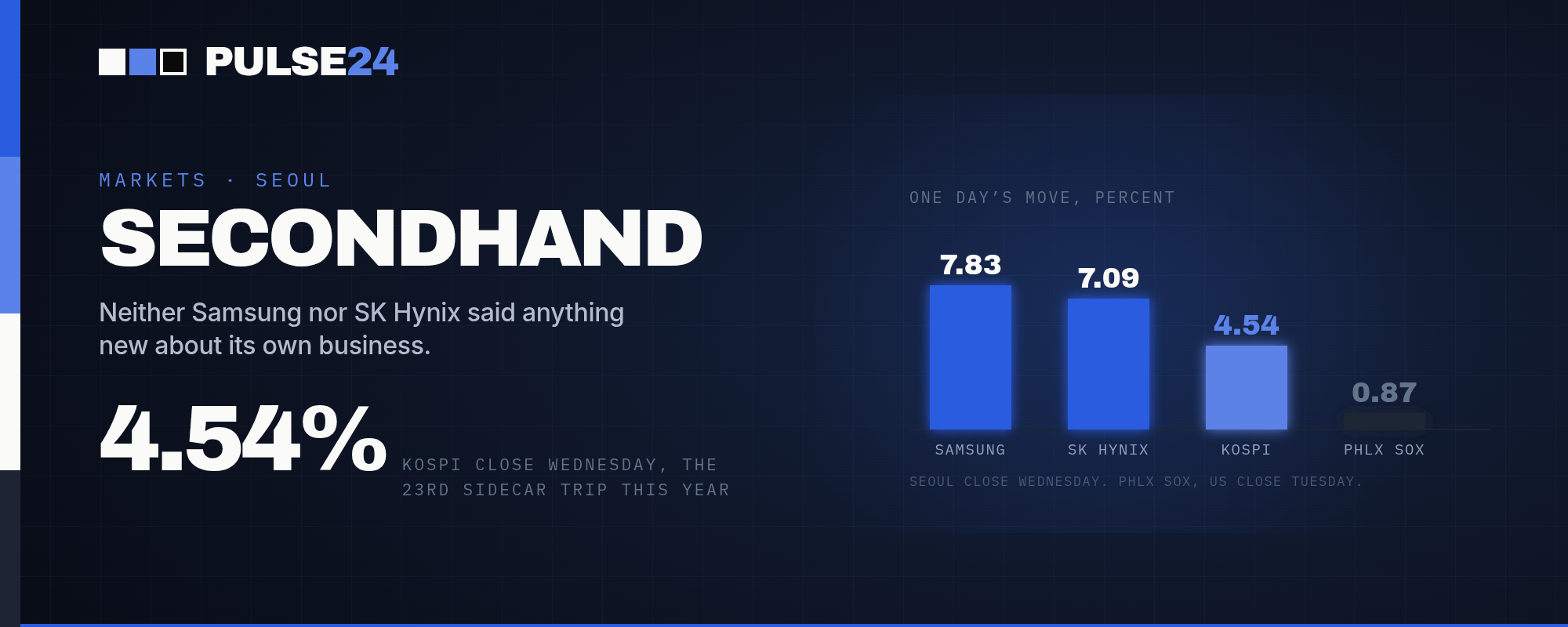
Samsung and SK Hynix both jumped more than 7% Wednesday after CoreWeave and Super Micro Computer's earnings pointed to accelerating AI infrastructure demand. CoreWeave's contracted backlog grew by tens of billions of dollars in a matter of weeks, even as credit markets price the company's five-year default odds close to a coin flip.
South Korea's Kospi index closed up 4.54% on Wednesday at 6,633.51, its sharpest single-day gain in months, and tripped the exchange's automatic buy-side circuit breaker, known locally as a sidecar, for the 23rd time this year. Samsung Electronics climbed 7.83% to 258,250 won. SK Hynix gained 7.09% to 1,526,000 won. Neither company said anything new about its own business on Wednesday. The catalyst arrived from roughly 6,000 miles away, in two earnings reports released after Tuesday's US market close.
CoreWeave and Super Micro Computer both reported quarterly results Tuesday evening, and both delivered a version of the same message: demand for AI computing capacity is not slowing down, whatever the last six weeks of stock charts suggested. Mirae Asset Securities analyst Kim Seok-hwan pointed directly to the two US reports as the reason Korean chip stocks opened strong and kept climbing into the close. The Philadelphia Semiconductor Index had already gained 0.87% in Tuesday's US session, and Micron, a direct SK Hynix competitor, added another 0.8%.
Why Two US Earnings Reports Moved a Korean Stock Exchange
Samsung and SK Hynix don't sell chips directly to CoreWeave or Super Micro Computer in a way most retail investors track closely. What they sell is high-bandwidth memory, the specialized DRAM that sits inside the Nvidia GPUs CoreWeave rents out by the hour and that Super Micro packages into servers for data center customers. When either company signals accelerating demand for AI infrastructure, it functions as a demand signal for the memory chips inside that infrastructure too. SK Hynix's own stock fell on the day it reported a 557% profit jump last quarter, with investors focused on spending plans rather than the earnings beat. Wednesday's rally shows how quickly that kind of sentiment can swing back the other way.
The Backlog Grew, and So Did the Skepticism
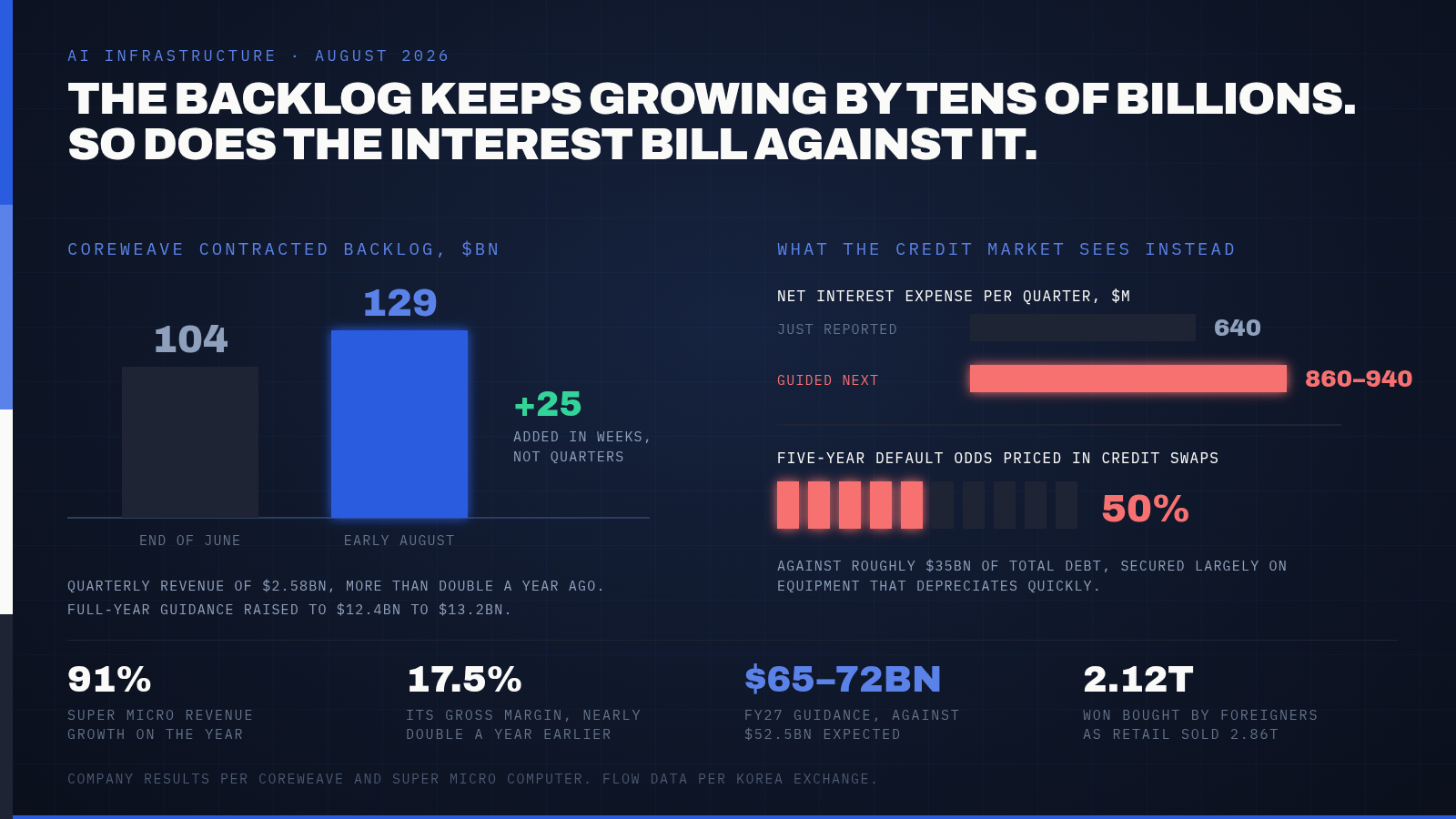
CoreWeave's numbers were the more complicated of the two. Revenue came in at roughly $2.58 billion, more than double what the company reported a year earlier, and management raised full-year guidance to a range of $12.4 billion to $13.2 billion. The contracted backlog reached $129 billion, up from $104 billion at the end of June, with more than $25 billion of that added in just the first weeks of the third quarter. Investors sent the stock up as much as 18% on Wednesday.
The same report also showed why bond investors have been treating CoreWeave differently than equity investors have. Net interest expense hit $640 million for the quarter, and the company guided next quarter's interest bill even higher, to a range of $860 million to $940 million, against total debt of roughly $35 billion. Heading into Tuesday's report, credit default swaps on CoreWeave's debt had priced a roughly 50% probability of default within five years, a level traders describe as pricing a coin flip. Nearly 80% of AI data center bonds sold since early 2025 are trading below their issue price, a sign this skepticism extends well beyond one company. A backlog growing by tens of billions of dollars in a matter of weeks and a bond market pricing even odds of default aren't necessarily in conflict. Both describe an industry financing an enormous buildout on debt secured against equipment that depreciates quickly, for demand that has never been tested by a real slowdown.
Super Micro Did the More Convincing Talking
Super Micro Computer's quarter looked messier on the surface and cleaner underneath. Revenue of $11.12 billion missed Wall Street's forecast by a few hundred million dollars, continuing a pattern of guidance misses that have dogged the stock this year. Gross margin nearly doubled to roughly 17.5%, though, from single digits a year earlier, and non-GAAP earnings of $1.70 a share blew past estimates that topped out under a dollar. The company logged more than $60 billion in new orders during the quarter. Management's fiscal 2027 guidance, a revenue range of $65 billion to $72 billion, sits well above the roughly $52.5 billion analysts had penciled in. Shares jumped in premarket trading and kept climbing through Wednesday's session.
What to Watch Next
Samsung and Micron report their own quarterly results in the coming weeks, and their forward commentary will say more about the durability of this rally than Wednesday's price action does. DRAM contract prices are already forecast to keep climbing through the third quarter, which should keep memory margins elevated regardless of what happens in Seoul this week. Watch CoreWeave's next quarterly interest expense figure against its own guided range, since a number that comes in high would reinforce the credit market's skepticism even as the backlog keeps growing. And watch whether Wednesday's foreign buying in Korean stocks, a net 2.12 trillion won, continues once the earnings news cycle fades, given retail investors were net sellers on the very same day.
The Pulse24 Take
AI infrastructure spending keeps producing two contradictory data points at once, and Wednesday supplied a clean example of both. CoreWeave's backlog grew by tens of billions of dollars in a matter of weeks, real evidence that customers keep signing up for AI computing capacity. In the same quarter, the company is paying north of $600 million in interest, on debt that bond markets have priced close to a coin flip on default. Wednesday's Kospi rally shows which of those two data points investors chose to believe, for one trading session at least, convincingly enough to pull two Korean chipmakers up more than 7% each on a day when neither company reported anything about itself. AI infrastructure stocks and memory chips are increasingly trading as a single global system rather than a collection of separate corporate stories. When CoreWeave and Super Micro Computer look healthy, Samsung and SK Hynix benefit before their own next earnings call even arrives. The reverse has been true before, and probably will be again.
How we read the data
Curious how we get from raw data to a take like this? Our Trader's Toolkit walks through the tools we lean on.
Explore the Toolkit